From Reactive to Predictive: Building Asset Performance Management Solutions with Flex83

.avif)
Fun fact: Every dollar spent on preventive maintenance prevents five dollars in catastrophic failures. Yet most manufacturing operations still operate reactively waiting for equipment to break before responding. This isn't a strategy; it's a financial vulnerability that costs organizations an estimated $5K to $50K+ per hour in asset downtime across industries.
The question isn't whether your organization needs predictive maintenance. The question is: How much is reactive maintenance costing you right now?
According to recent industry data, 50% asset downtime reduction is achievable through predictive maintenance approaches. Organizations are not just recovering costs; they're capturing $12.6 trillion in economic value from Industrial IoT technologies by 2030.
This blog explores how industrial OEMs and enterprises can move from reactive to predictive by building their own custom APM solutions on Flex83—an enterprise‑grade AIoT platform—delivering results in months instead of years, without sacrificing IP ownership or flexibility.
What you'll discover in this article: The business case for predictive maintenance, how it works, real-world results from major organizations, implementation strategies, and exactly why Flex83 stands out as the optimal platform for rapid deployment.
How Asset Maintenance Evolved
From the first day itself, most plants have followed the similar pattern: run the equipment until one day it completely fails , then send the maintenance teams to fix it. And honestly, this made sense only when the equipment was simpler, the competition was local, and downtime was just considered as a mishap or inconvenience. Fast forwarding to today, complex supply chain, delivery-on-demand, razor-thin margins, and unplanned downtime directly erodes the possibility of having a downtime because it costs millions within a blink.
The next in picture was PREVENTIVE MAINTENANCE. Preventive maintenance is the practice of scheduling inspections and replacing parts at a fixed time or regular intervals. This practice reduce failures as compares to reactive approaches and can lessen maintenance costs by double-digits but this is also insufficient. In this, the equipment is serviced based on a calendar, not on the basis of how the equipment actually performed, if one of them really needs to replace, or if they are deteriorating in real-world conditions. Some of the equipment was replaced even when it had a useful life while other failures occurred between scheduled visits and still cause unexpected downtime.
When connectivity became more reliable, cloud, and AI technologies became accessible, an inflection point occurred. The latest tech advancement opened newer doors for condition-based monitoring and predictive maintenance, decisions were made on the basis of data rather than reactions or schedules. This invited the concept of PREDICTIVE MAINTENANCE.
The Predictive Maintenance Revolution: A Different Approach Entirely
.avif)
This is where things get interesting.
Imagine knowing, three days in advance, that an equipment is about to fail. Imagine scheduling maintenance during a planned window instead of having production grind to a halt at 2 AM on a Saturday. Imagine physical equipment(s) telling you exactly what it needs, when it needs it.
That's PREDICTIVE MAINTENANCE.
Have a look at this: You are using real-time data and AI to forecast exactly when an equipment is likely to fail instead of waiting for failure (reactive) or maintaining a schedule (preventive). You collect continous data, run it precisely through machine learning algorithms and then get predictions without fail.
The results are impossible to ignore. This has been revolutionary for Industrial OEMs and Enterprises. Organizations are seeing 25-50% reductions in downtime. Not 5% or 10%. Twenty-five to fifty percent. Equipment lasting 20-40% longer. Maintenance costs dropping another 30-40% on top of what preventive already saves.
Shell Energy prevented $2 million in equipment failures using this approach. Siemens achieved a 99.99885% quality rate—near-perfect manufacturing—through predictive equipment monitoring. GE reduced defects by 25%. These aren't small improvements. They're transformation-level results.
The payback period? It’s typically twelve to eighteen months. Often you see returns much faster. That first major prevented failure usually covers the entire implementation cost.
The Business Case: Beyond Just Cutting Costs
The financial value of predictive maintenance is compelling: lesser catastrophic failures, fewer emergency calls, less scraps, and finally better customer relationships. You're hitting delivery commitments. You're reducing the ripple effects that flow through your supply chain when something breaks unexpectedly.
Here's the bigger picture.
- Supply chain reliability and customer trust: Stable uptime supports on‑time delivery, service‑level agreements, and premium contracts that depend on consistent performance.
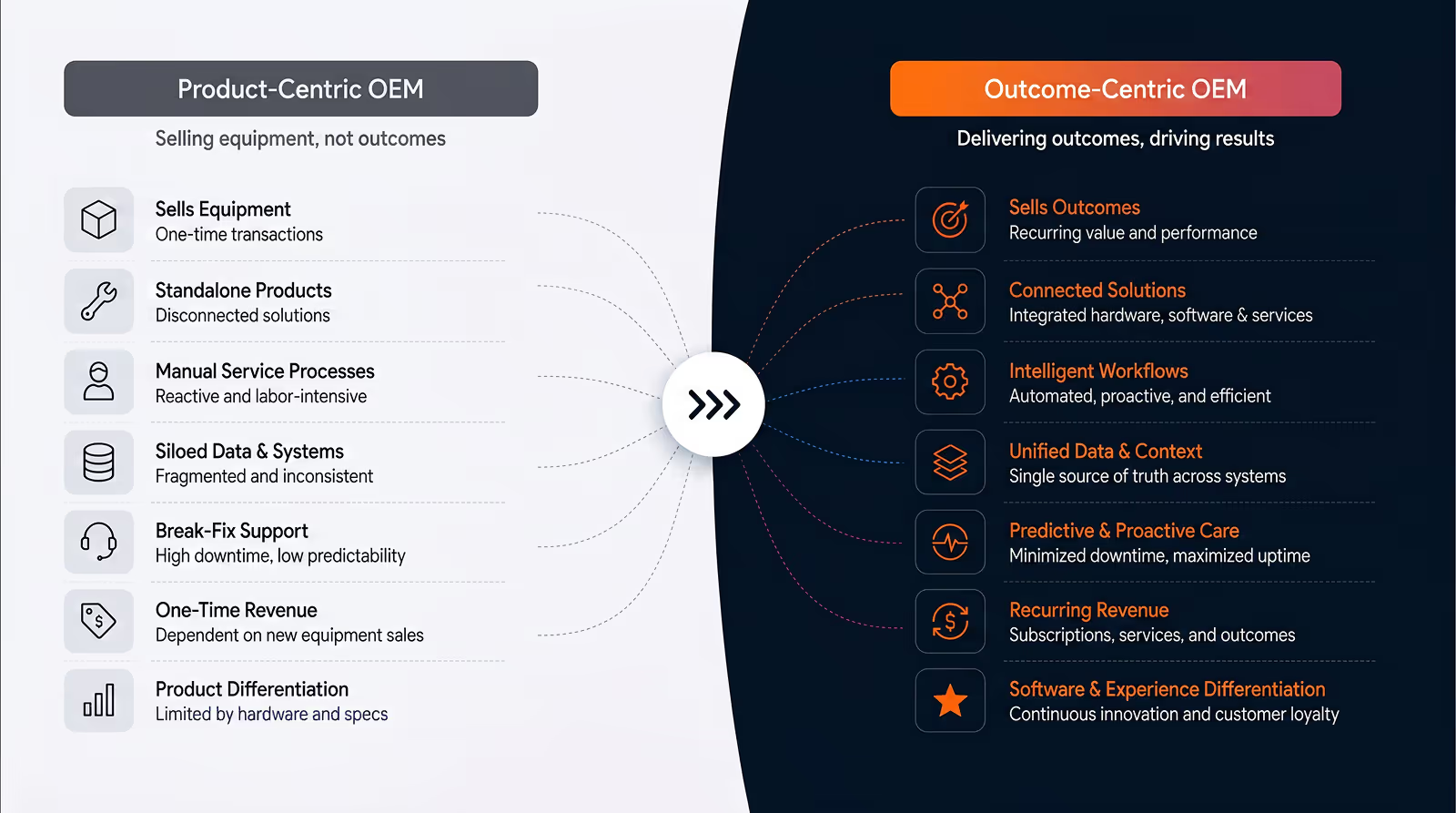
- New business models: For OEMs and Enterprises, connected and reliably performing assets enable outcome‑based offerings such as uptime guarantees, pay‑per‑use, and performance‑as‑a‑service, opening higher‑margin revenue streams. Companies with reliably performing equipment can offer better service. They can promise uptime guarantees. They can invest in growth instead of constantly patching systems. They can eventually build entirely new business models around reliability.
- Workforce effectiveness and retention: When maintenance teams spend more time planning and less time firefighting at odd hours, job satisfaction improves and tribal expertise is retained rather than burned out.
Enter Flex83: The AIoT Platform You Need
.avif)
Despite a clear value, many predictive maintenance programs fail even at the pilot. Various challenges include long expensive custom development projects that take upto 24 months to start showing results; fragmented tools for connectivity, analytics and visualization requiring extensive glue code; lack of unified, governed data layer to feed AI/ML models and operational dashboard consistency across teams; vendor lock-in to single-cloud or proprietary stacks that do not match long-term business or even compliance needs.
This is where the true value of predictive maintenance lies. They see the case studies. They do the math. Then they try to figure out how to actually build a predictive maintenance system.
Either they follow a traditional path: Hire a systems integrator. Budget $2+ million. Clear your calendar for 18+ months. Assemble a team of 10-15 developers. Integrate countless systems. Deal with scope creep and delays. Hope everything works when you finally launch.
A lot of organizations look at that path and decide: "Nope. Not worth it. We'll stick with preventive maintenance."
Or they select the path worth chase: An AIoT Platform.
With Flex83, you can build and deploy a complete predictive maintenance solution in a few weeks instead of 18 months. That too, at roughly 1/6th the cost and with a team of 2-3 developers instead of 10-15.
We obviously know you must be thinking that sounds almost too good to be true. Here's how it actually works:
Flex83 comes with pre-built microservices for pretty much everything you need.:
- Systems integration.
- Real-time dashboards.
- Alert management.
- Predictive algorithms.
- API connections to your existing systems.
- Custom dashboards for your business, integration with your systems, tuning algorithms for your specific equipment.
The platform also handles something that trips up a lot of organizations: it's cloud-agnostic. You're not locked into one vendor. Deploy on AWS, Azure, Google Cloud, or keep it on-premise. That flexibility matters because it means you're not gambling your entire operation on one provider's roadmap.
And you own what you build. Your solution belongs to you. You're not renting someone else's platform forever—you're building your own asset.
Real Results from Organizations That Are Doing This
Shell Energy: They deployed predictive monitoring across a refinery. In the first year, the system identified two potential equipment failures that, if not caught, would have cost over $2 million each in emergency repairs. Not 2 million combined—2 million each. That first year alone paid for years of the system.
Siemens: They applied predictive monitoring across high-speed assembly lines. Result? 99.99885% quality rate. For context, that's near-perfect. That level of consistency isn't just impressive—it's the kind of number that wins customers and justifies premium pricing.
GE: They used AI-powered diagnostics to monitor equipment performance. Defect rates dropped 25%. When you trace the root cause, it wasn't a product design issue—it was equipment degradation causing defects. By preventing the degradation, defects disappeared.
ABB: They implemented predictive optimization across manufacturing. Energy consumption dropped 50%. Operational efficiency improved 25%. For large industrial operations, these aren't nice-to-haves—they're the difference between margin and no margin.
What's striking about all of these is that they span different industries, different equipment types, different operational challenges. Yet the results are consistent. The pattern is real.
The Concerns That Actually Matter
We've heard every objection imaginable to predictive maintenance.
Sitting with multiple OEMs, having different conversations with different teams. Let us address the ones that actually make sense:
- Isn't this technology really expensive?
The implementation cost is real, but it's not actually expensive relative to what you're saving. And the Flex83 approach keeps it reasonable. You're looking at a few hundred thousand dollars, not millions. Against typical savings, you break even in months. - Don't we need data scientists and AI experts?
Not really. Pre-built models handle most common assets. Flex83 abstracts the complexity. Start with what's pre-built, build expertise internally over time. Many organizations use consulting partners for the first year, then build internal capability. - What about security? Our data is sensitive.
Fair concern. Enterprise security frameworks exist for exactly this reason. Hybrid and on-premise deployment options are available. Data can stay local; cloud is just for analytics. - Does this require massive organizational change?
Yes and no. You need change management, but it's not revolutionary. Your maintenance team will work differently—they'll use data to make decisions instead of hunches. Most teams prefer this. They're not fighting fires 24/7.
Why Flex83 Stands Out
You may have looked at a lot of AIoT platforms. Here's why Flex83 is different:
- Speed: 3-6 weeks to market vs. 18+ months for custom development. In a competitive space, that's enormous.
- Cost: 1/6th the price of custom development. That changes the equation from "can we afford this?" to "can we afford not to do this?"
- Flexibility: Cloud-agnostic. You're not locked into one vendor's platform or roadmap.
- Ownership: Your solution belongs to your company. You own the IP. You can modify it, enhance it, integrate it however you need.
For OEMs specifically: You can add predictive capabilities to your assets. Suddenly you're not just selling machines—you're selling reliability and performance. That's a different business model. Premium pricing becomes possible.
Here's a better comparison to alternatives:
- Custom development takes forever, costs millions, and creates ongoing maintenance burden.
- Legacy platforms are inflexible, expensive to license, and slow to innovate.
- Flex83 splits the difference—you get customization and ownership without the timeline and cost of full custom development.
The Honest Truth About Implementation
Here's what we must not forget to mention: there is no magic to how we build our AIoT platform. It requires work. You need to commit resources. You need to tune the system. You need to get your team trained and aligned. But—and this is important—it's not some overwhelming undertaking that requires complete organizational overhaul.
The phased approach we described earlier works because you're proving value incrementally. After the pilot, your leadership sees real results. That changes the conversation from "should we do this?" to "how fast can we scale this?"
The technical implementation is the easy part. The organizational change piece—getting teams to think in terms of data and prediction instead of reaction and repair—that takes attention but isn't complicated. Most maintenance teams actually embrace it once they see it working.
The one thing we would caution against: don't try to boil the ocean in month one. Pick your most painful critical asset, deploy there, prove it works, then expand.
What This Means for You
If you're reading this, you're probably one of three people:
Option 1: You're an operations leader frustrated by reactive maintenance and its constant crises. You know something has to change.
Option 2: You're an OEM looking to differentiate in an increasingly commoditized market. You know your customers want reliability, not just equipment.
Option 3: You're a finance leader looking at maintenance budgets and wondering why they keep growing while results don't improve.
Whoever you are, the fundamental opportunity is the same: the companies that solve this problem now will have a significant competitive advantage over the next 5-10 years.
Predictive maintenance isn't new conceptually. But it's finally accessible practically. The technology works. The ROI is proven. The time to implement is reasonable.
In Conclusion
The shift from reactive to predictive maintenance isn’t just a technological evolution—it’s a strategic necessity. As downtime costs, customer expectations, and competitive pressures rise, organizations can’t afford to rely on outdated maintenance models. Predictive maintenance transforms maintenance from a cost center into a value driver, turning data into foresight and foresight into tangible business results.
Flex83 makes that transformation achievable—quickly, affordably, and at scale. Its AIoT architecture empowers industrial enterprises and OEMs alike to build Industrial IoT solutions that predict, prevent, and optimize in real time. With pre-built microservices, cloud-agnostic deployment, and a rapid implementation cycle, Flex83 eliminates the barriers that once made predictive maintenance inaccessible.
Whether the goal is to extend asset lifespan, unlock new revenue streams, or deliver higher service reliability, Flex83 gives you the tools to do it—without years of development or vendor lock-in. The result is a future where assets are smarter, operations are steadier, and performance is fully under your control.

.avif)
.avif)