Federated identity and tenant hierarchies — built for OEM channels.
OEMs sell to dealers who sell to end customers. SSO, sub-tenant hierarchies, and per-customer data isolation are non-negotiable for enterprise sales but rarely built right. Flex83 ships the model so you sell up-market without rebuilding identity for every deal.
Channel sales break identity models that weren’t designed for them.
Mid-market apps assume one tenant per customer. OEMs don’t live in that world. You have dealers, regional distributors, end customers, and end-customer sub-sites — each needing its own identity, its own data, and its own audit trail.
3+ levels
A typical OEM channel runs three to four levels deep. A flat tenant model breaks the moment a dealer onboards their first multi-site customer.
Non-negotiable
Enterprise customers want SAML or OIDC into their own IdP, SCIM provisioning, RBAC scoped to their site, and an audit log they can inspect — or the deal stalls.
Bolted-on
Identity is the hardest thing to retrofit. Teams who skip it at the start spend the next year rebuilding their auth model under deal pressure.
Built for OEMs — not for single-tenant SaaS.
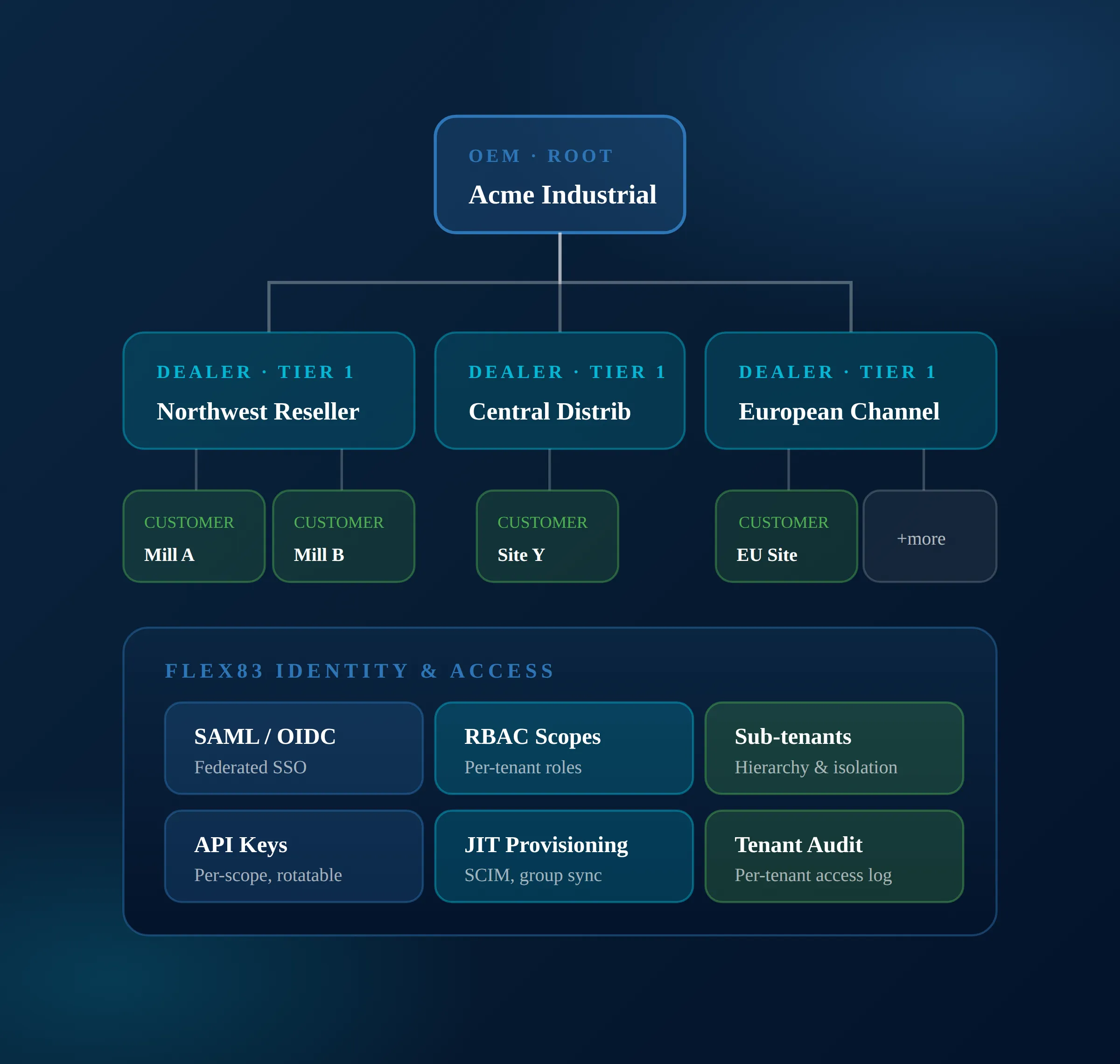
Flex83 ships SAML, OIDC, SCIM, and a sub-tenant hierarchy model out of the box. Define your channel structure once; provision dealers and end-customers under it. Each tenant federates its own identity provider, each role scope respects the hierarchy, every action lands in a per-tenant audit log.
Federated SSO into each tenant’s identity provider of choice.
OEM → Dealer → Customer → Site, multiple levels deep.
Roles and permissions inherit and override across the hierarchy.
Per-scope, rotatable keys for programmatic tenant access.
Staged rollouts, canary deployments, and atomic rollback per fleet segment.
Per-device inference latency, throughput, and drift monitoring.
From OEM root to end-customer login — one identity model.
A reference architecture for shipping multi-level channel identity on Flex83.
ML Studios trains on historical telemetry from FlexLake.
Replay against production data; promote in Model Registry.
Export to ONNX with metadata, signature, and version tag.
Staged rollout to fleet segments with canary and rollback.
Per-device latency, throughput, and drift in the dashboard.
Identity stops blocking the enterprise deal.
Three things that change when channel identity is a platform capability instead of a vendor questionnaire.
Close enterprise deals on the first call
When the customer’s security team asks for SSO, SCIM, audit, and RBAC, your answer is “yes, configured in the console.” Not “yes, in our Q3 release.”
Sell through channels without losing visibility
OEMs see what dealers see. Dealers see what their customers see. Every tier of the channel has the access it needs — nothing more.
Identity that survives growth
Adding a new dealer, a new region, or a new product line is configuration — not a re-architecture of your auth model.
Identity at OEM channel scale.
Federation into customer IdPs — Okta, Azure AD, Ping, and more
Channel hierarchies 3+ levels deep in production today
Automated user provisioning and deprovisioning per tenant
Audit logs visible to the tenant who owns them
Stop losing enterprise deals on the security review. Start passing them on day one.
Talk to a Flex83 platform expert about your channel identity model. We’ll map your OEM-dealer-customer structure, walk you through federation, and show what shipping a SAML-ready tenant looks like in minutes.