Bridge legacy OT protocols to modern cloud — natively.
Industrial OEMs ship products that speak Modbus, BACnet, OPC-UA, MQTT, and proprietary serial. Connecting them to modern cloud and AI stacks usually means writing custom adapter code that breaks under load. Flex83 ships 70+ connectors as platform capability — no glue code required.
The OT-to-IT bridge is where industrial projects die.
The data is in the PLC. The model is in the cloud. The gap in between is six months of integration code, a brittle middleware vendor, and the engineer who knows how it works.
60%+
Cisco’s survey of 1,845 IT and business decision-makers found 60% of IoT initiatives stall before production — OT integration is the most common breaking point.
Last mile
McKinsey calls it the “last IT/OT mile” — the integration layer between operational technology and modern data stacks. It’s where 70% of Industry 4.0 pilots never reach scale.
Months
Custom Modbus or OPC-UA adapters for one machine line take weeks. Multiply by 10 machine types and 5 sites and the integration backlog never closes.
Every industrial protocol your customers use — supported out of the box.
Flex83 ships native support for 70+ industrial and IT protocols: Modbus TCP/RTU, OPC-UA, BACnet, MQTT, AMQP, S7, Profinet, and dozens more. Connect a device, register an asset type, normalize the schema — the data flows.
Your team writes business logic. Flex83 handles the wire format.
Modbus, OPC-UA, BACnet, MQTT, S7, AMQP, Profinet, and 60+ more.
Map raw OT registers to canonical JSON or Parquet schemas.
Versioned schemas, contracts, and validation across every source.
Run translation and normalization at the gateway, not just in the cloud.
Device identity, OTA, and fleet management for every connected asset.
Reusable asset templates — one definition, every site, every tenant.
From PLC register to AI model — no custom code in between.
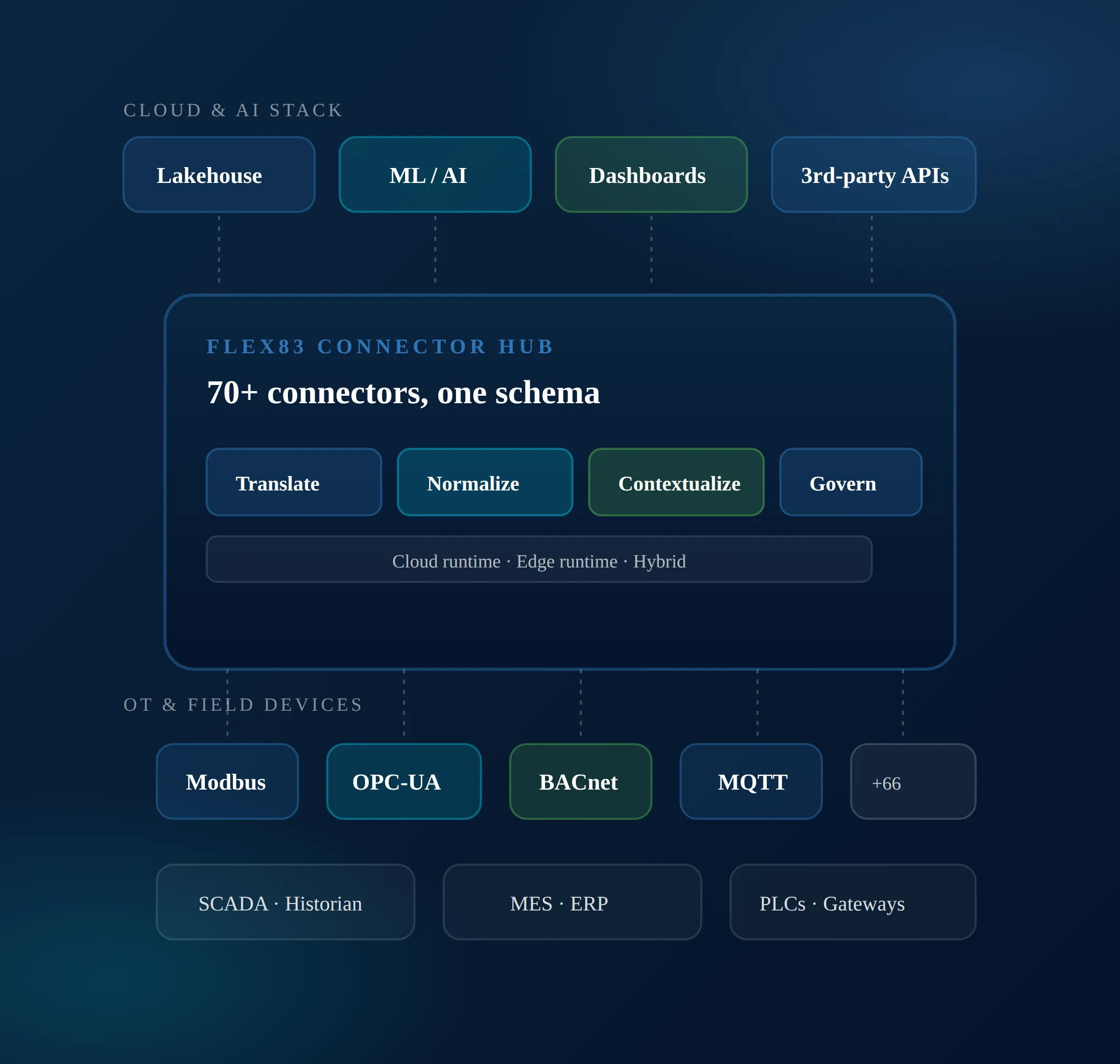
A reference architecture for connecting OT data sources to modern cloud and AI workloads on Flex83.
Auto-detect devices on the network and identify the protocol.
Pick a connector. Map registers, tags, or topics to an asset type.
FlexIoT Hub translates raw OT data to a canonical schema.
Schema registry validates and enriches every record on the wire.
Data lands in the lakehouse, ready for stream, batch, ML, and dashboards.
The OT-to-cloud bridge stops being a project.
Three things that change when 70+ connectors ship as platform capability.
Onboard a new asset class in days
New machine, new vendor, new protocol — pick a connector, define the asset type, ship. No adapter sprint.
Run translation where the data is
Same connector logic runs at the edge gateway or in the cloud. Sites with intermittent connectivity stay productive.
Stop maintaining glue code
Every custom Python adapter is technical debt. Flex83 connectors are versioned, certified, and supported — not your engineer’s side project.
The connector layer that scales.
Pre-built protocol connectors shipped on the platform
Lines of custom adapter code required for supported protocols
Flink and Spark runtimes — no cluster ops
Devices ingesting OT data on Flex83 today
Stop writing protocol adapters. Start shipping outcomes.
Talk to a Flex83 platform expert about your OT integration roadmap. We’ll map your devices to connectors, walk you through the edge architecture, and show what production looks like in 8–12 weeks.