Industrial OEMs Are Becoming Software Companies — Most Haven’t Updated Their Platform Strategy Yet

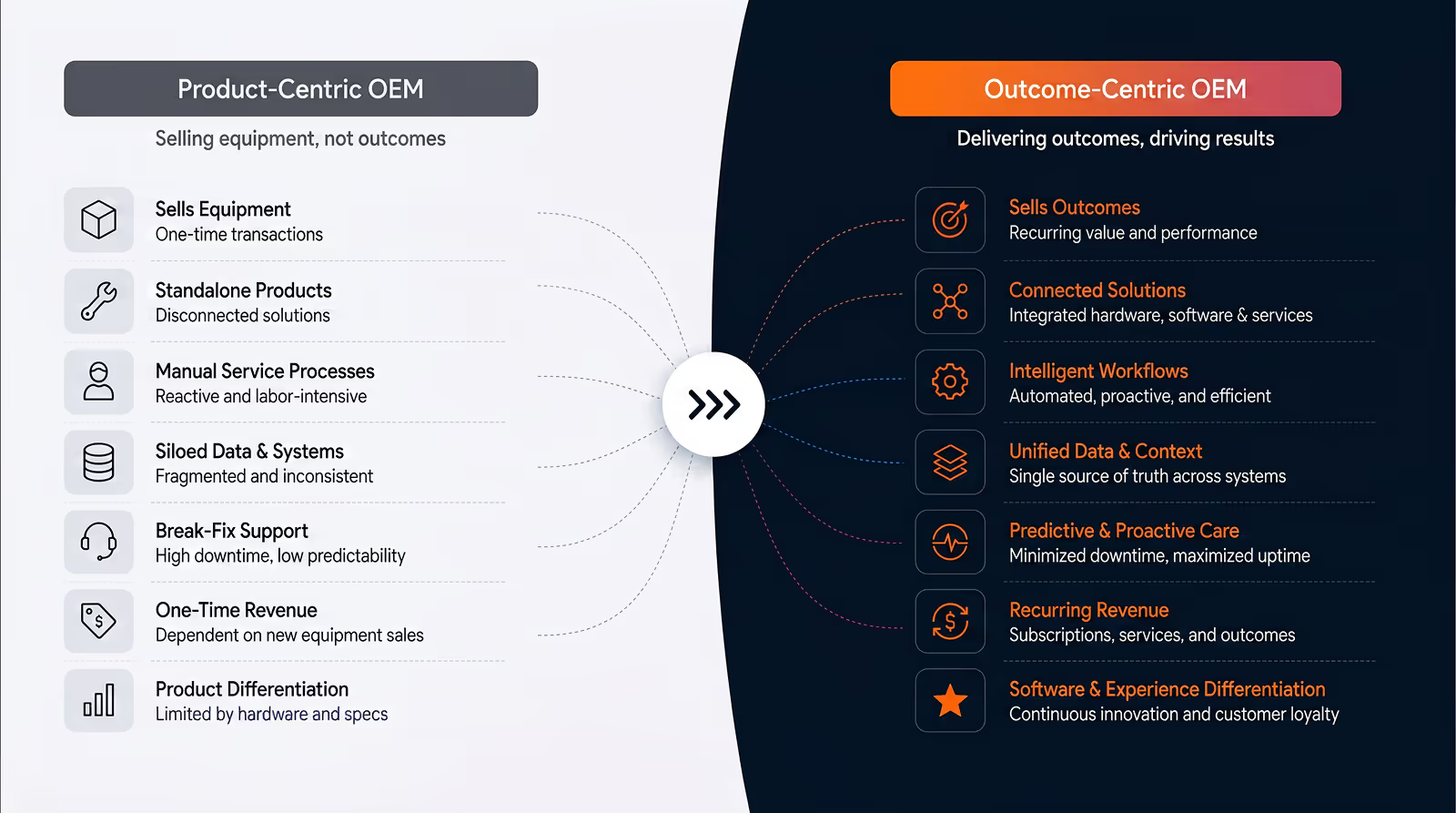
The product is no longer a business. The platform around the product is. Here’s why the next decade of industrial competition will be won in the software layer — and what every OEM leadership team needs to rethink.
A compressor company quietly evolves into a service company. A turbine builder repositions itself as a real-time intelligence provider. A machine-tool OEM begins selling availability instead of equipment. A pumps manufacturer prices its product by the liter delivered, not the unit shipped. A truck-engine maker now competes on guaranteed fuel-burn outcomes written into the contract.
What sounds like a story about reinvention is actually a story about inevitability.
The transformation is already underway across the global industrial economy — driven not by ambition, but by buyer expectations, capital efficiency, and the dawning realization that future margins will not come from the hardware itself. The product is the entry point. The platform is a business.
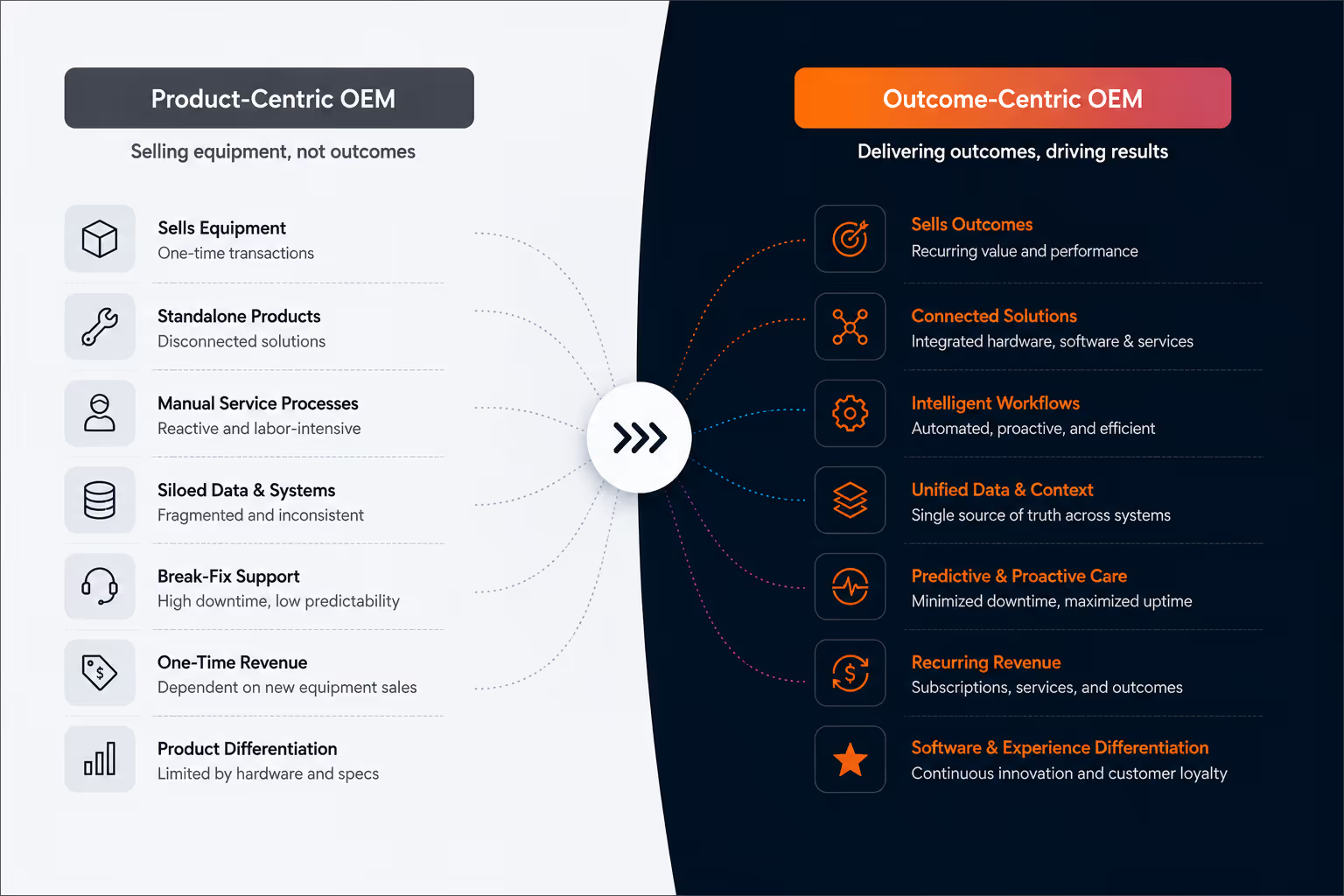
For decades, industrial OEMs competed through engineering excellence, manufacturing scale, and supply-chain mastery. The product was a business. The software was overhead. Connectivity was a feature. Service was a cost center. That assumption no longer holds.
In 2026, the physical product is increasingly the entry point — not the value proposition. The long-term value is created after the asset is deployed. It is generated through connected services, remote diagnostics, predictive maintenance, performance optimization, outcome-based contracts, and software-led customer experiences. The boardroom that once measured success in units shipped now reads dashboards on installed-base utilization, contract attach rates, AI-agent activations, and recurring digital revenue.
This is not a marketing shift. It is a category-level rewriting of how industrial businesses create, capture, and defend value.
The shift is not about IoT anymore
The first wave of industrial digital transformation was framed as an IoT story. Connect the asset. Stream the telemetry. Build a dashboard. Run a pilot. Demonstrate ROI. This framing is now obsolete.
The current shift was not triggered because sensors became cheaper or because connectivity stacks matured. It was triggered because the buyer changed. Industrial customers — operators, plant heads, fleet owners, asset-intensive enterprises — now expect continuous outcomes from the equipment they purchase:
- Fleet-wide visibility across geographies, asset types, and OEM brands
- Proactive support that arrives before downtime, not after a ticket is raised
- Benchmark insights against peer cohorts and best-in-class performance
- Uptime guarantees and SLA-backed performance commitments
- AI-assisted recommendations embedded directly into daily operations
- Self-service portals, mobile experiences, and integrated digital billing
In the new buyer mindset, the digital experience surrounding the equipment carries as much weight as the equipment itself. Capital purchase decisions are increasingly influenced by the software story: How will my data be unified across plants? What insights will I get on day one? What does the renewal experience look like? How will AI evolve on top of this asset over the next decade?
“IoT vs. not IoT” is no longer the right question. The right question is whether the OEM has the platform foundation to deliver software-grade outcomes at an industrial scale.
The legacy platform gap
Most first-generation industrial platforms were built for a narrower world. They were designed to connect assets — collect telemetry, render dashboards, trigger threshold alerts, and produce weekly reports. That architecture worked for proof of concept. It does not work for business models.
When industrial OEMs attempt to move from product economics to service economics, they almost always hit the same five constraints:
- Fragmented enterprise systems. Telemetry sits in one stack. ERP sits in another. CRM, FSM, PLM, MES, and document repositories all live in isolation. Without a unifying layer, the operational picture is incomplete, and most decisions are made on partial information.
- Siloed customer context. The OEM rarely knows what the customer is doing with the asset, who owns the renewal, what tickets are open, how the unit compares to similar deployments, or whether the contract is at risk.
- Disconnected service workflows. Insights live in one system; action lives in another. By the time a recommendation reaches a technician, the moment has often passed — and the customer has noticed.
- Expensive custom integration. Every new customer, every new asset family, every new geography becomes a fresh integration project — eroding margin, slowing time-to-value, and making the platform team a constant bottleneck.
- AI pilots without context. Without unified, governed data, AI models become demoware. They predict the wrong thing, miss operational nuance, and rarely make it past the pilot phase.
The cost of these gaps is no longer technical — it is strategic. They cap how fast the OEM can scale a new revenue model, how confidently it can sign outcome-based contracts, and how seriously enterprise buyers take its software roadmap.
What winning OEMs are building now
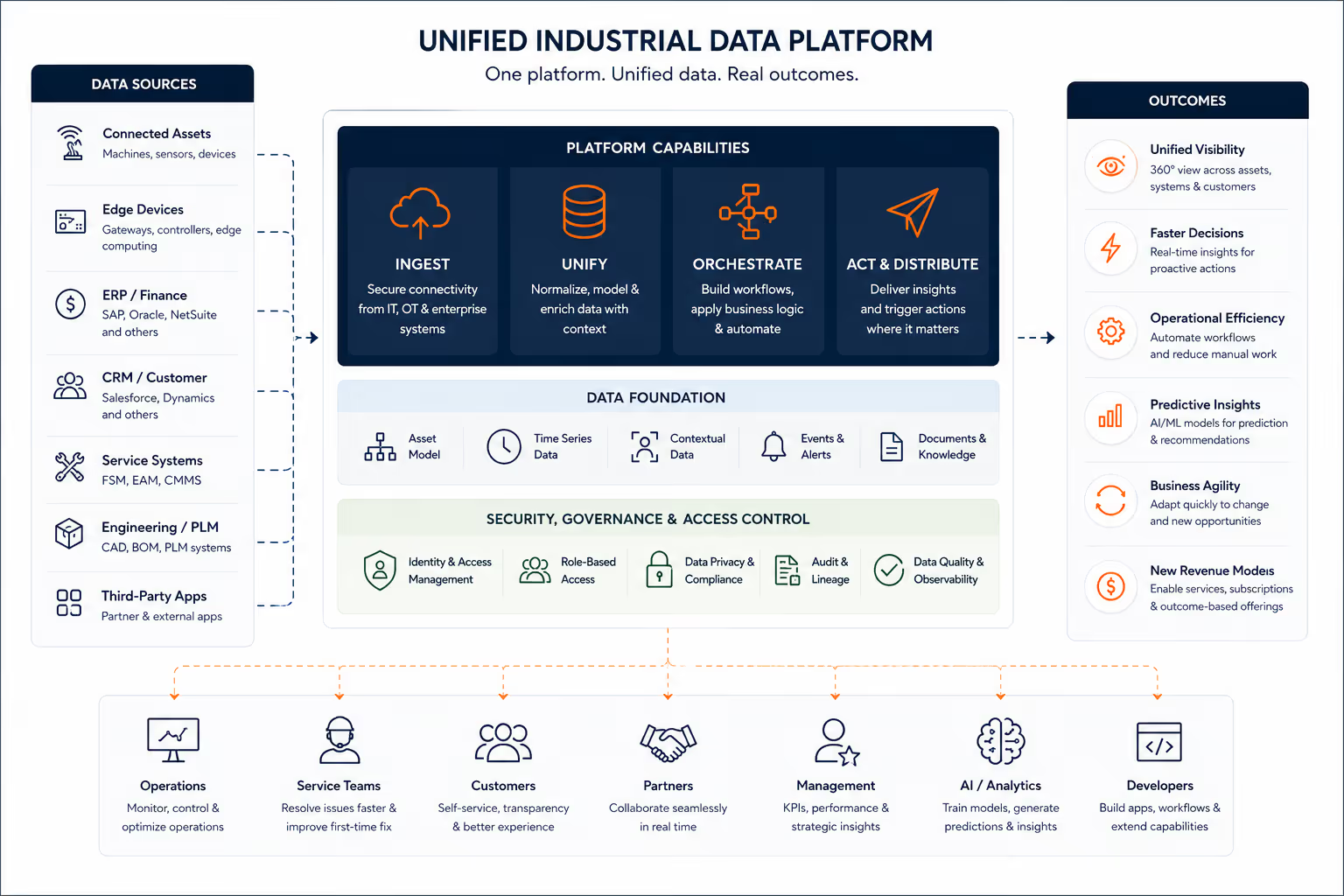
The OEMs successfully crossing from product business to platform business are not simply buying more tools. They are rebuilding the operating spine of the company in around four layers.
1. A unified operational data foundation
The modern industrial stack treats data as a product. It combines IoT telemetry, ERP records, CRM data, service workflows, engineering metadata, knowledge content, and unstructured documentation into a single, governed context layer. This is increasingly described as an industrial data fabric, an operational digital twin, or — in its richest form — an industrial knowledge graph.
The terminology is less important than the discipline: every downstream action, every AI model, every customer experience draws from the same trusted, contextualized source. Without it, every team in the company will quietly invent its own version of the truth.
2. Workflow orchestration
Insight without action is a wasted insight. The next layer turns events and recommendations into automated workflows: service ticket creation, technician dispatch, parts recommendations, customer alerts, SLA enforcement, escalation paths, warranty validation, and billing events.
The OEM’s organization becomes responsive at the speed of its assets, not the speed of its email threads. The orchestration layer is also where most of the operational ROI surfaces — fewer truck rolls, faster mean-time-to-resolution, better first-time-fix rates, and measurable reductions in unplanned downtime.
3. An AI and agentic action layer
This is where 2026 looks decisively different from 2022.
Predictive analytics has matured into generative and agentic AI — industrial copilots, domain-specific large language models, and AI agents that don’t just surface insights but execute multi-step actions across systems. An AI agent can interpret a vibration anomaly, cross-reference engineering documentation, suggest a remediation, file a service ticket, schedule the technician, and update the customer — all within a governed framework with human-in-the-loop approvals.
But agentic AI only works when it is grounded in the unified data foundation. Without that grounding, industrial AI becomes dashboard decoration, and OEMs end up paying for intelligence they cannot operationalize.
4. A commercial and experience layer
The often-missed fourth layer is the one closest to revenue. Subscription billing, usage-based metering, outcome contracts, partner portals, customer dashboards, mobile field experiences, and embedded marketplaces are what convert technical capability into recurring revenue.
This is where industrial OEMs cross most clearly into software-company territory — and where most legacy platforms have nothing to offer.
How leaders are sequencing the transformation
Few OEMs can rebuild the entire spine in one program. The winning pattern is a deliberate sequence rather than a single big bang re-platforming.
The most effective transformations begin with the data foundation — because every later layer depends on it. They then layer in workflow orchestration around the highest-value service operations, often starting with one product family or one geography. AI and agentic capabilities come next, built on top of trusted data and visible workflows. The commercial layer is sequenced last but planned from day one so that early data and orchestration choices don’t lock the OEM out of future business models.
What sets successful programs apart is not just sequencing — it is governance. A single platform owner, an enterprise-grade architecture review, a clear ownership model between product, IT, and services, and a roadmap measured in business outcomes rather than feature lists. The OEMs that treat this as an IT project tend to stall. The OEMs that treat it as a business reinvention tend to accelerate.
The cleanest way to compress this journey is to standardize on a single industrial AI operations platform that already integrates the four layers — eliminating years of custom stitching. This is the design principle behind unified industrial AI operations platforms, including IoT83’s own 83AIOPlatform, built specifically to give industrial OEMs the software-grade foundation that hyperscaler IoT services and traditional SCADA stacks were never designed to deliver.
Why this matters now
The boardroom conversation has fundamentally changed. Two years ago, the questions were about pilots and ROI. Today, they are about business-model durability:
- How do we monetize connected services across the installed base?
- How do we scale installed base intelligence into a recurring revenue line?
- How do we unify operations across regions, brands, and acquired entities?
- How do we deploy AI without re-platforming the company twice in five years?
- How do we ensure our software roadmap doesn’t become a competitive liability?
These are not IT questions. They are software-company questions, being asked inside hardware-company boardrooms. And they are being asked for new urgency, for three reasons.
First, the cost of waiting is compounding. Every quarter the platform decision is deferred, more custom integrations are written, more siloed data accumulates, and more AI initiatives launch on shaky foundations. The cleanup bill grows quietly in the background.
Second, AI has rewritten the platform timeline. Generative and agentic AI demand a context-rich, governed data fabric. OEMs without that foundation are watching competitors deploy industrial copilots and outcome services they cannot match — not because their hardware is inferior, but because their software substrate is.
Third, buyers are voting with their contracts. Outcome-based and subscription-style purchasing is now a stated preference among large industrial buyers, and procurement teams increasingly scrutinise the OEM’s software stack as part of due diligence. A weak platform story is now a deal of risk — and in some categories, a deal-breaker.
The next decade belongs to software-defined OEMs
The OEMs that win over the next decade will not simply build better equipment. They will build better digital ecosystems around equipment. They will know:
- What every asset is doing, in real time, in context
- How customers are using the asset versus how it was designed
- Which service to offer next, and to whom
- When to intervene before failure, churn, or contract risk materializes
- How to create predictable, expandable recurring revenue from the installed base
- How to release new AI-driven capabilities as software upgrades, not hardware refreshes
This is the operating definition of a software-defined OEM. It is not about adopting cloud, buying an IoT platform, or launching an AI pilot. It is about treating software infrastructure as strategic product infrastructure — funded, governed, and prioritized the way a manufacturer once prioritized plant capacity.
.png)
The future will not be kind to OEMs that continue to bolt software onto a hardware identity. It will reward those who recognize the inversion that has already happened: the product is the entry point, and the platform is the business.
For industrial OEMs ready to make that shift, the strategic question is no longer “Do we need a platform?” It is “Do we own a platform foundation strong enough to carry the next ten years of services, AI, and commercial reinvention?”
The OEMs answering that question correctly today are quietly becoming the software companies of tomorrow’s industrial economy.


.avif)
.avif)