Process streaming data at enterprise scale
Ingest continuous events, process them with Flink, SQL, or rules, and deliver governed data to analytics, AI/ML, and operational systems, all on one managed platform.
















Continuous data outruns periodic systems
Ingestion, processing, and delivery still run on a batch window built for hourly or nightly refreshes, a model that works fine for a monthly report and breaks the moment a threshold, a silent device, or a customer action needs a response measured in seconds.
The data is accurate, but the timing isn't
Hourly or overnight dashboards tell you what happened after the fact. By the time the data is refreshed, the opportunity to respond may already be gone.
Every source speaks its own language
Devices, event hubs, and business systems each produce data at a different rate and shape, and keeping that flow consistent, with schema intact, takes engineering effort most teams would rather spend elsewhere.
Real-time logic drags a cluster in with it
Building processing logic for live data usually means also taking on cluster provisioning, tuning, and failure recovery, on top of the business logic that matters.
Build your end-to-end stream processing pipeline
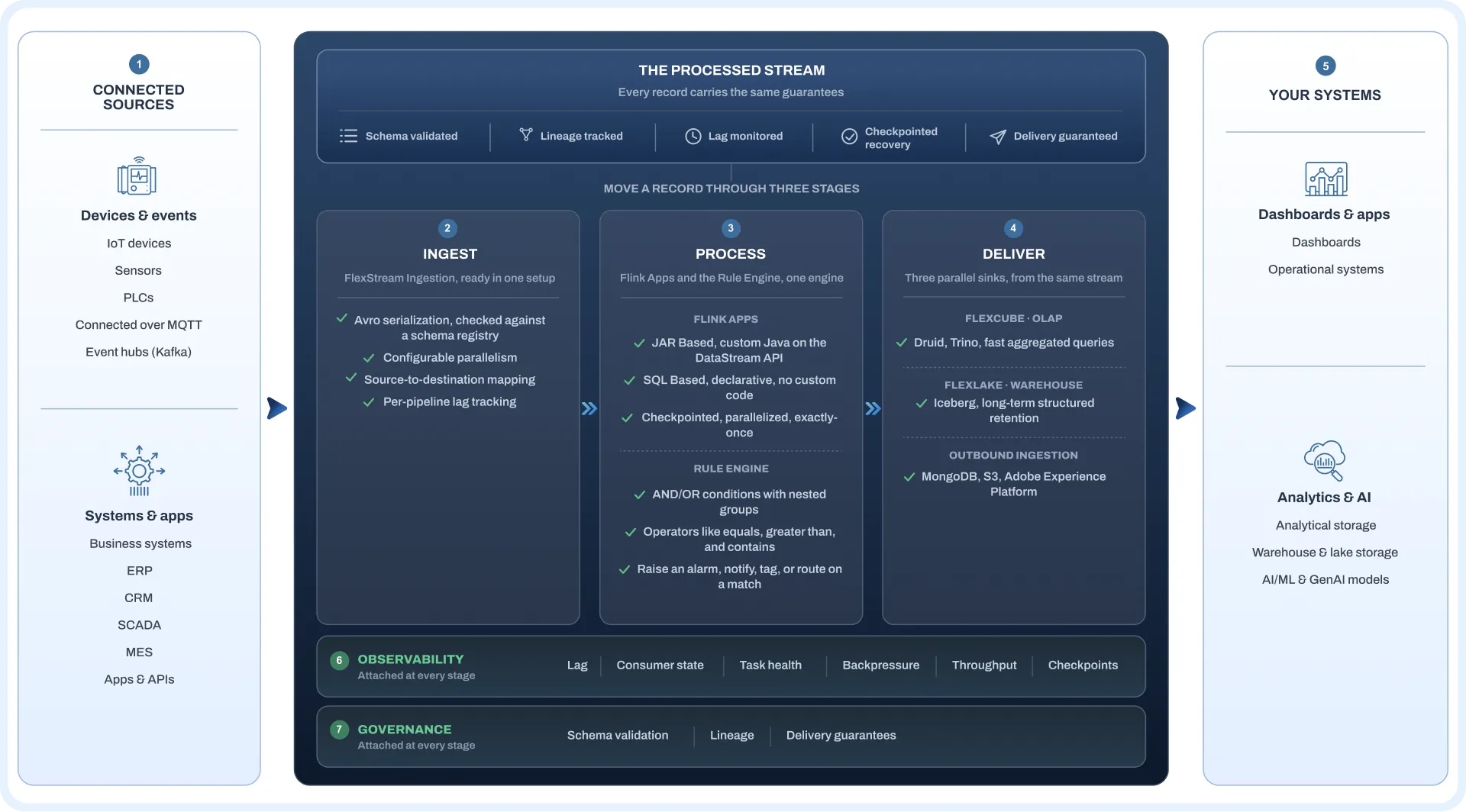
Bring ingestion, processing, business logic, storage, and delivery together with Flex83, with observability and governance attached at every stage.
Core capabilities
Get continuous telemetry ingestion and transformation at scale, all through the same engine below, whether the job calls for custom code, a SQL query, or a simple rule.
Ingest every event in one setup
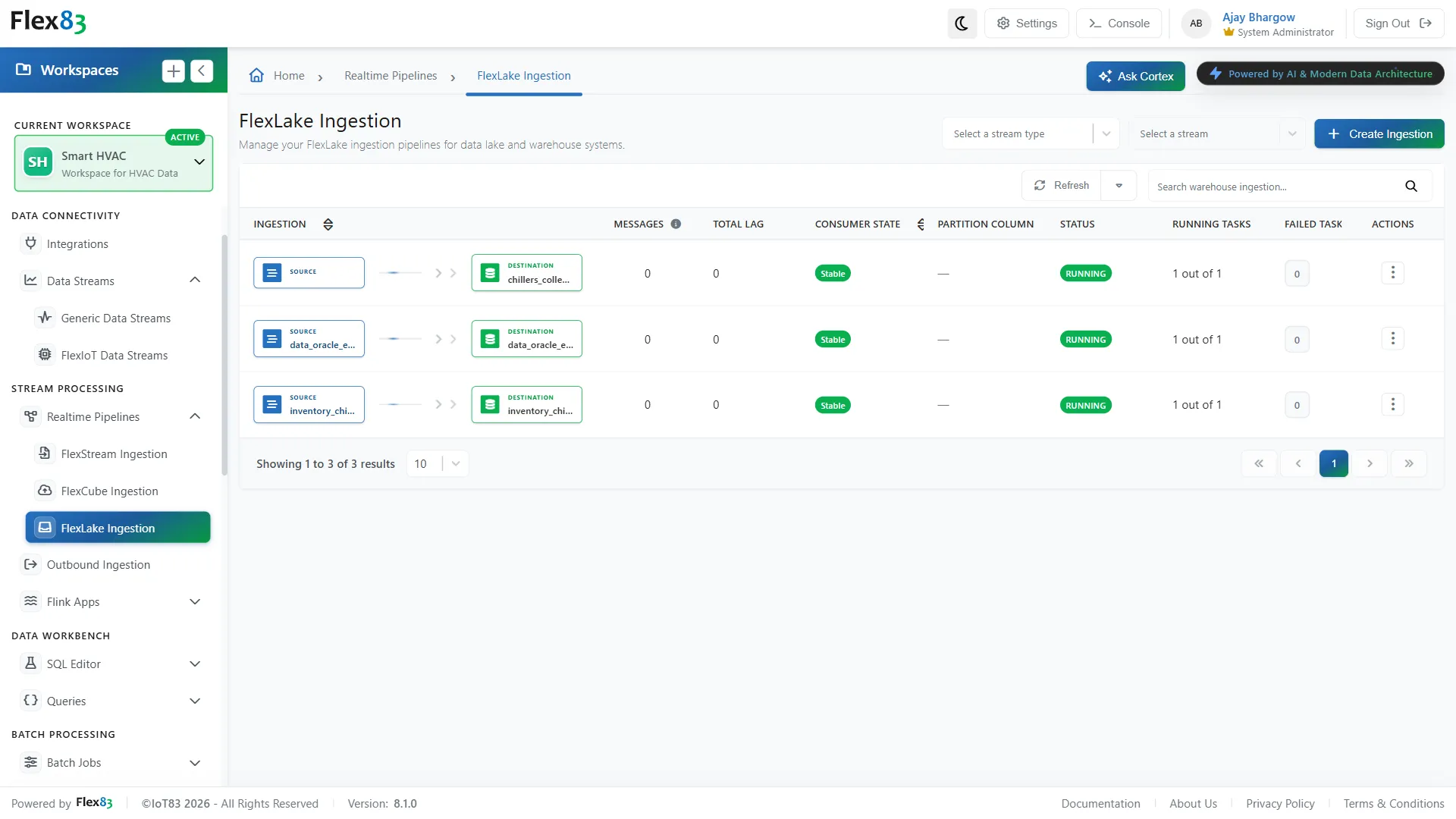
Configure a source once, and every event it produces arrives ready to process. A stream holds its schema, its serialization format, and its destination mapping, then scales ingestion automatically as volume grows.
Use code for control, SQL for speed
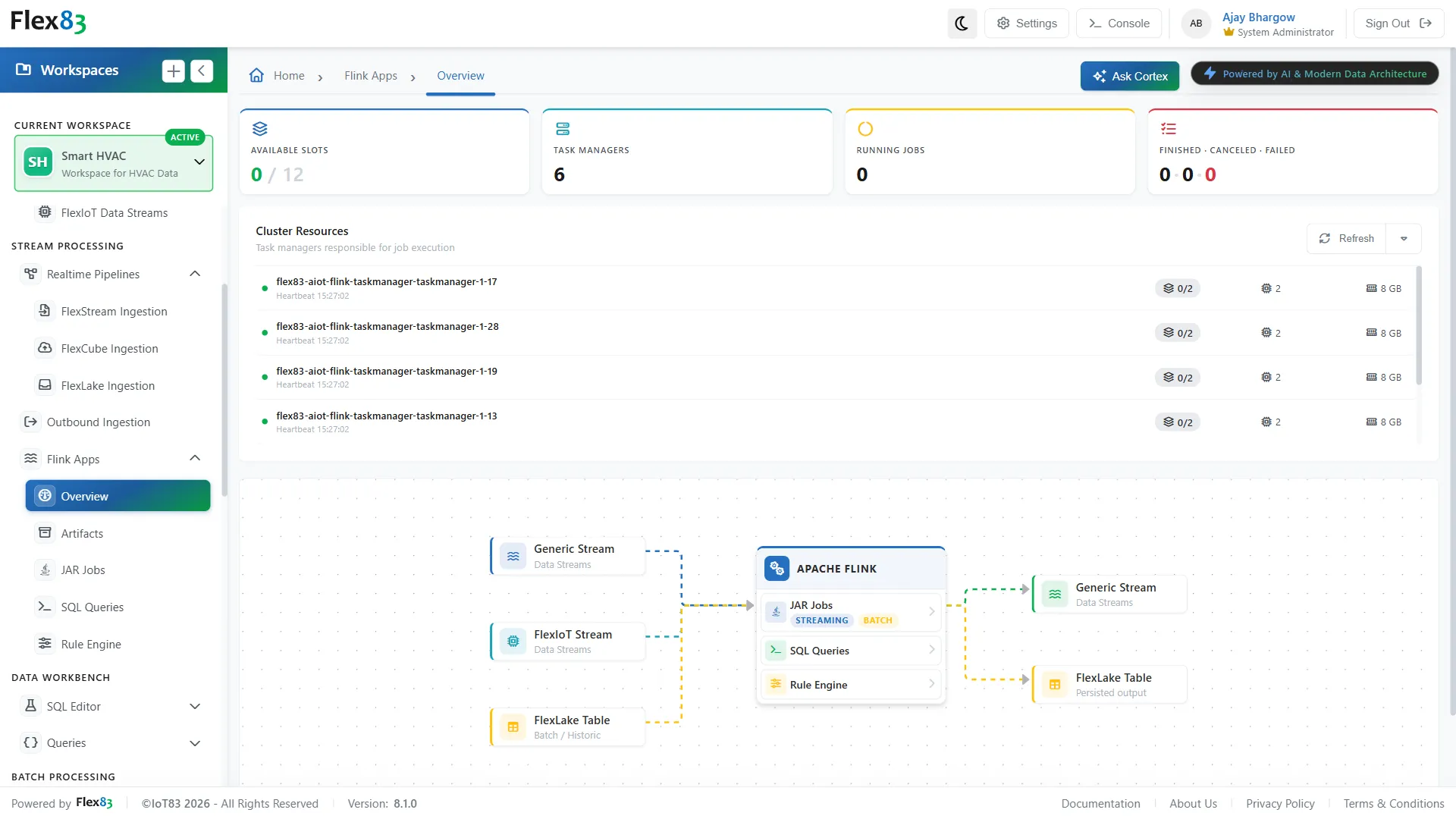
Choose the processing model that fits the workload. Use Flink Apps for custom Java logic or declarative SQL for filtering and transformations, all on the same engine with job-level backpressure tracking.
Configure a response without a pipeline
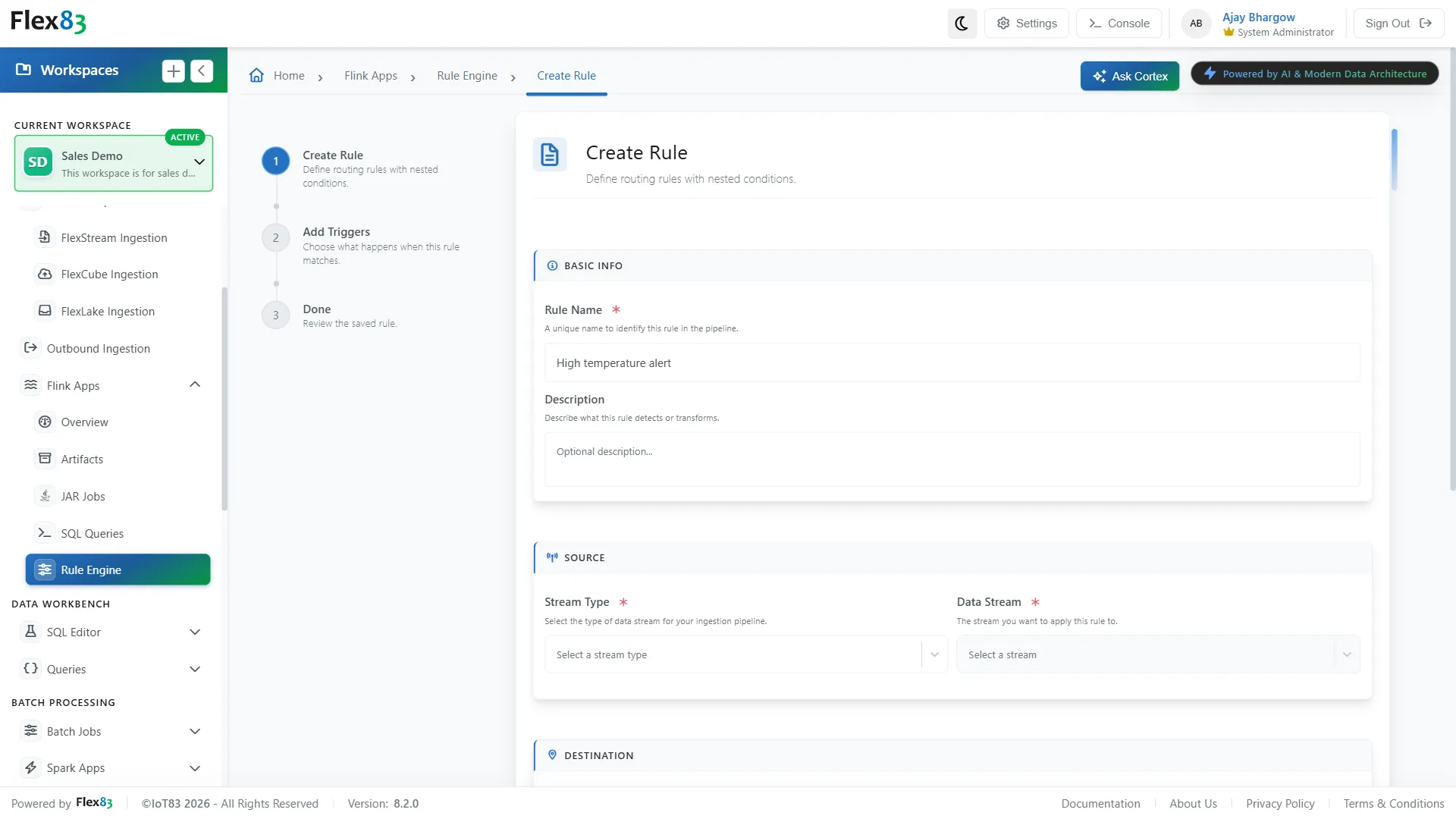
Turn a condition into an action directly. The Rule Engine watches a field on every incoming event, compares it against the condition, and triggers an alarm, a notification, or a routed event on a match.

Send results to every destination that needs them
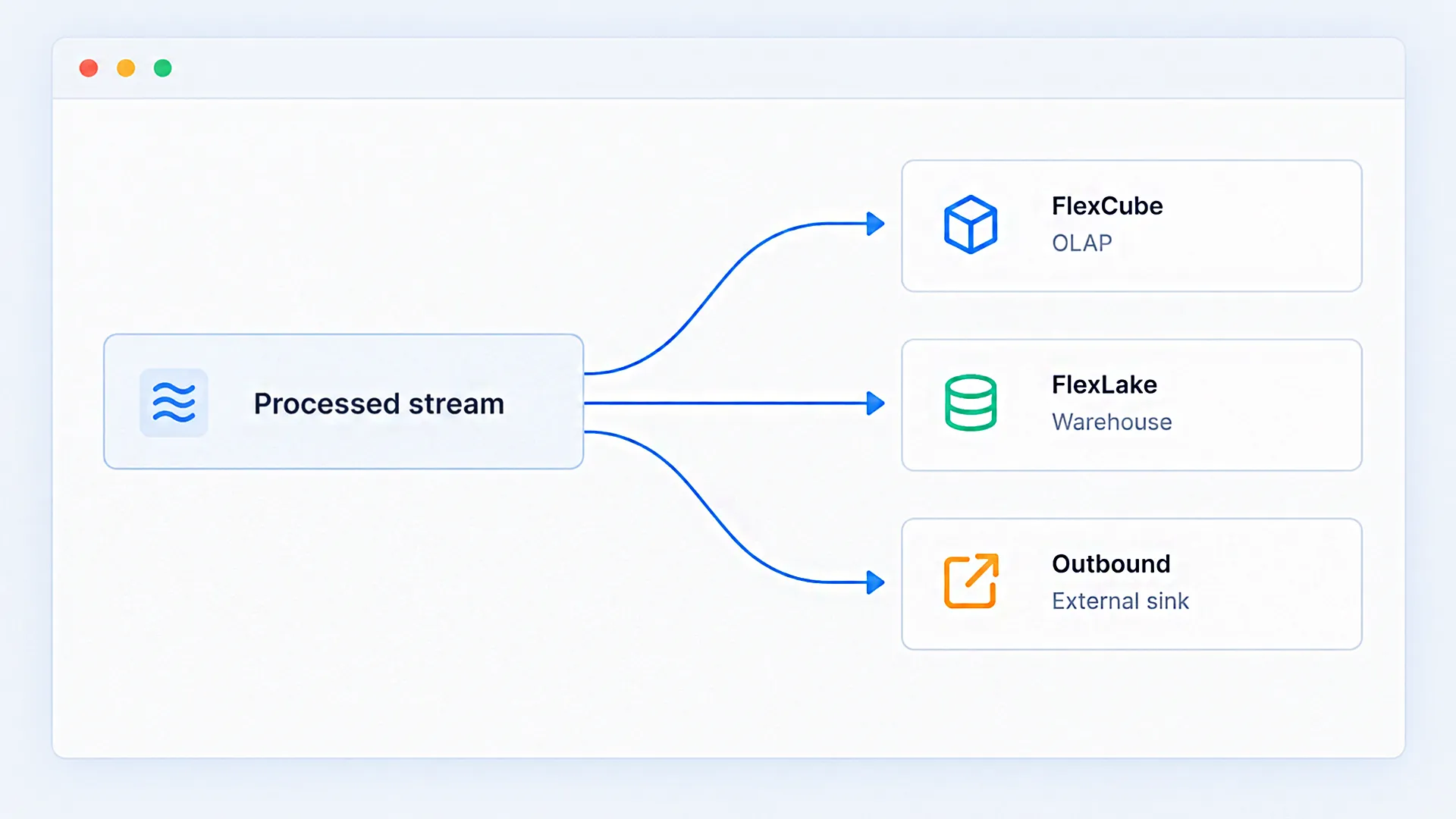
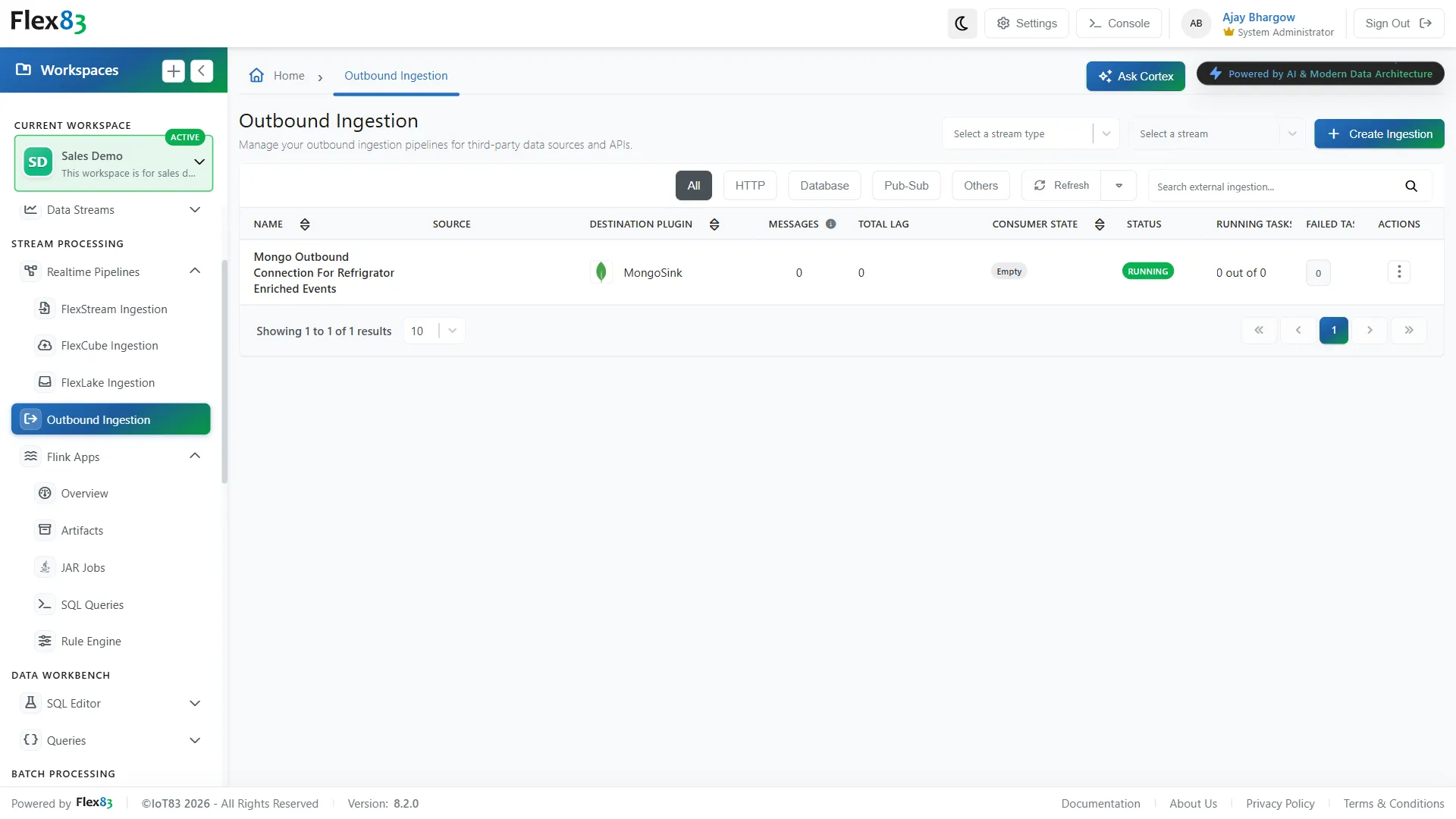
Route the same processed stream to more than one place at once. FlexCube lands it in fast analytical storage, FlexLake syncs it to your warehouse, and Outbound Ingestion pushes it to external systems, all in parallel. The same stream also reaches AI/ML and GenAI handling directly, feeding anomaly detection and forecast models with no separate export step.
Recover automatically when a task fails
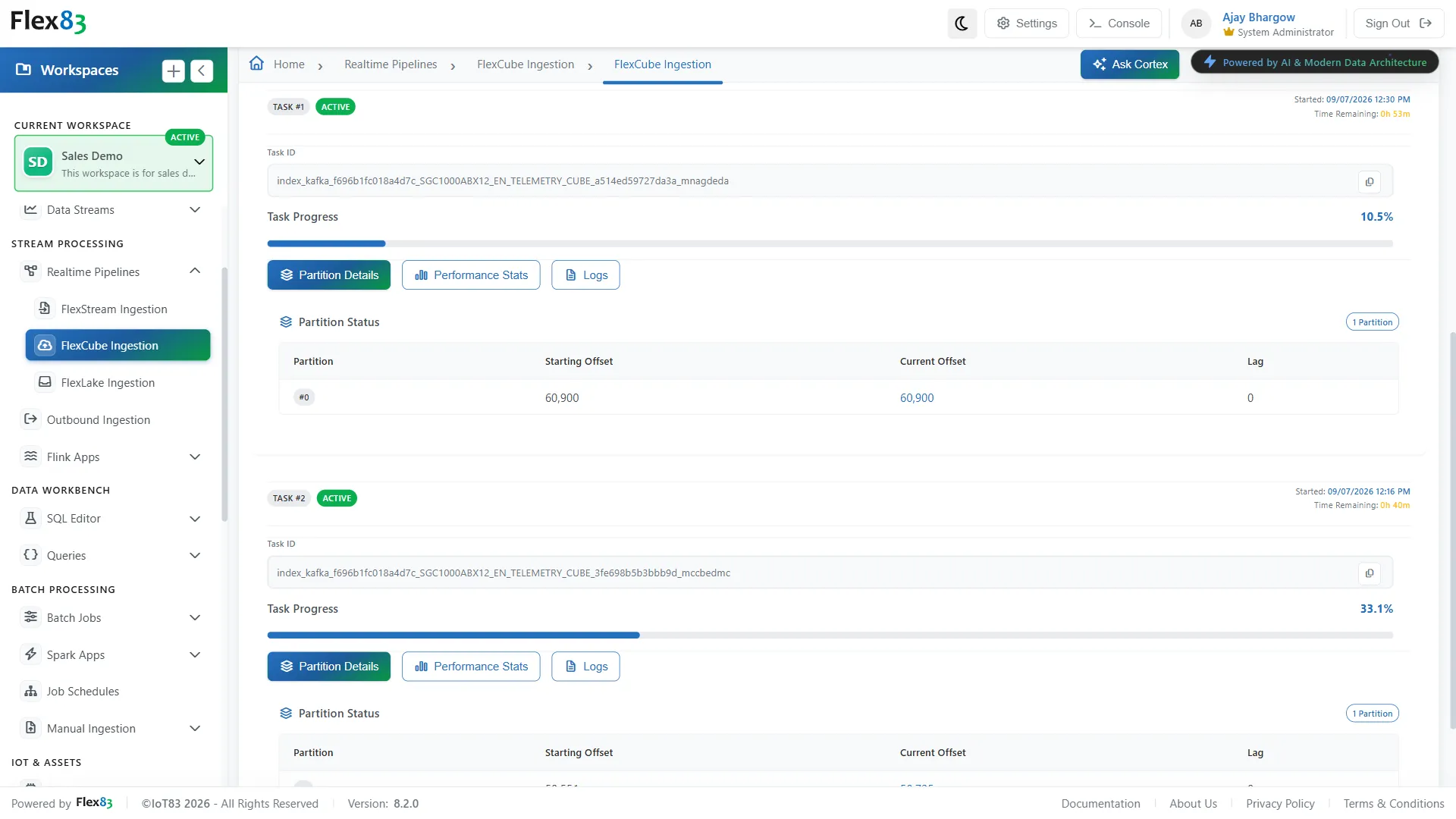
Set the checkpoint interval, and if a task fails, it picks up right where it left off, with delivery guarantees, exactly-once or at-least-once, applied automatically.
Watch every pipeline's health as it runs
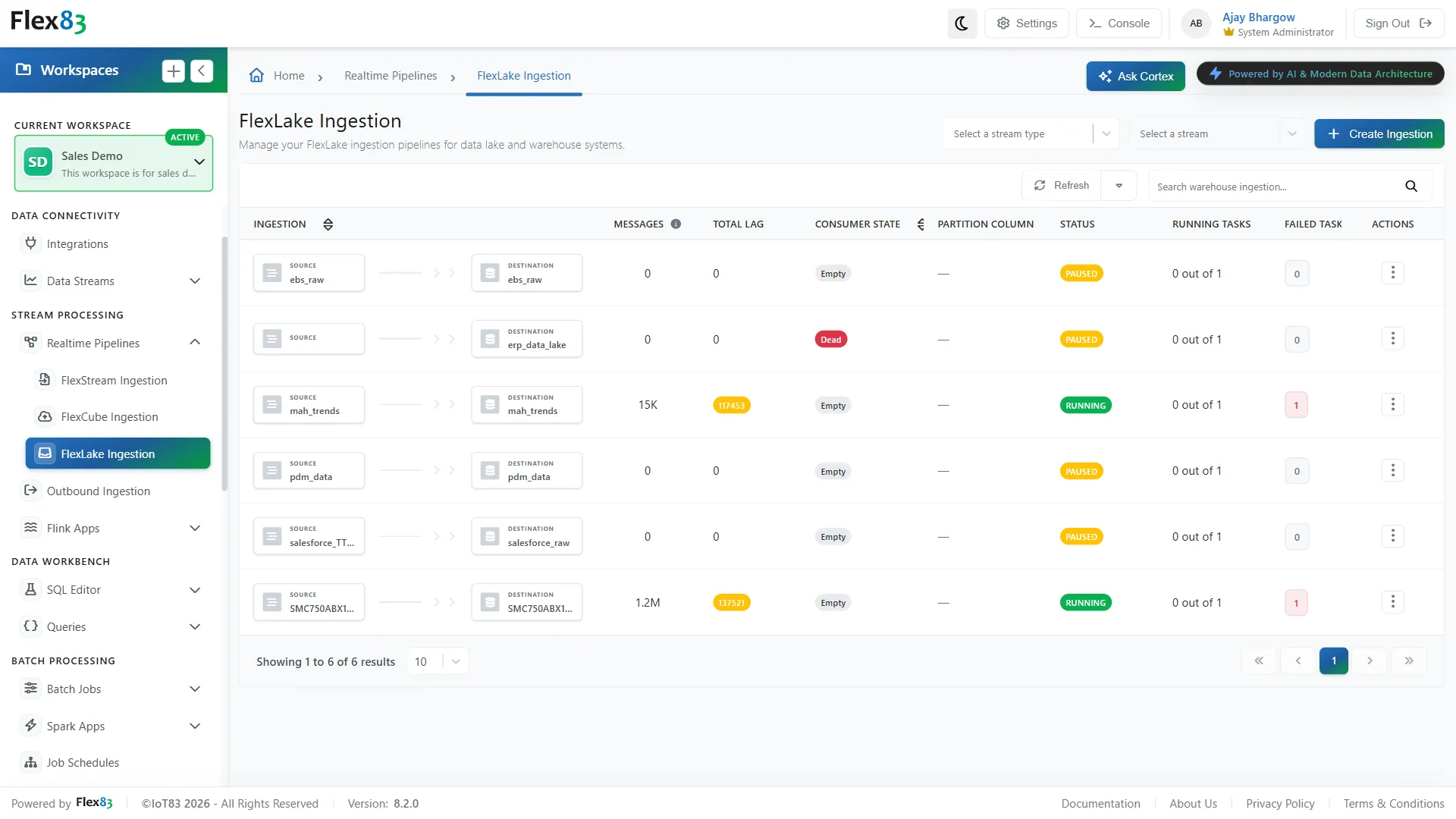
See lag, consumer state, and task health for every pipeline, refreshed automatically. Lineage connects every destination table back to its originating stream, tracing a slowdown to its source in seconds.
Faster decisions, less overhead, more trustworthy data
Flex83 gives you real-time processing, built-in governance, and scalable delivery in one continuous data flow.
Catch events the moment they happen
FlexStream Ingestion never stops reading, so an event reaches processing the instant it's created, not after a nightly job finally catches up.
Cut decision latency with continuous visibility
Lag and pipeline status refresh in real time, so every decision runs against what's happening right now, not last night's report.
Detect failures before they become downtime
A Rule Engine condition, like a reading crossing a safe threshold, fires an alarm immediately, before the equipment fails, not after.
Keep the team on pipeline logic, not infrastructure
Checkpointing, task recovery, and cluster resources run themselves underneath Flink Apps, so a failed task restarts on its own, no page, no manual fix.
Reuse what's already built
A SQL Based query, a JAR Based template, or a saved rule condition drops straight into the next pipeline, no rebuilding the same logic for a new device type or site.
Keep every record traceable end to end
Lineage traces a destination table straight back to its source stream, so a downstream model or dashboard can point to the pipeline and schema that produced every record.
See how teams are already using this
Four patterns running in production today. Select a use case to see it in action.
Asset Performance Management
A rule watching asset telemetry raises an alarm the moment a reading crosses a safe threshold, enabling teams to respond before a condition becomes a larger issue.
Fleet Monitoring and Operational Visibility
Field device and meter telemetry lands continuously in fast, query-ready analytical storage, keeping fleet-wide status current for operations teams.

Predictive Maintenance
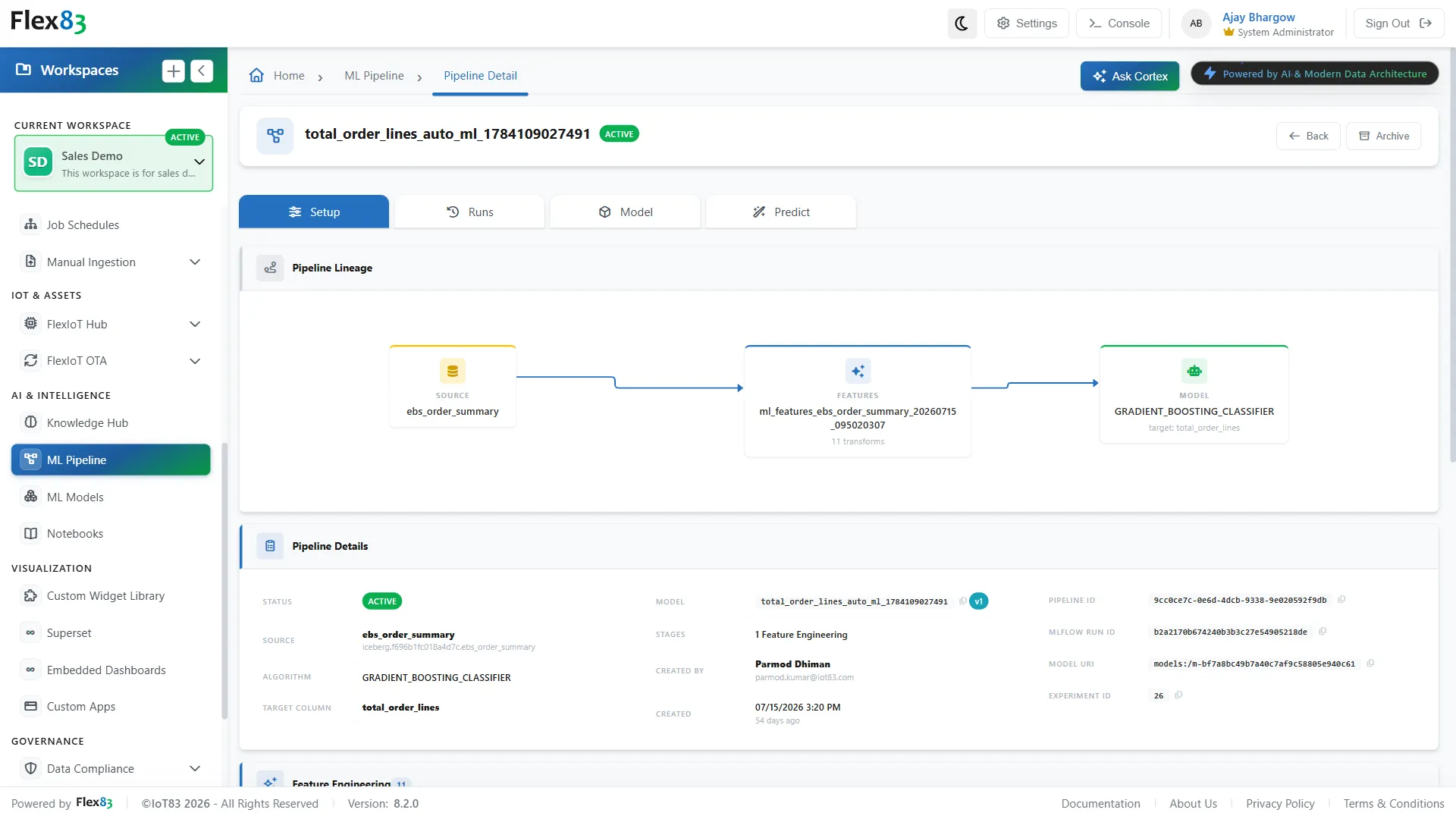
Aggregated telemetry streams feed directly into the platform's AI/ML workflows for anomaly detection and forecasting models.
Compliance and Long-Term Reporting
Processed events sync continuously into warehouse and lake storage, so historical and compliance reporting always reflects the latest data, without a separate batch job to keep it current.
Get more than a processing engine with Flex83
ONE PLATFORM
Flink Apps, the Rule Engine, FlexCube, and FlexLake run on one managed platform.
Streaming and batch pipelines draw from the same managed system, so pipelines and reporting stay aligned as it scales, with cluster resources and fault tolerance handled underneath.
YOUR CONTROL
Choose the level of control that fits the task.
JAR Based gives full code-level control on the DataStream API; SQL Based and the Rule Engine give faster, no-code paths in, all on the same Flink engine underneath.
BUILT IN LINEAGE
Lineage travels with every pipeline, back to its source.
Every FlexStream, FlexCube, and FlexLake ingestion pipeline carries lineage back to its originating stream, visible from that pipeline's own Actions menu.
STREAM TO AI
The same stream that powers your dashboards also trains your models.
Processed streams feed FlexCube and FlexLake for reporting, and the platform's AI/ML and GenAI handling for models, all from one governed stream.
Already running at this scale
Three published Flex83 deployments, each processing continuous, high-velocity data in production.
60M+ events processed per second, at sub-second latency
A global infrastructure operator's pipeline could not ingest and process data fast enough, and high-velocity data arriving faster than it could be processed delayed every analytics initiative behind it. Real-time, multi-protocol ingestion with enrichment and correlation moved data availability from hours to minutes, a 10x improvement, while sustaining 99.9% platform availability.
8x more files processed daily, in a third of the time
A Fortune 500 telecommunications company needed to process 40,000 geospatial signal files a day, up from 5,000 to 7,000, each carrying millions of millisecond-granularity readings. Flex83 Middleware refactored the ingestion pipeline, scaled throughput eightfold, and hit the goal in a third of the original timeline.
18M+ smart meters, managed on one continuous pipeline
A utility needed one system to continuously process telemetry from 18 million smart meters across consumer premises, transformers, feeders, and border points, from multiple manufacturers over both GPRS and RF, at frequencies from every 5 minutes to monthly depending on the meter profile.
Frequently Asked Questions
What's the difference between stream processing and batch processing on Flex83?
Stream processing captures and acts on each event continuously, as it's created. Batch processing runs on a schedule, over a defined interval. Flex83 supports both, side by side.
Do I need to write code to process streaming data?
Only if the logic calls for it. SQL Based Flink Apps and the Rule Engine both offer a declarative, configuration-first path for teams that prefer to skip custom code.
What happens if a pipeline falls behind?
Lag stays visible per pipeline in real time. Tasks can be tuned or restarted directly, and backpressure is monitored per job so a slowdown gets caught early.
Can I automate a response without building a full processing job?
Yes. The Rule Engine turns a condition into an action directly, as a standalone configuration.
Where can processed data go?
Analytical storage, warehouse or lake storage, or external systems, all in parallel from the same stream.
What happens if a processing job fails?
Checkpointing and configurable delivery guarantees support recovery, and individual tasks restart from their last checkpoint on their own.
Is streaming data available to AI and ML models?
Yes, processed streams feed directly into the platform's AI/ML and GenAI handling.
Make your next stream production-ready
Connect, process, and deliver continuous data at scale on Flex83, without stitching together multiple processing systems.