Trace Every Insight Back to Its Source — Sensor to Decision
When an AI-driven alert costs you a maintenance window or a regulator asks why a decision was made, 'trust the model' is not an answer. Flex83's AI-driven asset lineage gives every dashboard, prediction, and automated action a complete, auditable chain of custody - from the originating sensor to the operator who acted on it.
Trusted by teams at global enterprises
for industrial data and asset ecosystem















Without Lineage, Industrial AI Becomes a Black Box
1. Decisions you can't defend
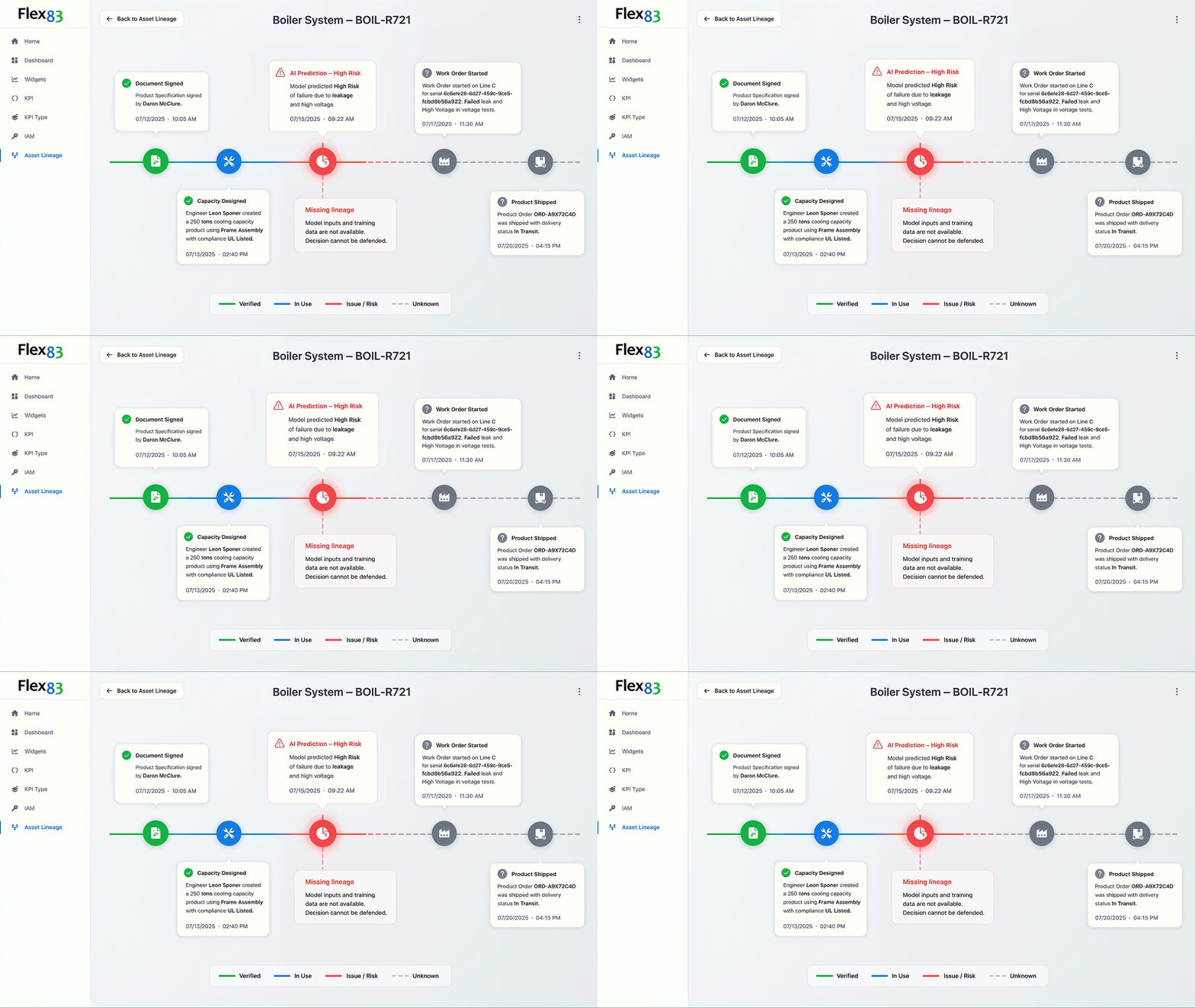
Predictive maintenance, automated work orders, and AI-driven shutdowns all generate consequences. Without lineage, you can't reconstruct why the model fired, what data it trusted, or whether that data was even valid at the time.
2. Audits that take weeks, not minutes
Regulated industries — pharma, energy, aerospace — pay for every audit hour. Stitching evidence from historians, MES exports, and ML notebooks is manual, slow, and risk-prone.
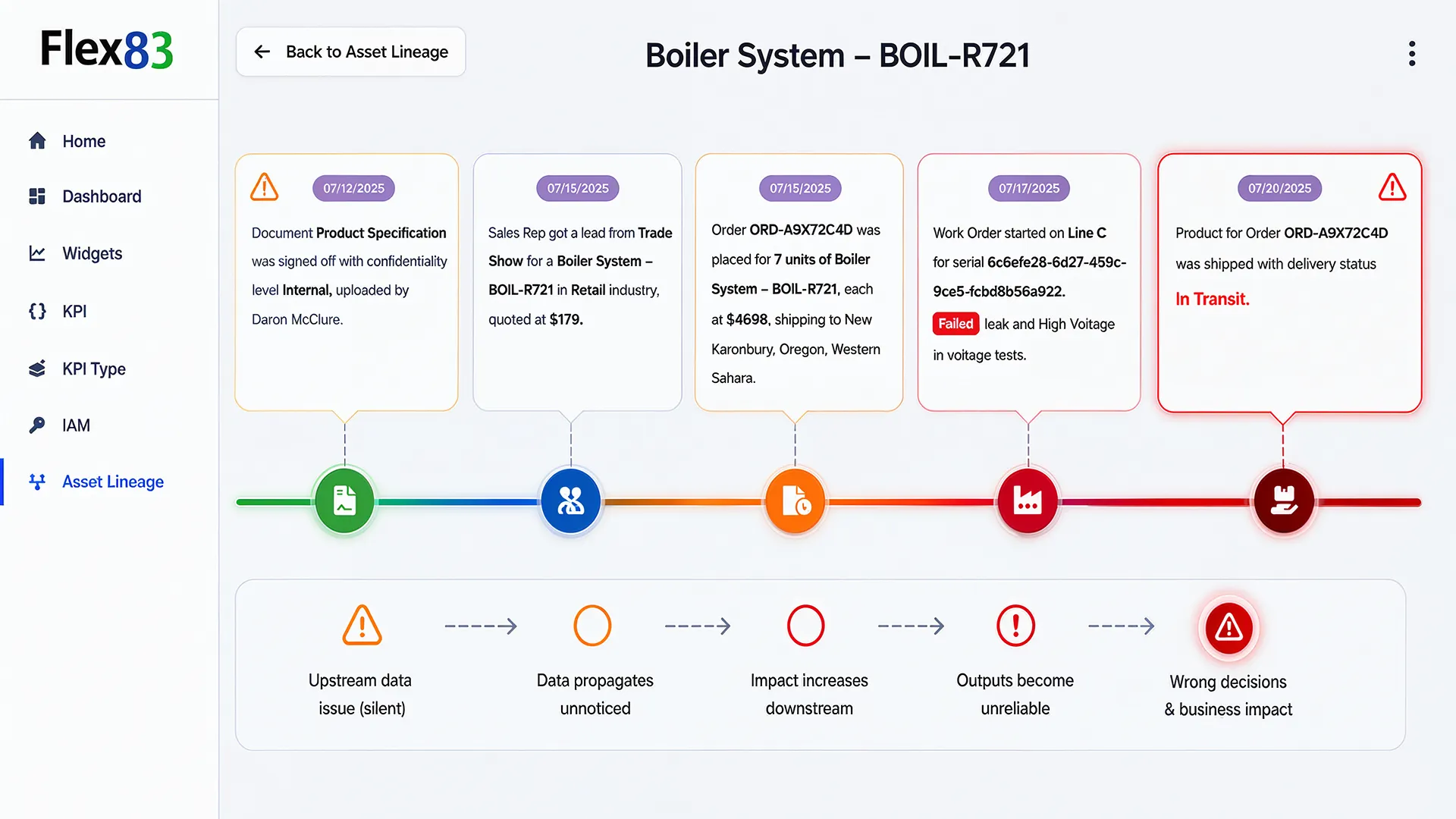
3. Data quality issues you find too late
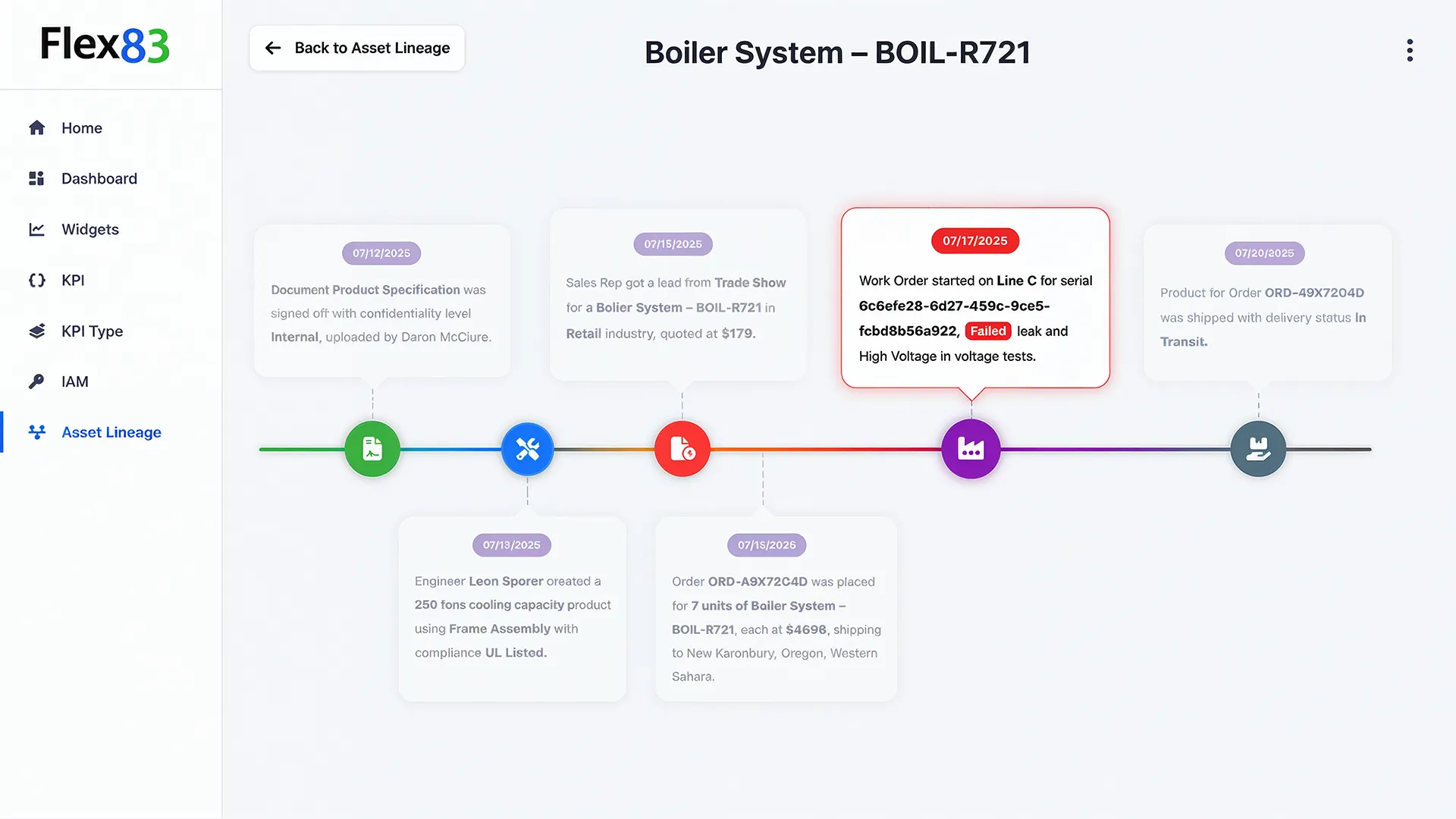
When a sensor drifts or a feed silently fails, downstream models keep producing outputs — they just become unreliable. Without lineage, you find out from a customer, not from your platform.
Flex83's AI-Driven Asset Lineage, End to End
.avif)
1. Automated Lineage Capture
Every ingest, transform, model inference, and dashboard render is captured automatically. No manual annotation, no separate lineage tool — lineage is a property of the platform, not a project.
.avif)
2. Asset Hierarchy as a Knowledge Graph
Plant → line → asset class → asset → component → sensor, modeled once and reused everywhere. AI agents and analysts navigate the same graph; queries return results in business context, not raw tag names.
.webp)
3. Explainable AI Out of the Box
For every prediction, Flex83 surfaces the contributing features, the training dataset version, the model version, and the upstream data quality status — in one panel, in plain language.
.webp)
4. Compliance-Ready Reporting
One-click export of audit packages — lineage, model cards, data quality, access logs — formatted for ISO 27001, SOC 2, FDA 21 CFR Part 11, and IEC 62443 reviews.
faster audit response time
of AI decisions explainable
fewer data-quality incidents in production
From Black Box to Glass Box
Every prediction, alert, and automated action carries its full provenance. Operators trust the platform because they can interrogate it.
Audits That Don't Stall the Business
Regulator asks a question; analyst clicks 'lineage'; evidence package ships in minutes. Audit cycles compress; operations keep running.
From Pilot to Production in Weeks, Not Years
Weeks 1–2
Weeks 3–6
Weeks 7–12
Weeks 13–16
Weeks 17+
Resources
.webp)
.webp)
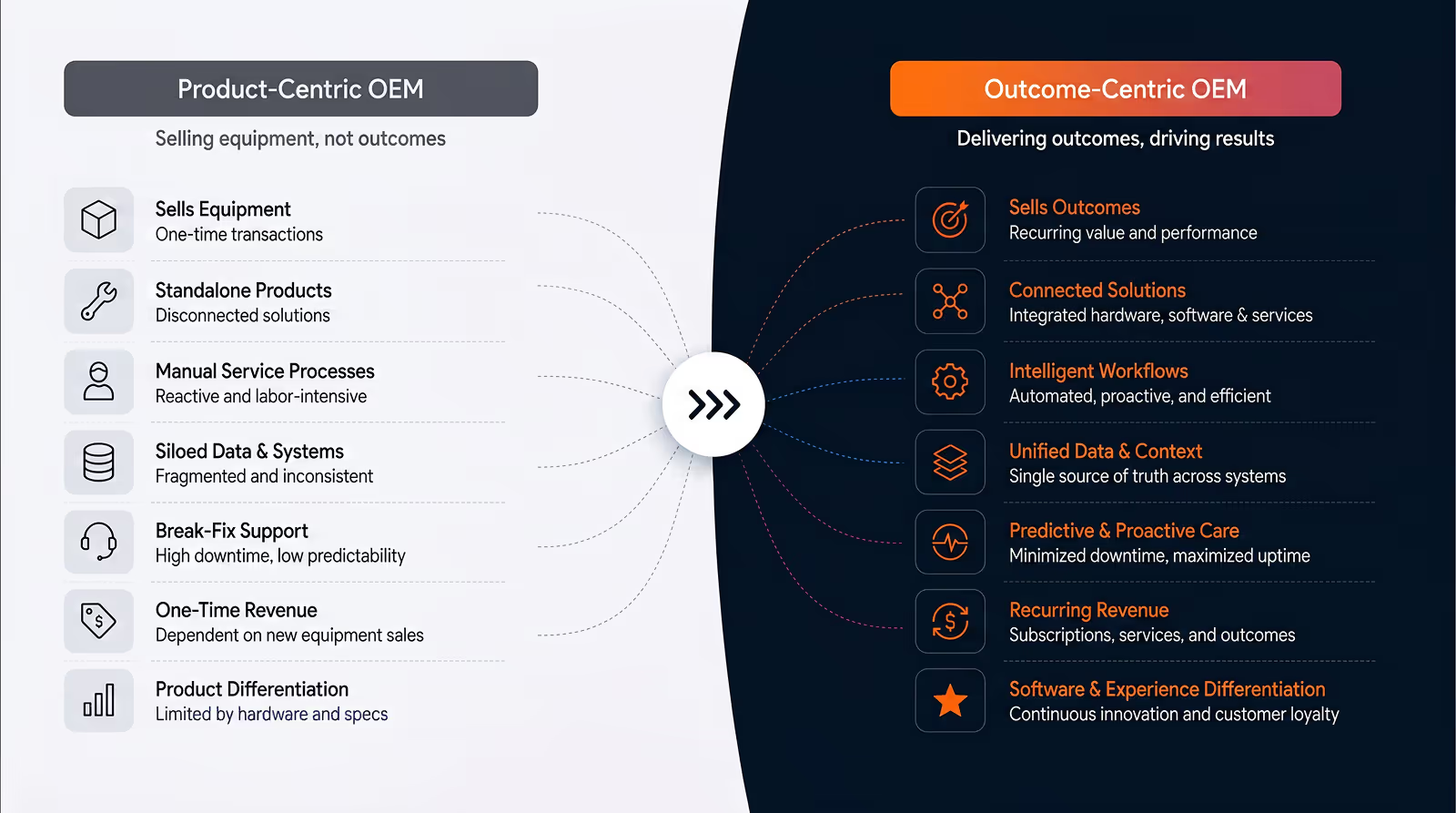
Industrial OEMs Are Becoming Software Companies — Most Haven’t Updated Their Platform Strategy Yet

Make Every Industrial AI Decision Defensible
Tell us about your asset portfolio, the AI workloads in production, and the compliance regimes you operate under. We'll show you what Flex83's AI-driven asset lineage looks like end-to-end.