Predict Failures Before They Hit the Maintenance Log
Predictive maintenance is the most-promised, least-delivered industrial AI outcome. Flex83 closes the gap: governed training data, embedded ML Studio, model registry, edge deployment, and live drift monitoring — so models stop dying in pilot and start preventing real failures.
Trusted by teams at global enterprises
for industrial data and asset ecosystem















Why Most Predictive Maintenance Projects Fail
1. Training data nobody trusts
Historical failure events are sparse, mislabeled, or stuck in spreadsheets. Without governed lineage and clean labels, models train on garbage and produce predictions nobody deploys.
2. Models that work in the notebook, not the plant
A model that hits 0.92 AUC in Jupyter often falls apart in production — different preprocessing, different feature pipelines, different latency budget. Most teams discover this six months into deployment.
3. No one watching the model after launch
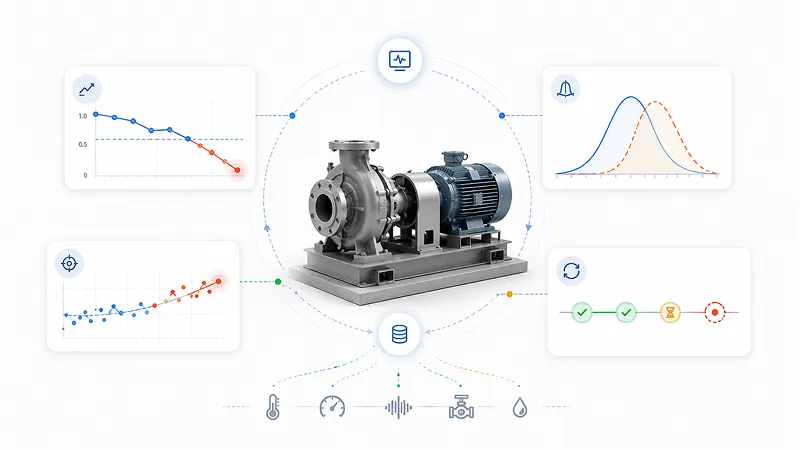
Sensors drift, conditions change, and model accuracy quietly decays. Without drift and data-quality monitoring built into the platform, the first sign of trouble is usually a missed failure.
Flex83 Predictive Maintenance, End to End
.webp)
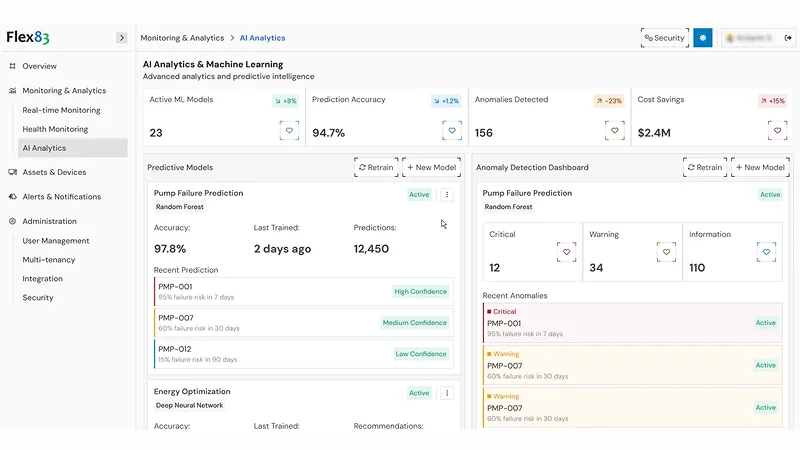
1. Governed Training Data, Ready to Use
Time-aligned, asset-aware, labeled. Flex83 ingests sensor data, fault codes, work orders, and ambient context — and exposes them as a feature store with version pinning, so every experiment is reproducible.
.avif)
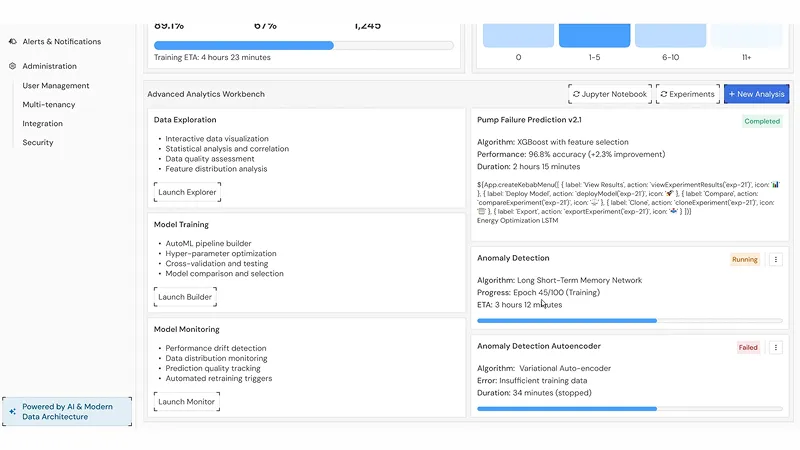
2. ML Studio for Anomaly Detection and RUL
Pre-built notebook templates for the most common predictive maintenance patterns — univariate anomaly, multivariate anomaly, remaining-useful-life regression, fault classification. Bring your own algorithm or start from a template.
.webp)
3. Edge or Cloud Inference, Same Model
Deploy via Flex Edge Agent for sub-second inference on the gateway, or in the cloud for fleet-wide scoring. Same model artifact, same monitoring. Customers see consistent behavior regardless of where the model runs.
.webp)
4. Drift Monitoring On by Default
Input drift, prediction drift, and accuracy decay tracked automatically. Alerts fire before customers notice. Retraining is triggered from the same workflow.
From Reactive. To Predictive. To Competitive.
reduction in unplanned downtime
cut in maintenance cost
extension in asset lifespan
From 'Pilot' to 'Production Standard'
Predictive maintenance stops being a science project and becomes the default mode of operations — for every connected asset class.
Models That Stay Honest
Drift monitoring and clean retraining loops mean the model you deploy in Q1 still earns its keep in Q4.
From Pilot to Production in Weeks, Not Years
Weeks 1–2
Weeks 3–6
Weeks 7–12
Weeks 13–16
Weeks 17+
Resources
.webp)
.webp)
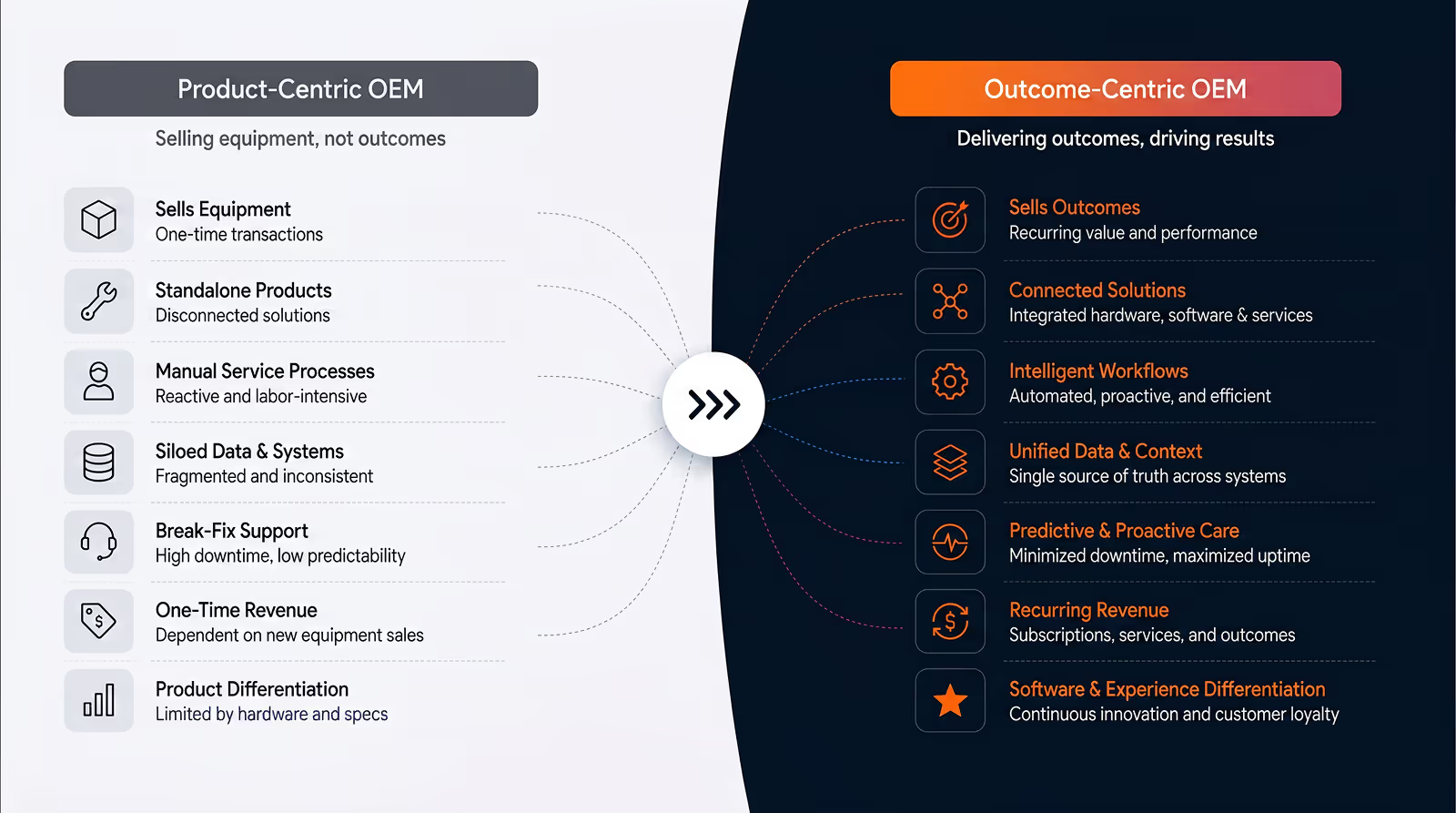
Industrial OEMs Are Becoming Software Companies — Most Haven’t Updated Their Platform Strategy Yet


Predictive Maintenance, Without the Pilot Trap
Tell us about your asset portfolio, the failure modes that cost you the most, and the data you already capture. We'll show you what a 12-week path to production predictive maintenance looks like on Flex83.