Launch a connected-product marketplace — without building the marketplace.
OEMs want to sell aftermarket digital services on top of their hardware — apps, AI features, premium data feeds. Building a marketplace is platform work, not core OEM competence. Flex83 ships the foundation so you ship the storefront.
Connected-services revenue is the OEM growth lever — if you can build the platform under it.
Recurring services revenue is where every connected-product OEM wants to be. The hardware sale is one-time. The marketplace is the annuity. The problem is the marketplace itself is harder than the products you want to put on it.
Annuity
OEMs that monetize aftermarket digital services trade one-time hardware revenue for recurring ARR. The valuation re-rating is significant. The platform burden is the blocker.
Multi-vendor
A real marketplace has third-party apps. That needs an SDK, certification, isolation, and revenue share — not a single-vendor app catalog.
Years
App SDK + tenant isolation + branding + metering + audit + revenue share + payments. Most OEMs that try to build this from scratch stall after the SDK.
The marketplace foundation, productized. You ship the storefront.
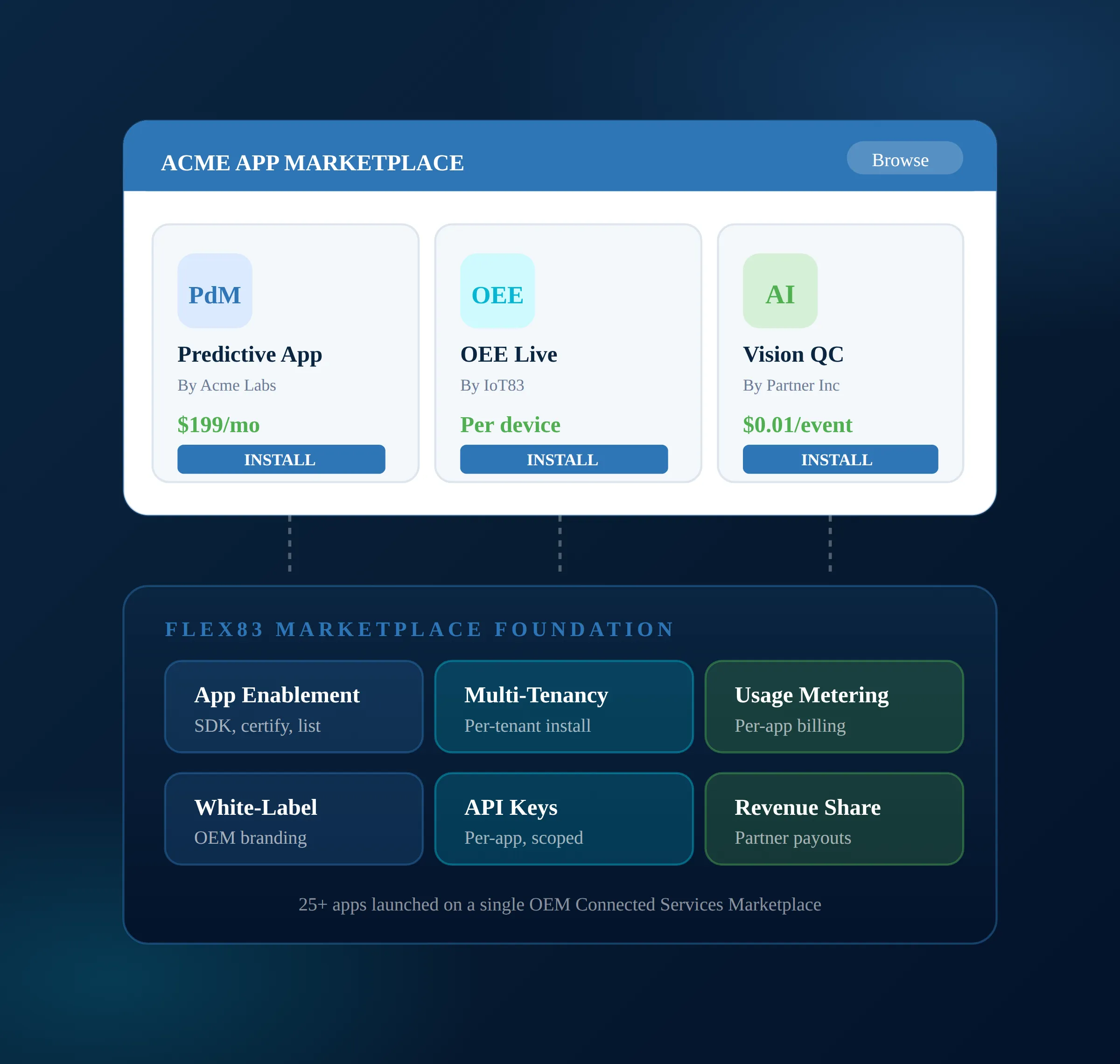
Flex83 ships every primitive a connected-product marketplace needs: app enablement SDK, multi-tenant install model, white-label branding, usage metering, scoped API keys, and revenue-share accounting. Your OEM team curates apps and brands the storefront. Partners ship apps under certification. Customers install per-tenant.
Your team owns the storefront. Flex83 owns the foundation.
SDK, certification, listing — OEM-owned and partner-friendly.
Per-tenant install — each customer’s app set isolated by default.
Marketplace UI, emails, domain — entirely under the OEM’s brand.
Per-app meters on devices, API calls, AI usage — for any pricing model.
Per-app credentials with rotation, scope, and revocation.
Track partner payouts and OEM splits per app, per tenant, per event.
From OEM hardware to OEM-branded app ecosystem.
A reference architecture for shipping a connected-product marketplace on Flex83.
Curate the app contract: APIs, data access, certification.
OEM and partner apps go through certification and listing.
White-label the marketplace UI, domain, and emails.
Customers install apps into their isolated workspace.
Usage flows into billing; revenue share splits to partners.
Turn the hardware sale into a forever relationship.
Three things that change when the marketplace ships as platform capability.
Recurring revenue on every shipped unit
Every device becomes a billing relationship. Per-tenant metering, per-app pricing, predictable ARR — without building the metering or the billing.
Open the platform to a partner ecosystem
Third-party apps multiply the catalog without expanding your team. Certified partners ship; you keep the curation, the branding, and the share.
Ship the marketplace in months, not years
The marketplace foundation is built. Your team picks the apps, the branding, and the pricing model — not the multi-tenant SDK and metering engine.
A marketplace in production today.
Apps shipped on a single Connected Services Marketplace
Faster app launch vs. previous in-house platform
Less downtime on the marketplace foundation vs. DIY
Install, isolation, metering, and audit by construction
Stop selling devices. Start running an app ecosystem.
Talk to a Flex83 platform expert about your connected-services strategy. We’ll walk you through the marketplace foundation, the partner SDK, and the revenue model — from first app to recurring ARR.