Deploy AI models to the edge — without an MLOps team.
Pushing inference to gateways and devices means managing model versions, heterogeneous hardware (ARM, x86, NPUs), OTA delivery, and cloud-edge sync. Most teams stall at one of those four. Flex83 handles the pipeline so your team ships the model.
Cloud-trained, edge-deployed is where AI projects go to die.
The model trains fine in the cloud. The hard part is getting it to thousands of heterogeneous devices, keeping versions in sync, and observing inference at the edge — without standing up a separate MLOps stack.
6+ tools
Model registry, packager, OTA service, edge runtime, fleet observability, rollback — six tools your team has to integrate and operate before a single model runs at the edge.
3+ hw archs
OEMs ship products across ARM, x86, and NPU variants. Each needs its own model build, its own runtime, and its own validation cycle — unless your platform abstracts it.
Months
Getting one model to one device is a hackathon. Getting versioned models to thousands of devices, with rollback, observability, and SOC2 compliance, is a project most teams stall on.
One pipeline from cloud training to edge inference — on every hardware target.
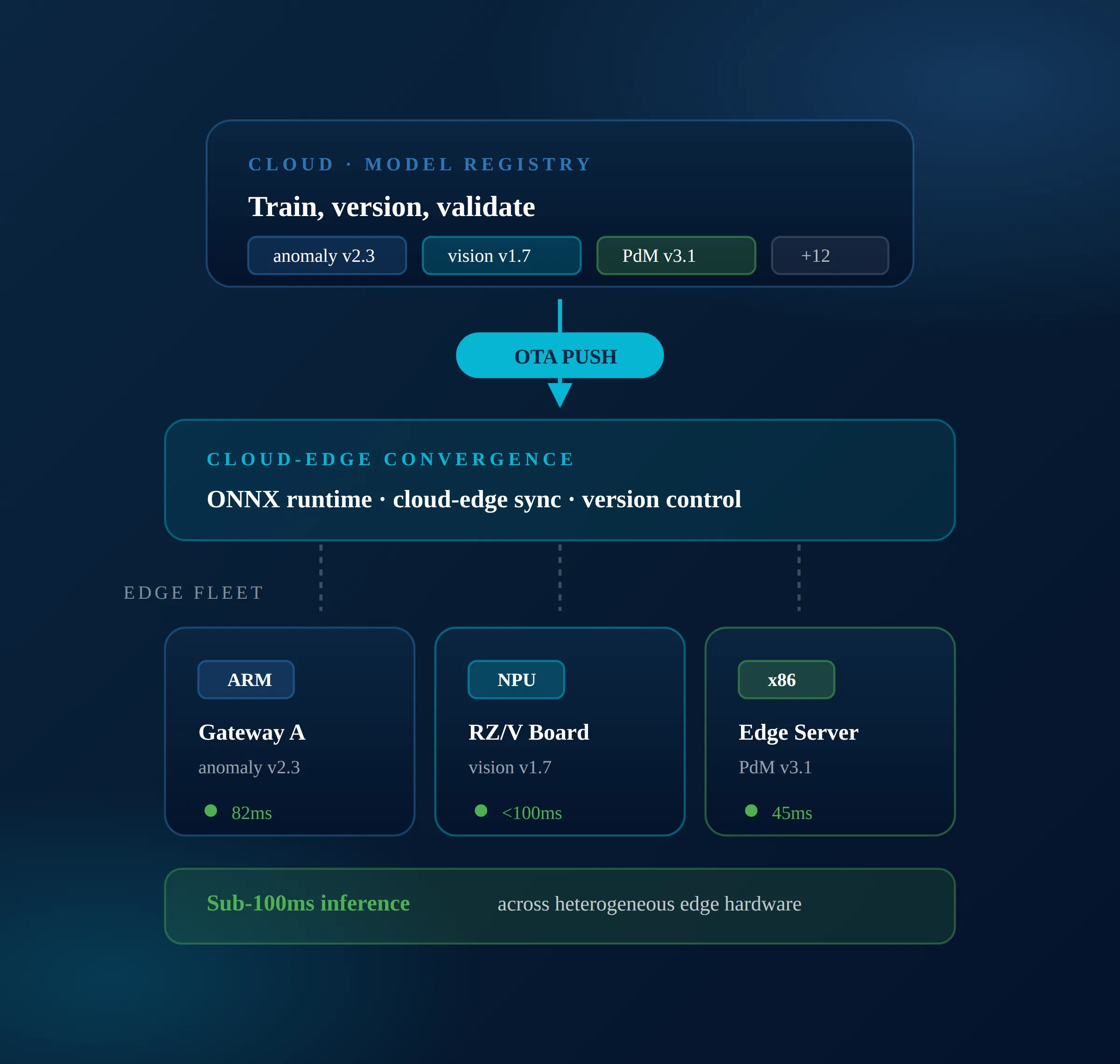
Flex83 ships cloud-edge convergence as a first-class capability. Train in the cloud. Validate against historical data. Package as ONNX. Push OTA to your fleet. Observe inference and roll back from one console.
Your data scientists ship the model. Flex83 ships it to every device.
One-click model deployment to gateways, devices, and edge servers.
Versioned models with metadata, lineage, and rollback — not S3 buckets.
Same model, same telemetry, one platform across cloud and edge.
Hardware-agnostic inference across ARM, x86, and NPU targets.
Staged rollouts, canary deployments, and atomic rollback per fleet segment.
Per-device inference latency, throughput, and drift monitoring.
From cloud training to edge inference — on one platform.
A reference architecture for shipping AI models to the edge on Flex83.
ML Studios trains on historical telemetry from FlexLake.
Replay against production data; promote in Model Registry.
Export to ONNX with metadata, signature, and version tag.
Staged rollout to fleet segments with canary and rollback.
Per-device latency, throughput, and drift in the dashboard.
Turn the hardware sale into a forever relationship.
Three things that change when the marketplace ships as platform capability.
Validate models 40% faster
Train against historical telemetry from FlexLake, then replay against live edge data — no separate validation infrastructure.
Hardware-agnostic, by construction
ONNX runtime means the same model lands on ARM gateways, x86 servers, and NPU boards — without per-target rebuilds or per-target validation.
Roll forward and roll back, atomically
Stage deployments, canary to a fleet segment, roll back in one click. Model Registry tracks every version, every signature, every rollout.
Compliance-grade governance, in production.
Edge inference latency on Renesas RZ/V series (NPU)
Faster model validation cycles vs. DIY edge MLOps
Standard runtime — ARM, x86, NPU from one model artifact
Atomic rollback to last known good model across fleet
Stop building edge MLOps. Start shipping edge AI.
Talk to a Flex83 platform expert about your edge AI roadmap. We’ll walk you through the cloud-edge architecture, the ONNX runtime, and what production looks like across your hardware fleet.