Build digital twins of assets and processes — once. Reuse everywhere.
Modeling assets, sites, and process hierarchies with real-time state, history, and relationships typically needs a custom graph or asset framework on top of cloud primitives. Flex83 ships it — define your asset model once, and every downstream workload speaks the same language.
Every team rebuilds the asset model. None of them stay in sync.
The PdM team has an asset tree. The dashboard team has a different one. The ML team has a third. Without a platform-level twin, every workload reinvents the model — and they drift apart the moment a sensor moves.
3+ models
Most industrial software stacks end up with separate asset models for monitoring, analytics, and AI. Each is brittle. None agree on what an asset is.
Custom graph
Teams either roll a Neo4j or assume a flat table. Both break when the asset hierarchy gets six levels deep, with cross-references and lifecycle events.
Drift
A sensor moves. A pump is replaced. A line is reconfigured. Without platform-managed lifecycle, the twin diverges from the real plant within weeks.
One canonical model — every workload reads from it.
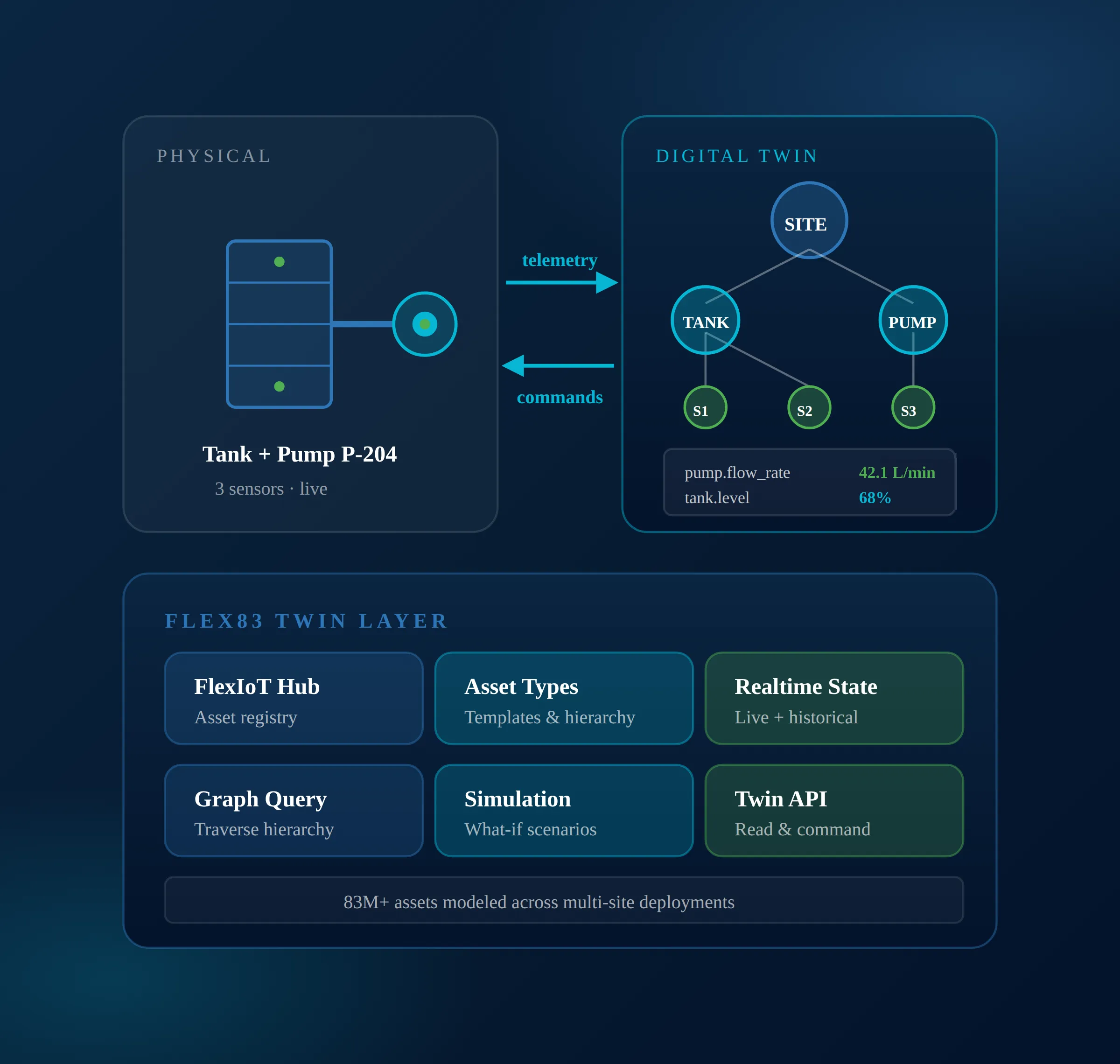
Flex83 ships FlexIoT Hub as the canonical asset and twin layer. Define asset types, model hierarchies, declare relationships, attach lifecycle events. Stream telemetry binds automatically. AI, dashboards, batch analytics, and customer APIs all consume from the same twin.
Your team models the plant. Flex83 keeps every workload in sync with it.
Canonical asset registry with identity, lifecycle, and metadata.
Templates for pumps, motors, lines — instantiate, don’t re-model.
Live properties bound to streaming telemetry — queryable in milliseconds.
Traverse hierarchy: site → line → machine → sensor in one query.
What-if scenarios against historical state for capacity and PdM planning.
REST and streaming APIs to read state, history, and write commands.
From asset definition to live twin — one model serves everything.
A reference architecture for shipping digital twins on Flex83.
Create reusable asset templates for pumps, motors, lines.
Build the site hierarchy from templates — no per-asset code.
Map streaming data to twin properties via schema registry.
Add maintenance events, work orders, and lifecycle states.
Dashboards, ML, batch, and APIs query one canonical twin.
Turn the hardware sale into a forever relationship.
Three things that change when the marketplace ships as platform capability.
Define the asset once, ship it everywhere
PdM, dashboards, AI assistants, batch analytics — all consume the same twin. Move a sensor; every workload updates.
Scale to multi-site without re-modeling
Asset templates instantiate across sites. Adding a new plant means cloning the type, not designing a new system.
Run simulations against live state
Replay historical state, run what-if scenarios, validate models — against the same twin that runs production.
Compliance-grade governance, in production.
Assets modeled across multi-site Flex83 deployments
Read by PdM, ML, dashboards, and customer APIs
Property updates bound to streaming telemetry
Asset types reusable across sites, tenants, and product lines
Stop maintaining three asset models. Start trusting one.
Talk to a Flex83 platform expert about your asset modeling roadmap. We’ll walk through your hierarchy, the twin layer, and how every downstream workload starts speaking the same language.