Enterprise Security & Access Management
Govern APIs, identities, and access across your platform
Manage API keys, roles, federated identities, tenant isolation, and audit trails from a centralized security layer in Flex83.

















Access breaks down without consistent controls
Every new integration, dashboard, or automated process is another decision about who or what can reach production data. Without a consistent framework, those decisions accumulate into broad permissions, forgotten credentials, and gaps in visibility.
Roles get defined ad hoc
A new hire inherits permissions from someone with a similar role. A contractor gets broader access because defining the right scope takes longer. Over time, no one has a reliable view of who can access what.
Credentials outlive their purpose
An API key created for a one-time integration can remain active long after the original need disappears. When no one knows what a credential is used for or what it can access, teams hesitate to revoke it.
Access activity is hard to trace
Without consistent audit records, answering basic questions during an investigation becomes difficult: who made the request, what did they access, and when did it happen? Teams end up searching across systems to reconstruct activity after the fact.
One system to handle identity, credentials, and the record left behind
Access & Security brings together the modules in Flex83 that handle identity, credentials, and activity. Every sign-in, every key, and every request flows into the same governed record.
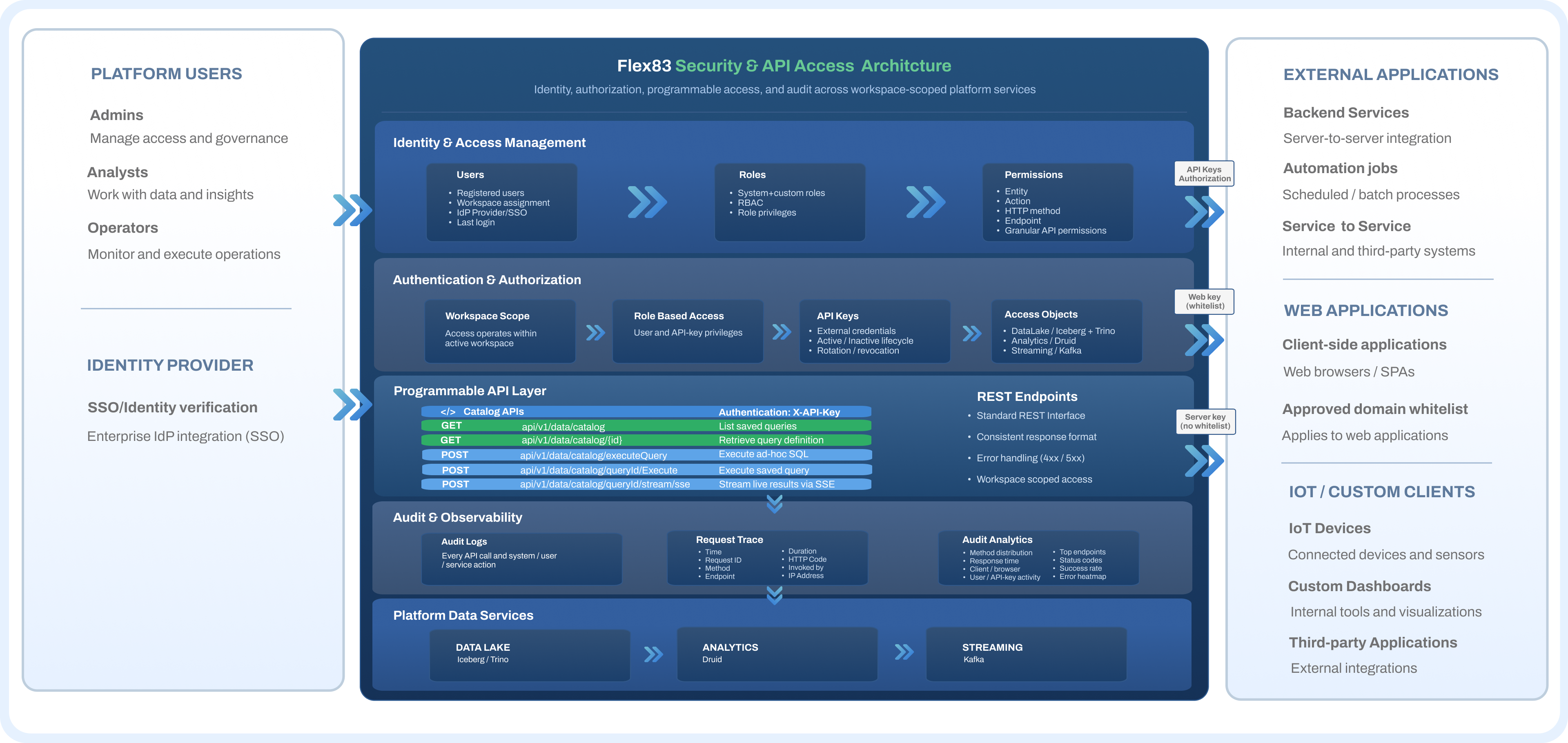
Built-in controls for every access point
A robust security and access framework built into one platform, covering identity, permissions, APIs, tenant isolation, and auditability.
Define access with RBAC
Set precise permissions for every role and apply them consistently across users and services. Verify what each role can actually do before access is assigned.
Scope every API key
Create dedicated credentials for dashboards, applications, devices, and services, with each key limited to the resources it needs.
Govern application access
Let developers and external systems query or stream platform data through authenticated APIs, without creating individual user accounts for every integration.

Isolate every tenant
Keep each customer, business unit, or team within its own workspace, with data, pipelines, configuration, and access boundaries kept separate.
Federate enterprise identity
Connect the identity provider your organization already uses and carry existing authentication and group-based access into Flex83.
Audit every action
Every request carries an audit trail showing who or what made it, what happened, and where it came from.
Secure access at every level
Bring identity, permissions, API access, and tenant isolation under the same security framework, so your teams can control access without adding operational overhead.
Consistent access across users and integrations
Define a role once and apply it consistently across users and API keys. New hires, contractors, and integrations inherit the right permissions without teams recreating access rules each time.
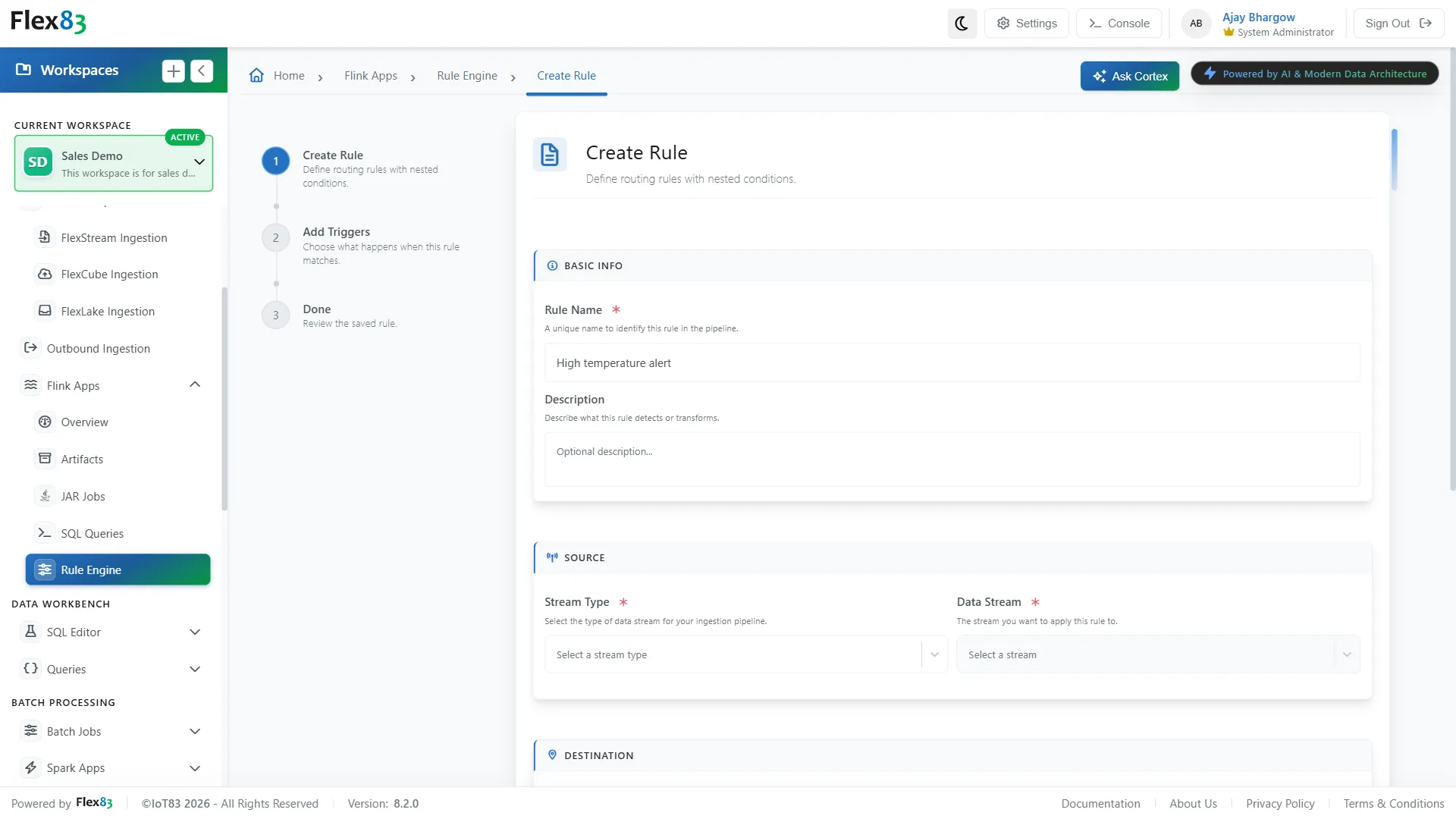
Limit the damage of a leaked key
Scope every API key to the specific data and domains it needs. If a credential is exposed, its permissions still limit what it can reach.

Trace every request
Every request is tied to its invoking identity and source IP, while filtering and analytics help teams quickly narrow activity to the relevant endpoint or time window.
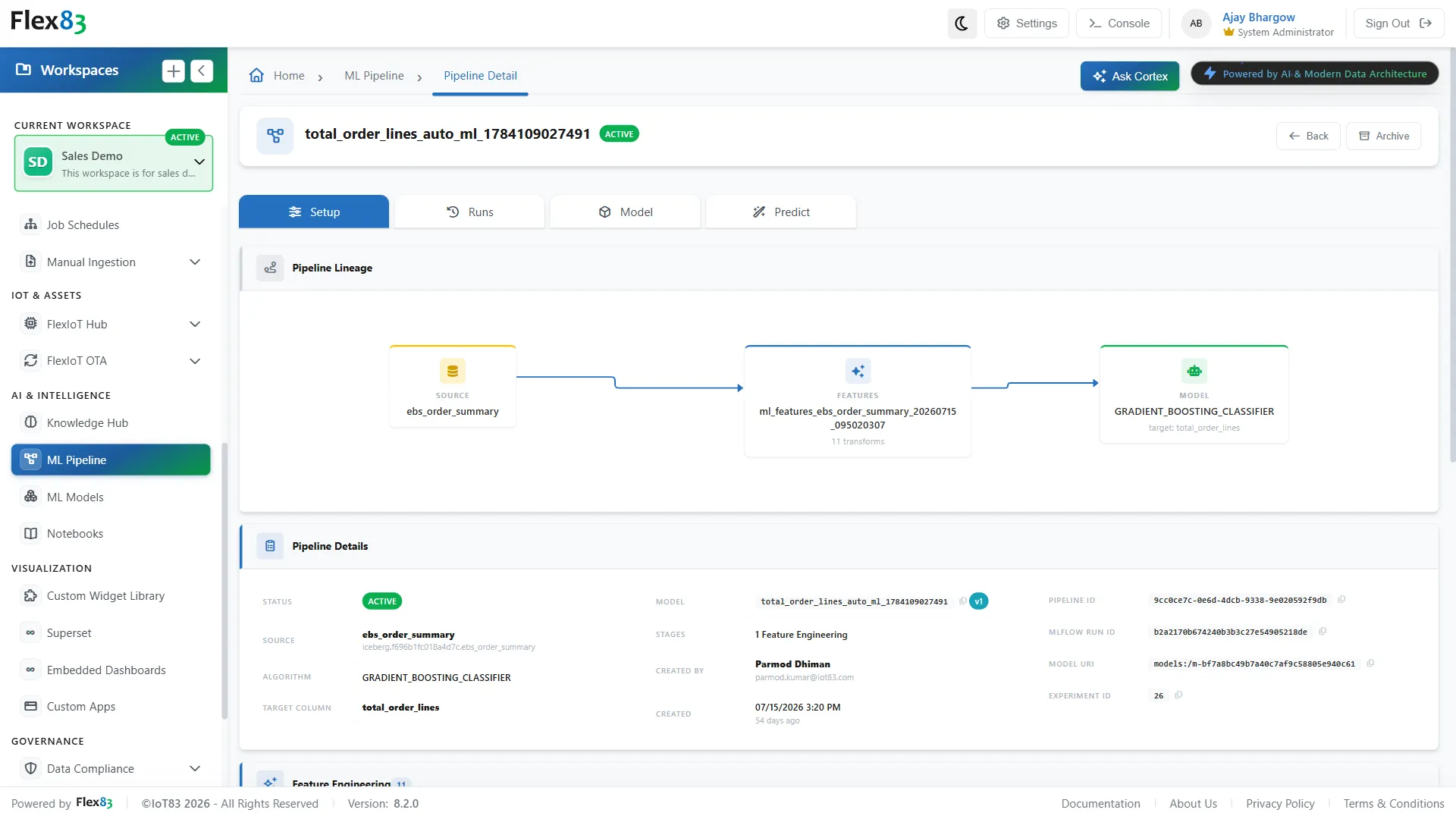
Scale without cross-access
Keep customers, teams, and business units isolated in their own workspaces from day one. Their data, pipelines, and configuration stay separated without requiring a separate platform for each environment.
Access management across industrial use cases
Customer-facing IoT platforms
Give customers secure access to connected products, services, and operational data without exposing the underlying platform. Tenant isolation, role-based permissions, and scoped API keys keep each customer environment separate.
Enterprise system integrations
Connect ERP, BI, analytics, and other enterprise applications through governed APIs. Give each integration access to the specific platform data and services it needs without broader permissions.
Partner and developer access
Provide controlled access to platform resources for partners, developers, and external service providers. Scoped credentials and defined roles establish clear boundaries for every external connection.
Connected device and edge access
Authenticate machines, edge applications, and services as they connect to the platform. Dedicated credentials and scoped permissions control what each connection can access and provide a clear record of activity.
Built and running in production today
Access & Security isn't a roadmap item. It's already running in production, at the scale these two teams needed it to.
4M+ records under one governed access and audit model.
A global power management manufacturer needed the same roles, organization hierarchy, and audit trail to work consistently across every product line, rather than being rebuilt product by product. Standardizing user management, role management, and a multi-tenant customer hierarchy, spanning OEM teams, distributors, service partners, and end customers, let every new application reuse the same access model and the same audit logging. The result: more than 4 million records managed at 99.99% availability, with new applications shipping three times faster.
5M+ connected endpoints, secured under one governed access model.
A power and utilities provider grew to more than 5 million connected endpoints without re-architecting its platform. Role-based controls protect every data layer, while isolated, branded tenant workspaces keep operations separated across multiple regions and thousands of users. All of it runs on SOC 2 Type 2, ISO, and CVE-certified infrastructure, at a total cost of ownership under $0.10 per asset, per month.
Frequently Asked Questions
What is enterprise API and access management?
Enterprise API and access management controls how users, applications, devices, and services access platform resources. It brings authentication, permissions, API credentials, tenant isolation, and audit trails under a consistent access framework.
How does Flex83 control API access?
Yes. Flex83 supports RBAC, allowing teams to create reusable roles, assign permissions across platform resources and actions, and apply roles to users or API keys.
How does Flex83 secure API keys?
Flex83 lets teams create dedicated API keys for individual integrations, services, dashboards, and devices. Keys can be scoped to specific Access Objects, while browser keys can be restricted to approved domains.
Can Flex83 support multi-tenant access control?
Yes. Flex83 provides isolated workspaces for customers, teams, and business units. Data, pipelines, configuration, and access remain separated within each workspace.
Does Flex83 support OIDC-based single sign-on?
Yes. Flex83 supports OIDC for federated identity, connecting to identity providers such as Okta, Azure AD, Auth0, Keycloak, and Ping Identity. Organizations can connect their existing identity providers and map identity-provider groups to Flex83 roles.
Can Flex83 connect external applications through APIs?
Yes. Flex83 provides APIs that allow external applications and services to access platform data programmatically. Teams can run saved or ad-hoc queries and stream results to external systems.
Does Flex83 provide audit trails for API activity?
Yes. Flex83 records the identity behind requests and captures source IP information. Teams can search and filter platform activity to support security investigations and compliance reviews.
Build a stronger access model
Give every user, integration, and tenant the right boundaries from the start, with less manual administration as your platform grows.