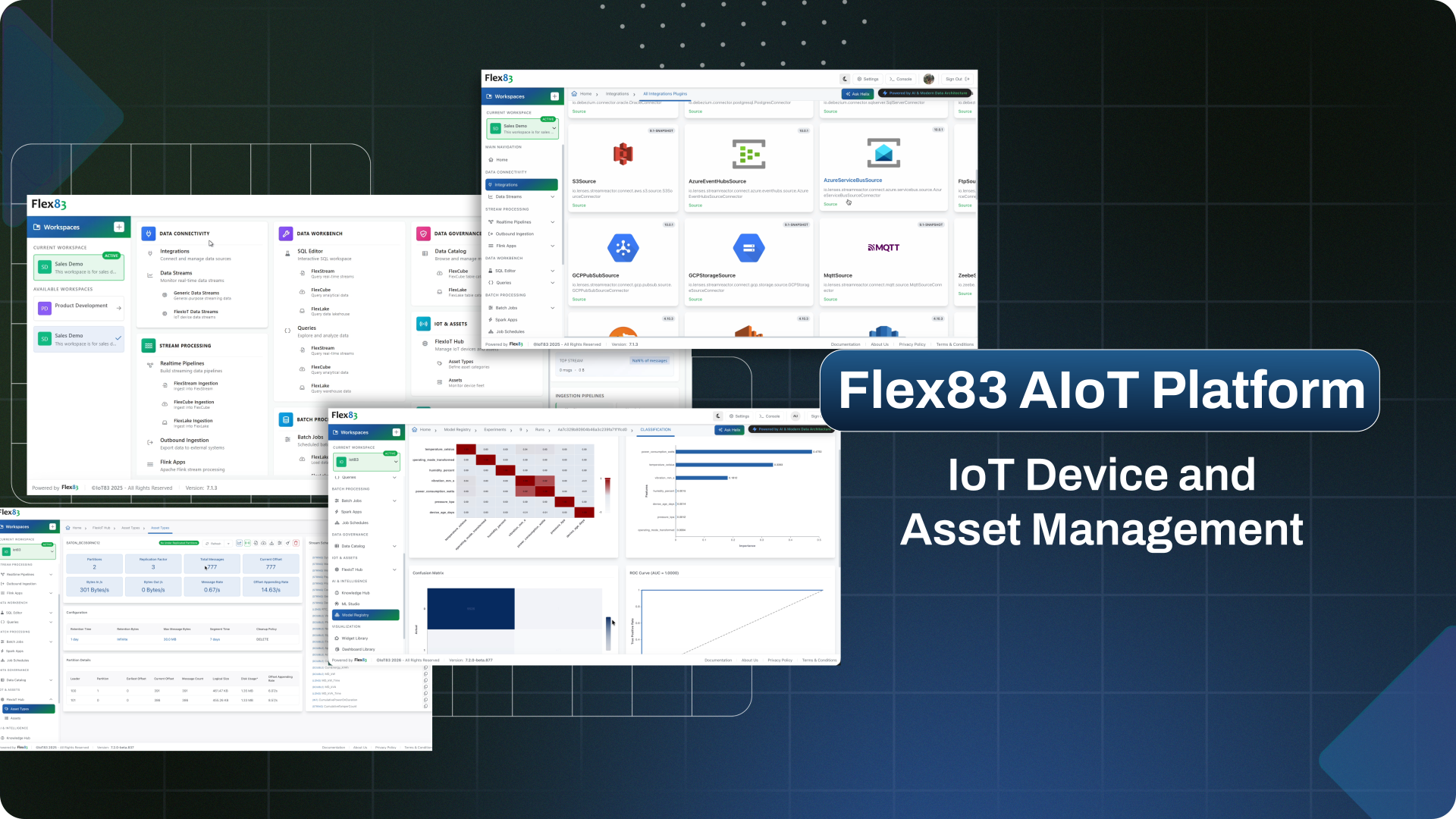
IoT Device & Asset Management Platform
Know every connected asset, down to its firmware
Register equipment, issue its credentials, map it to a site, and push over-the-air updates in waves you control, all from one record with Flex83.














Asset data is fragmented across the tools meant to manage it
Industrial operators, OEMs supporting an installed base, utilities, and facilities teams all hit the same ceiling as they move past a pilot. What worked for a handful of devices stops working somewhere in the first few thousand.
Visibility, access control, and firmware discipline degrade at the same point, and each one makes the others harder. Equipment you cannot locate is equipment you cannot secure, and it is usually the same equipment running a version nobody has tracked.
Fleets outgrow spreadsheets
As organizations move from pilot projects to thousands of devices across sites, manually tracking what is registered, where it lives, and whether it is online stops being viable.
Access gets harder to control at scale
Devices need credentials that can be issued, revoked, and rotated quickly, especially during incidents or maintenance windows, with no physical access to the hardware.
Firmware drifts across the fleet
Different devices end up running different versions, with no consistent, auditable way to push updates, verify what shipped, and stop a bad one before it spreads.
Govern the whole asset lifecycle from one record
Flex83 turns connected equipment into one governed record. FlexIoT Hub covers everything up to the point a unit is connected and placed, FlexIoT OTA covers everything after, and both write to the same record so nothing needs reconciling.
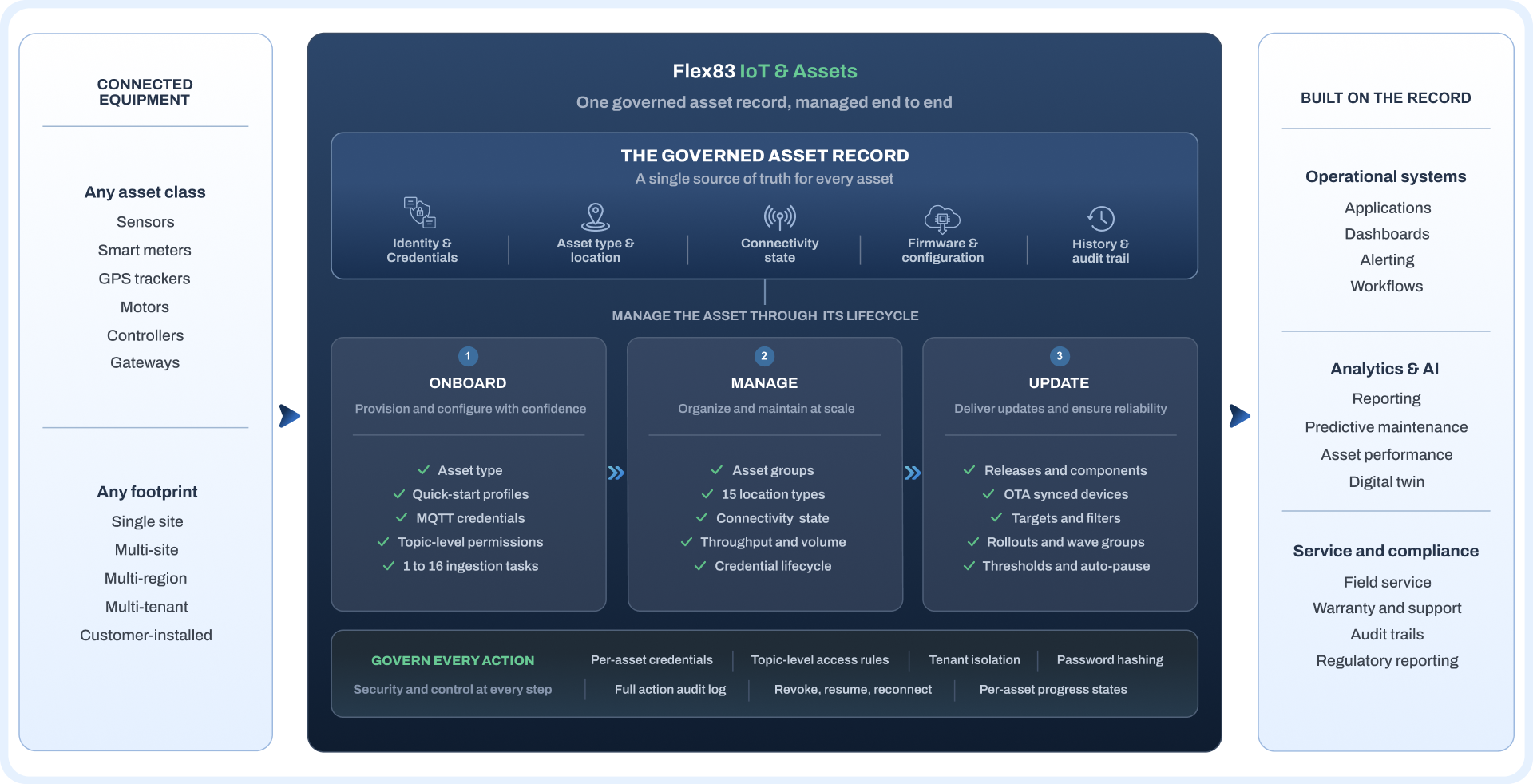
Take an asset from first registration to current firmware
8 things you can do with every connected asset you run, each shown with a working example rather than just described.
Onboard a class in one setup
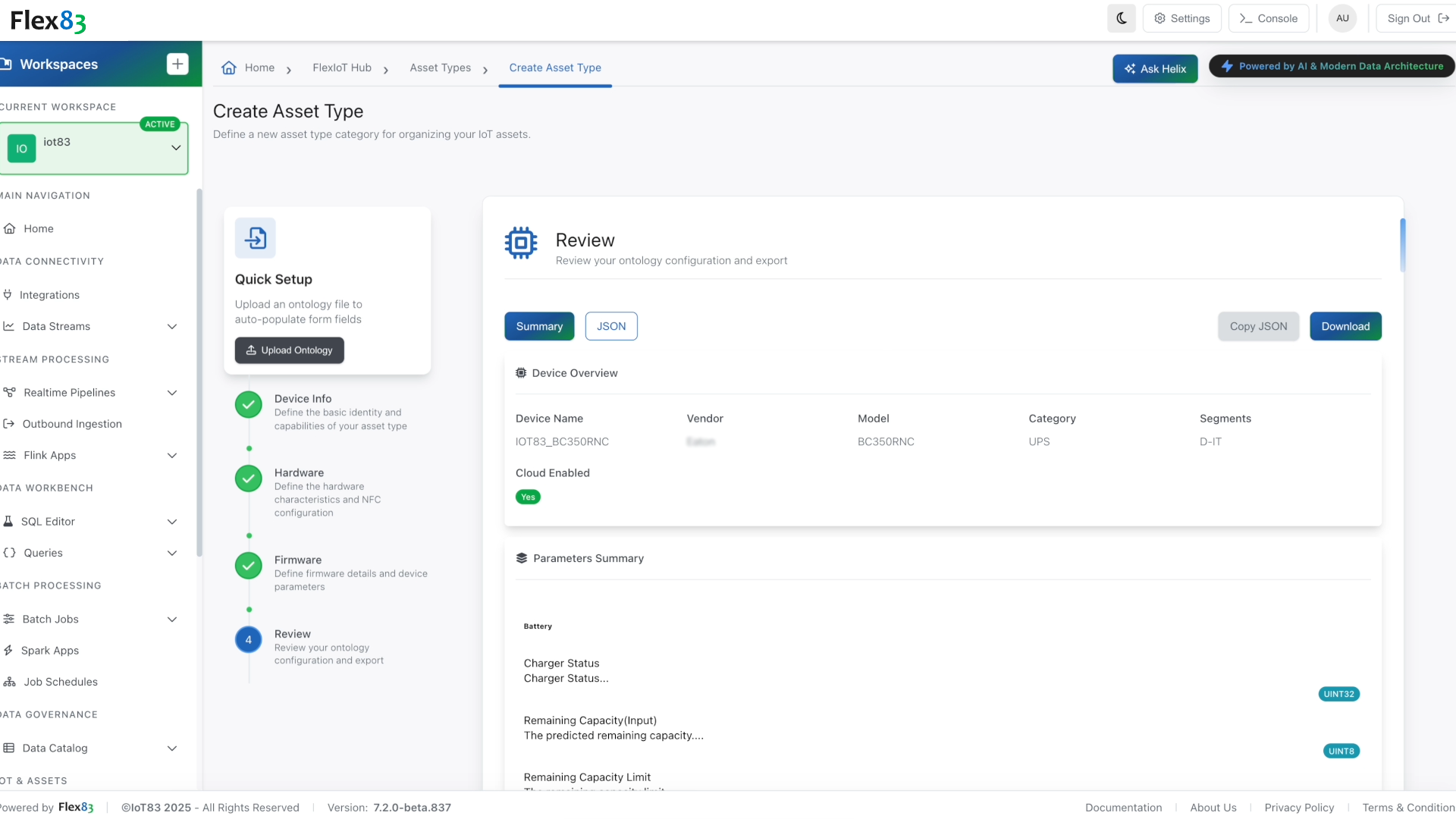
Configure a class once and every unit you add afterward arrives ready to work. An Asset Type holds the ingestion pattern, credential policy, and properties for that class, and scales ingestion from 1 to 16 parallel tasks as your volume grows.
Control access from anywhere
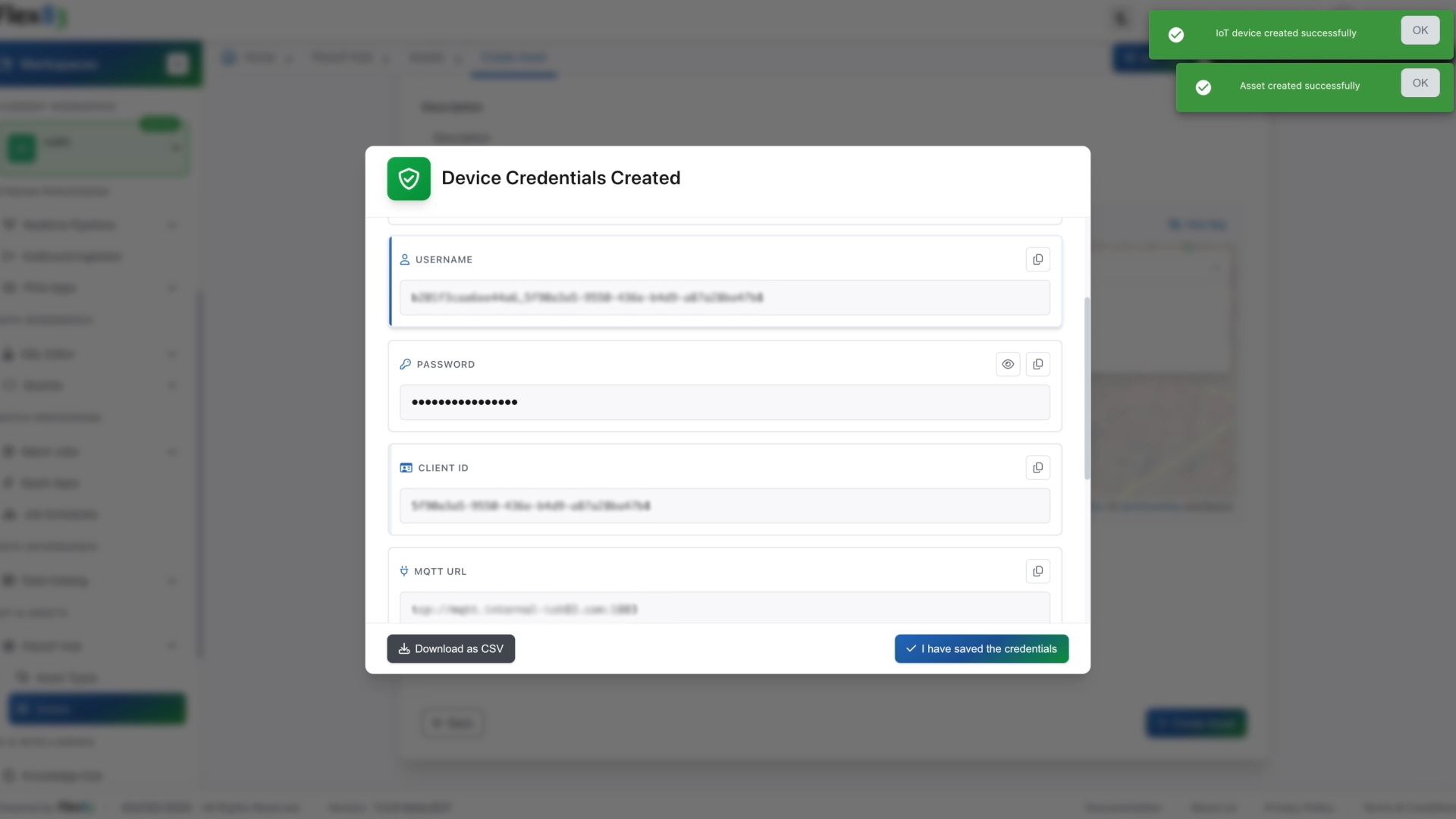
Grant or cut off access in seconds, wherever the equipment is installed. Registering an Asset generates its MQTT username, password, and client ID and scopes it to its own topics, so you can revoke, resume, reconnect, or remove it remotely.
Catch an outage the second it starts
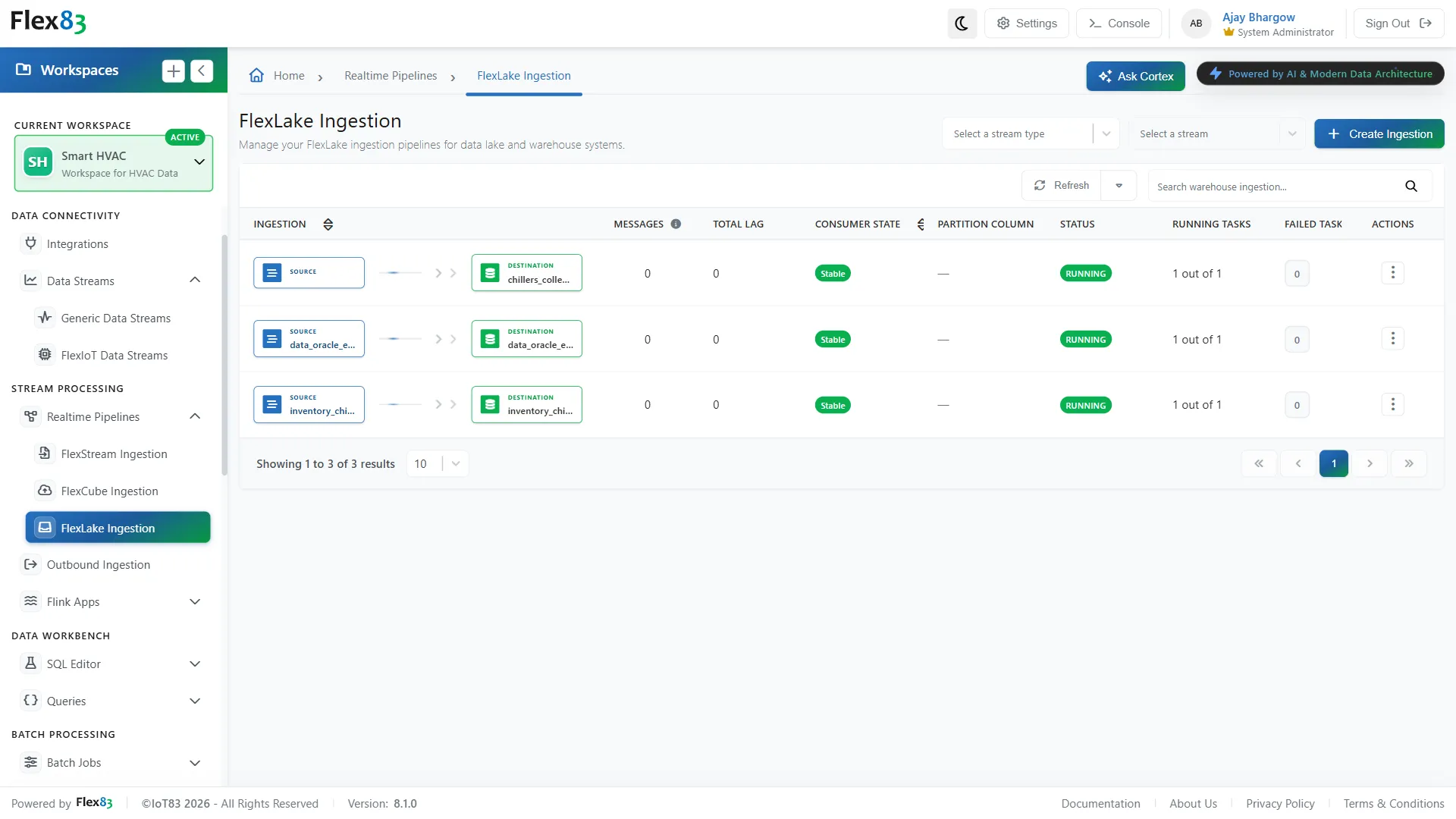
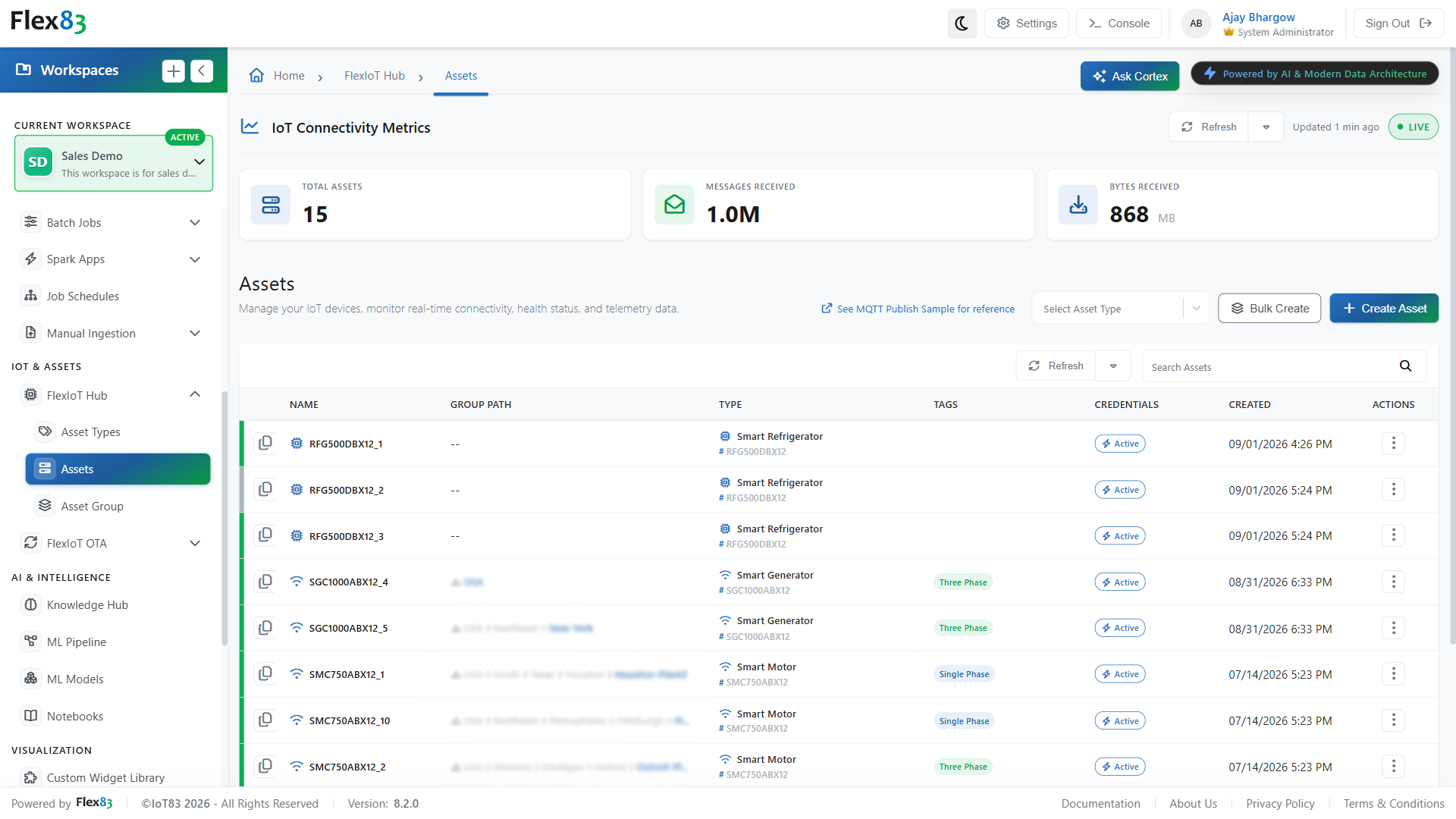
Learn that an asset has dropped while you can still act on it. FlexIoT Hub receives connect and disconnect events as they happen, and gives you live packet counts, byte volume, message counts, and a last-seen timestamp on anything quiet.

Pinpoint any asset across every site
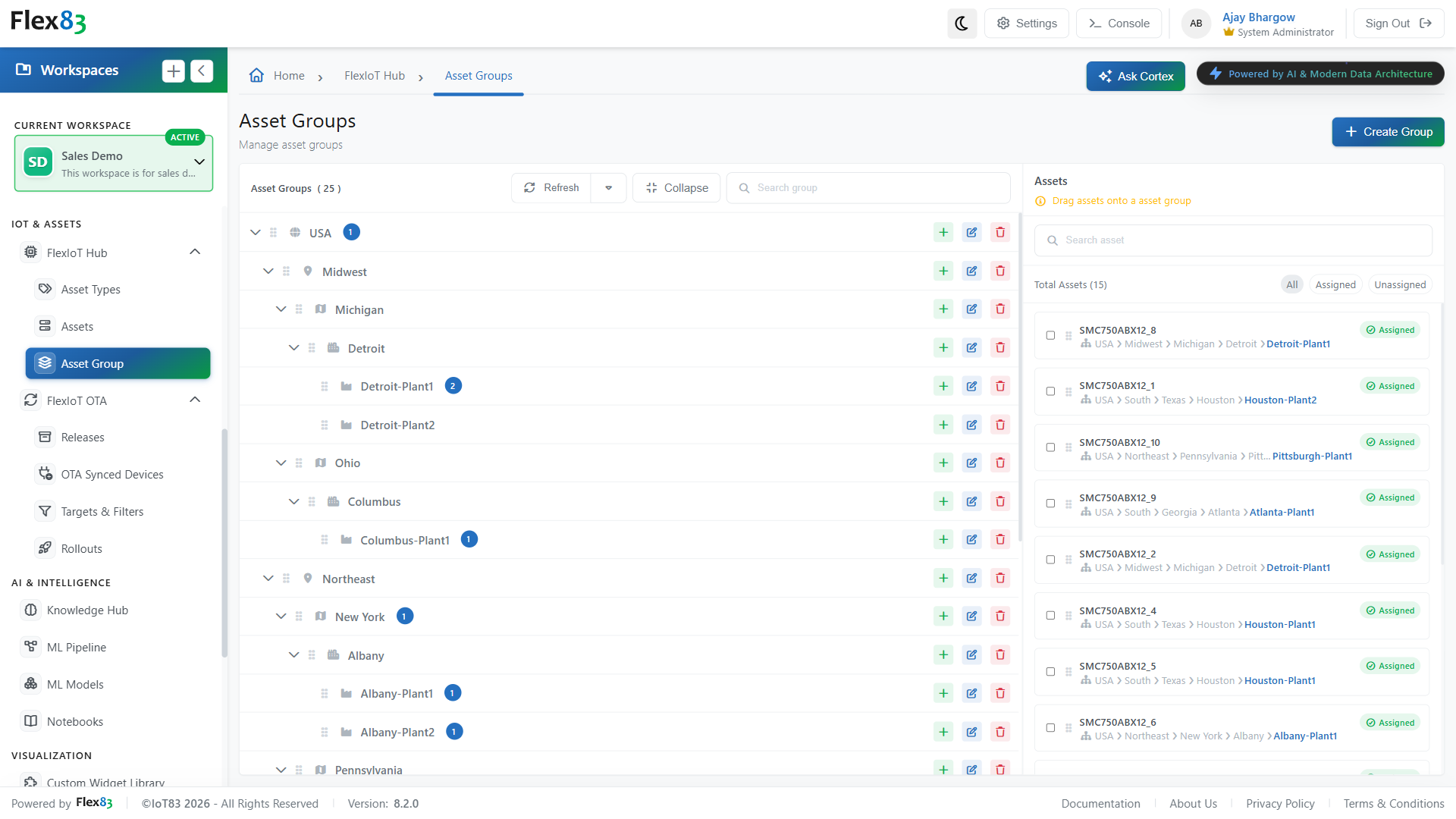
Locate equipment by where it physically sits rather than by memory. Asset Groups model place as a tree of fifteen predefined types, country down to room, and you can filter at any level to return everything beneath it.
Verify firmware before it ships
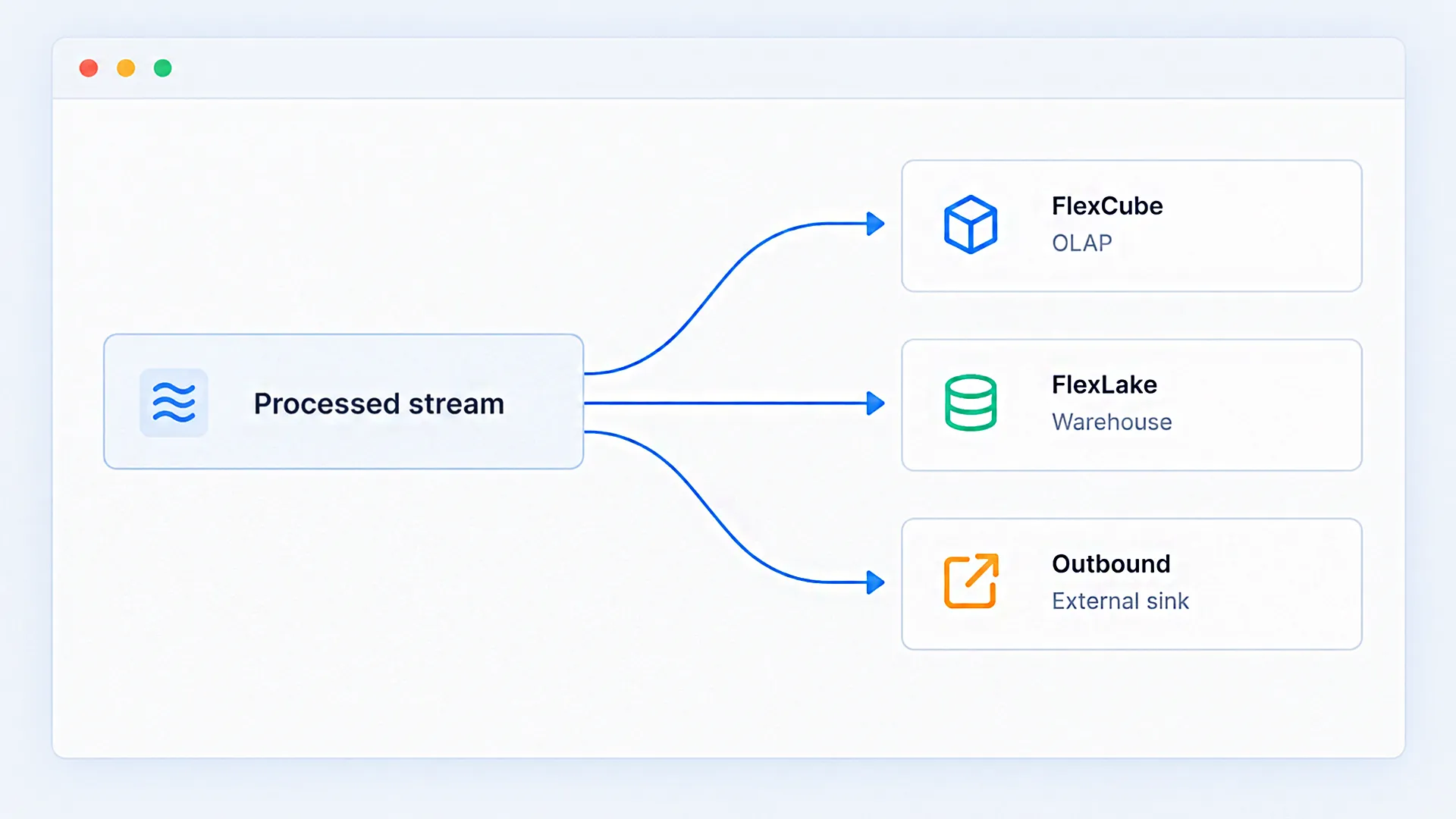
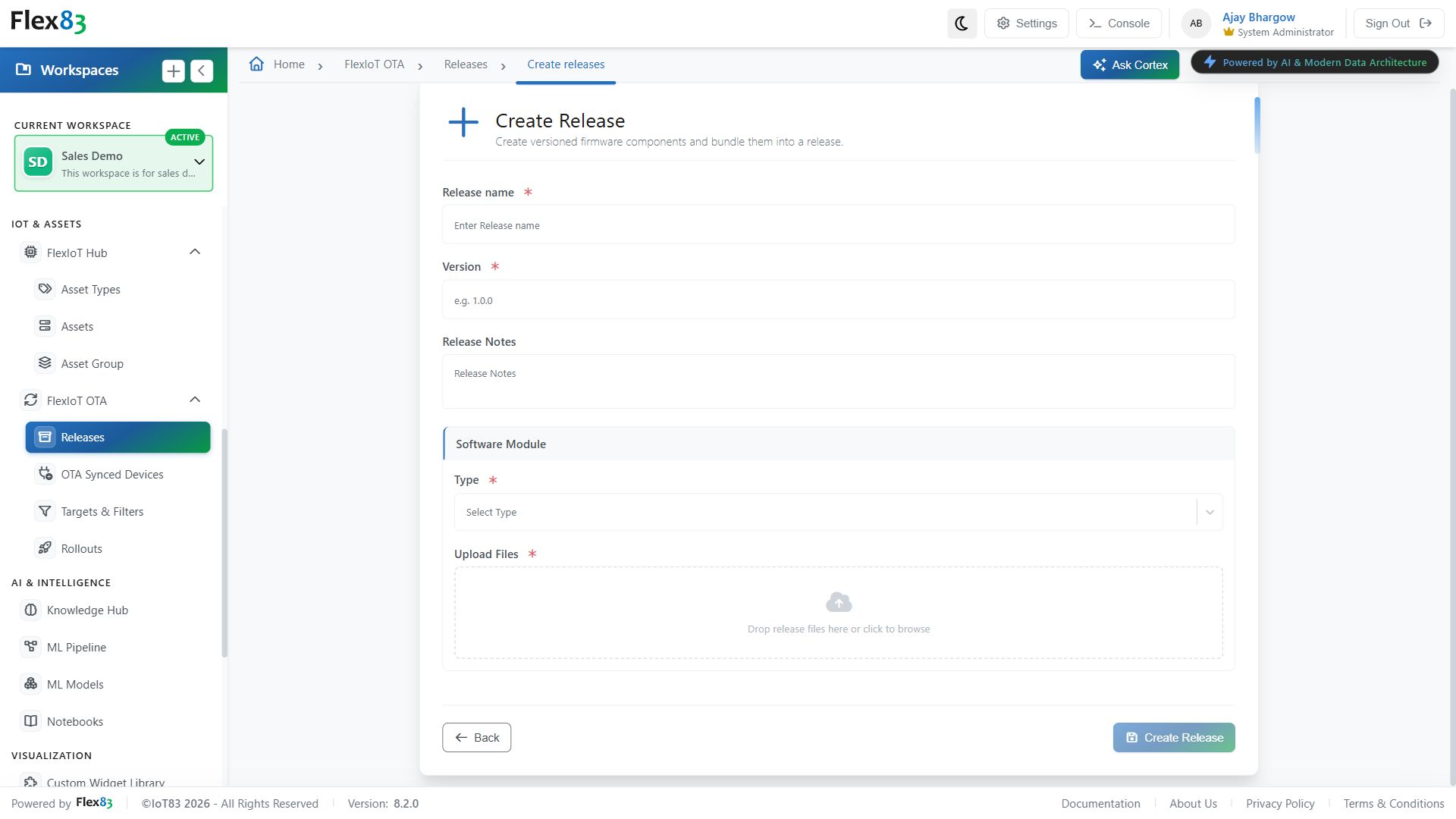
Ship only what has been proven complete. A Release bundles Components, each SHA256-verified on upload, and holds in Draft until every required file lands, so only a whole build ever becomes deployable.
Confirm scope before you ship
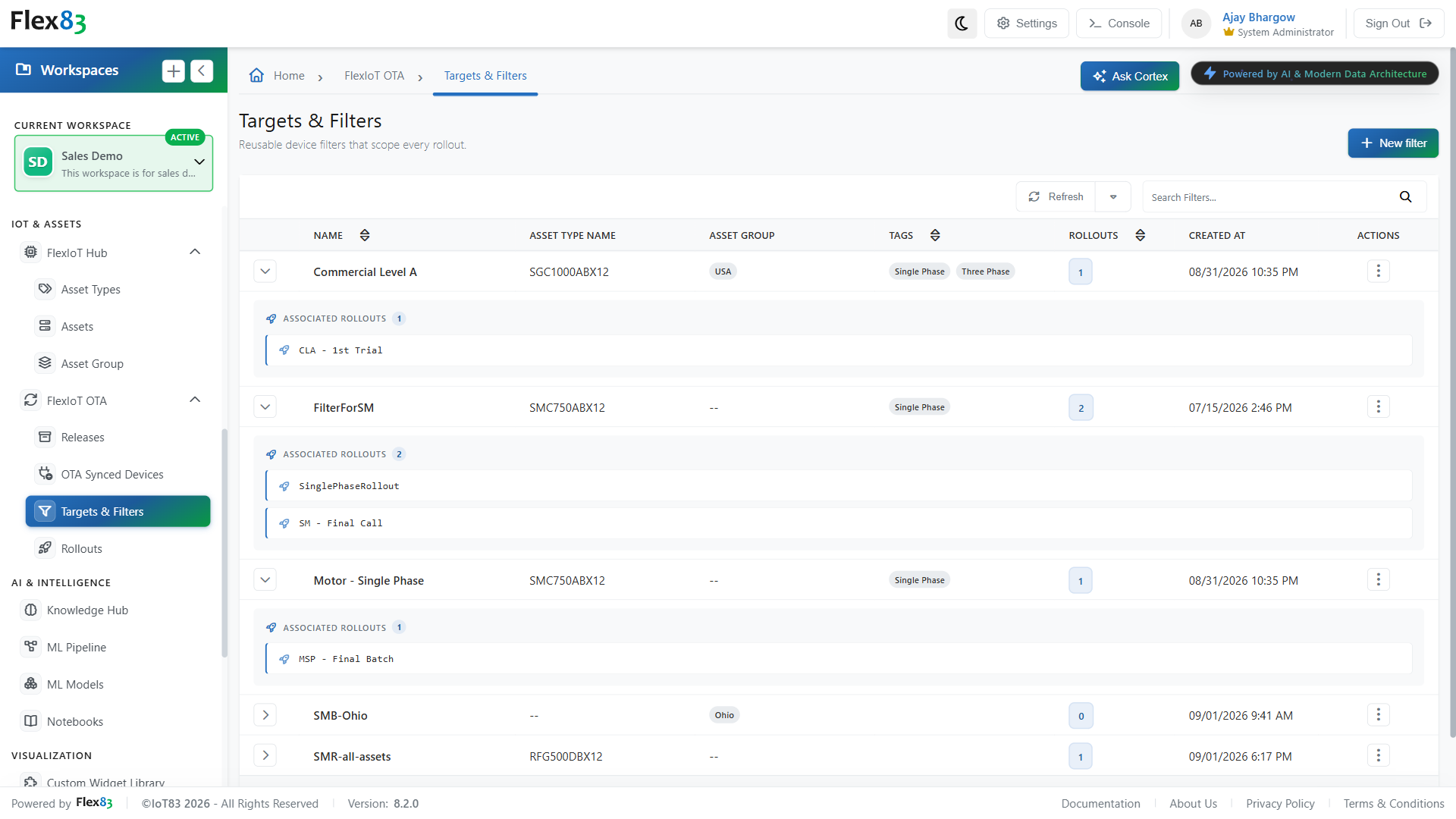
See the exact set of assets an update will reach before you launch it. Targets & Filters combines asset type with tags or groups and previews the matching count, and eligibility is limited to assets provisioned into OTA Synced Devices.
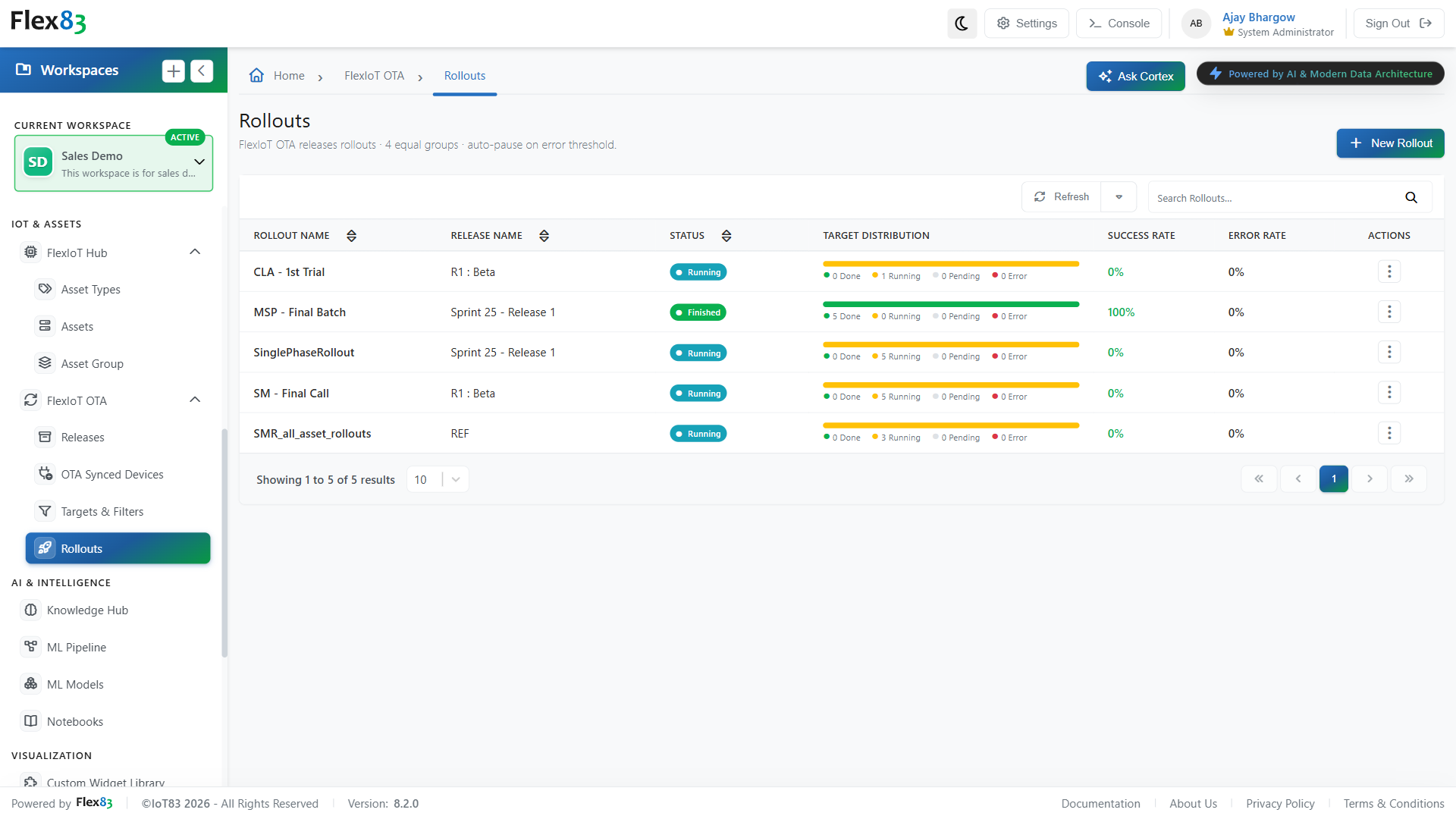
Contain a bad release to one wave
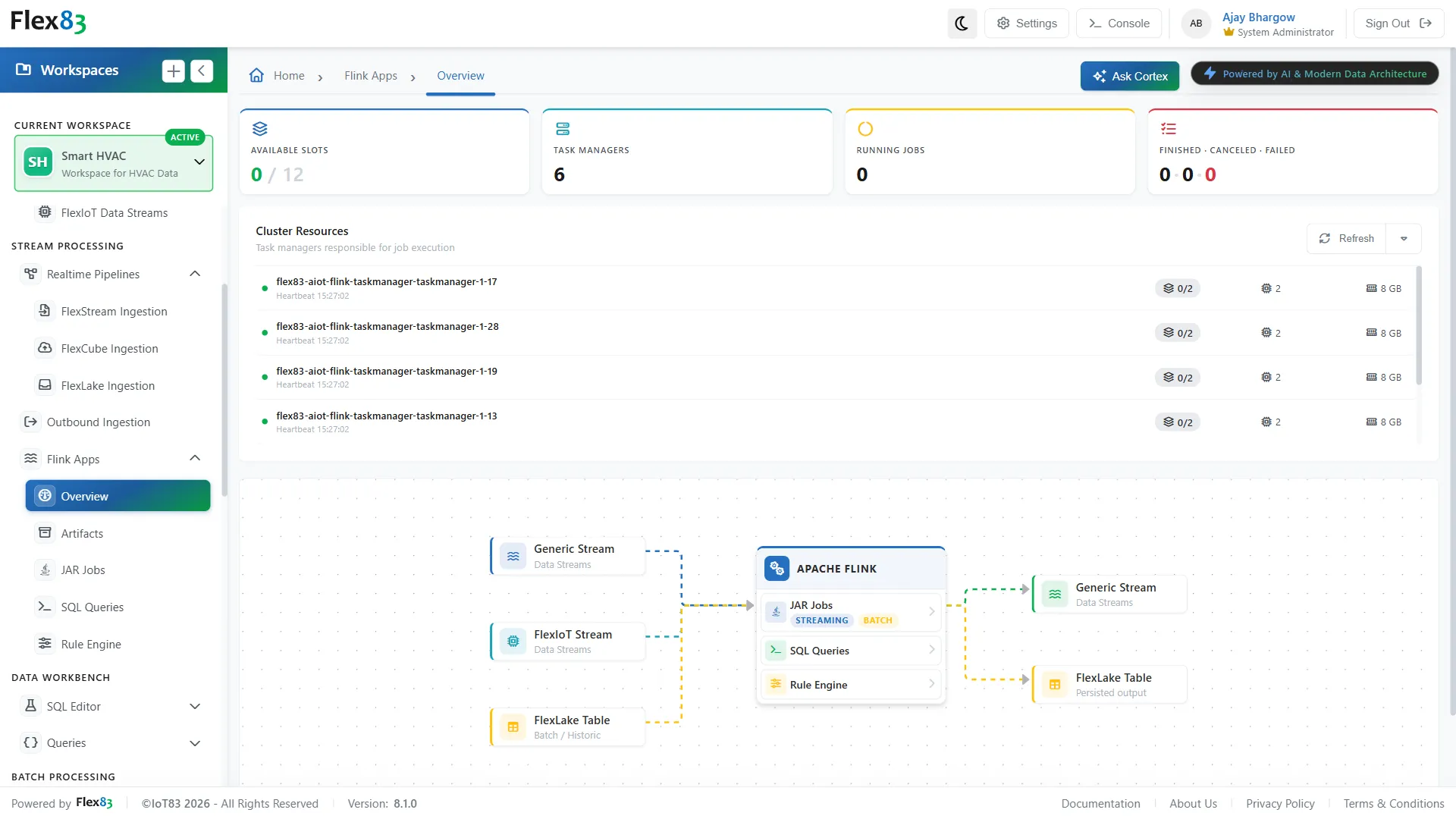
Limit how far a bad build can travel. A Rollout runs a published release in wave groups under thresholds you set in advance: clearing success advances the wave, and crossing the error threshold pauses the rollout for you.
Isolate tenants at the connection
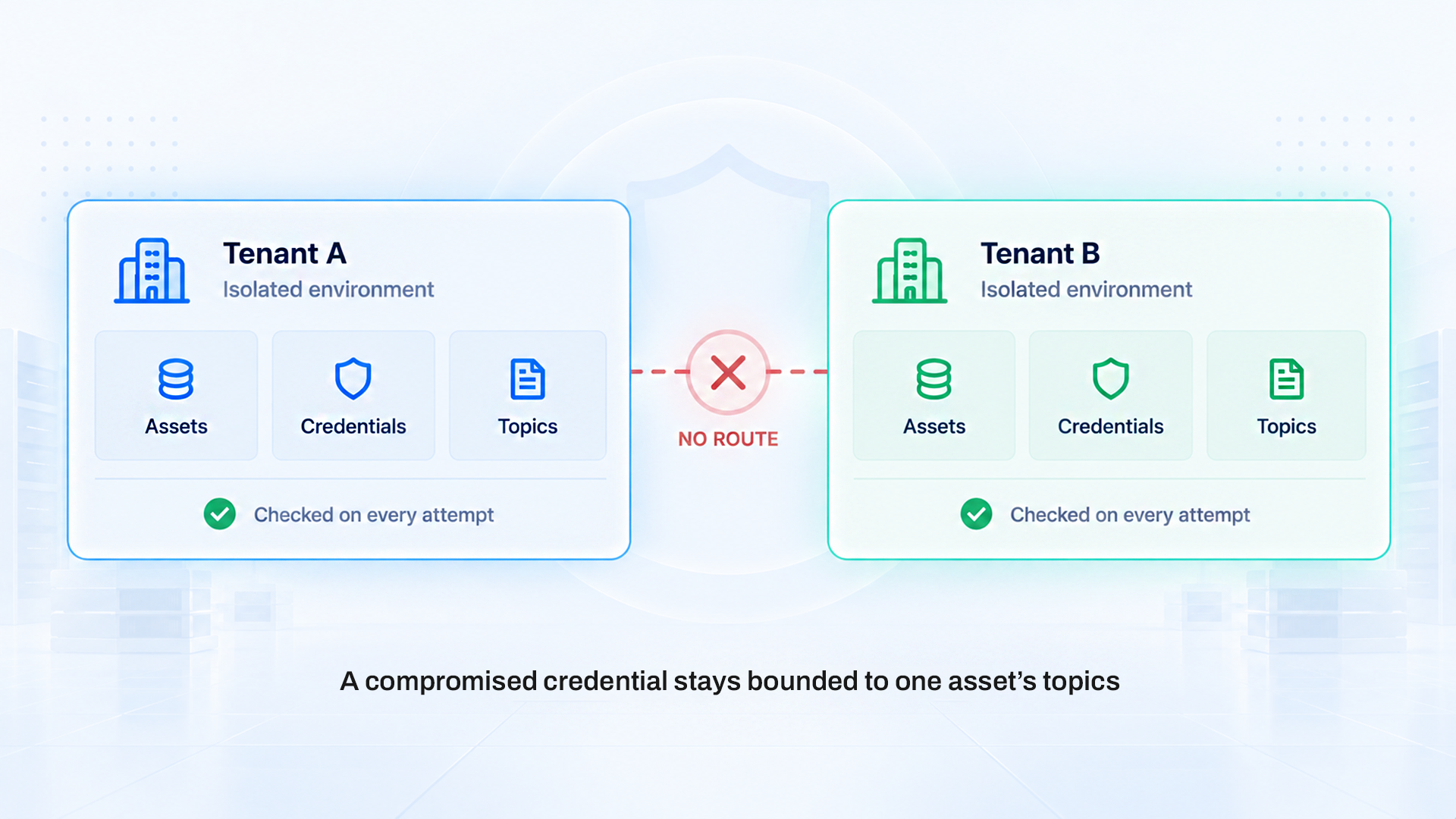
Run many customers on one platform and show that they stay apart. Flex83 enforces separation at the point an asset connects, so each tenant keeps its own assets, credentials, and data streams, with every channel request checked against its rules.
Turn fleet visibility into measurable uptime
Flex83 keeps registration, access, location, and firmware on one asset record, so the same source answers an incident, a site audit, and a rollout without anyone reconciling systems first.
Contained failure
A rollout runs in wave groups under thresholds you set in advance, so a bad build stops at the wave it started in. You fix it and resume rather than recovering every unit at once.
Onboarding that scales
Configure an asset type once and every unit registered under it inherits the ingestion pattern, credential policy, and properties. Adding a category becomes a configuration step rather than a project.
Immediate access control
Revoke a compromised credential and the live connection drops with it, with no ticket queue and no site visit. Resume issues a new password and leaves the access rules untouched.
Location that survives growth
One hierarchy covers a single building and a multi-country footprint using the same fifteen place types. Filtering at any level returns everything beneath it, so growth changes the depth rather than the model.
Cost held at scale
Endpoint growth adds records to the platform you already run rather than new systems to operate. Throughput scales inside an asset type instead of across parallel builds.
Faster delivery
Product lines share one registration, access, and firmware foundation rather than each rebuilding its own. New applications start from the asset record instead of from scratch.
Pick the job you need to run first
Every deployment runs on the same registration, access, location, and firmware model, so what differs is only where you start. Some teams begin by bringing a new equipment category online and scaling it past pilot. Others start by making units findable across sites and diagnosable without a visit, by shortening how long a compromised credential stays live, or by getting a firmware fix out in waves they control.
Bring a new equipment category online, then take it from pilot to production count.
Give operations a way to find equipment by where it physically sits, and diagnose an outage without a site visit.
Contain a suspected compromise in seconds, rotate credentials on your own schedule, and keep tenants provably apart.
Package a fix, confirm exactly what it will reach, and ship it in waves that stop themselves.
Why teams choose Flex83 over 4 separate tools
One write path, always current
Registration and firmware update the same asset record, so no sync job needs scheduling and no window opens during which the record disagrees with the equipment. A stitched stack is only as current as its last successful job.
Rollout safety comes with the platform
Wave groups, success and error thresholds, and automatic pause are how an update executes here. Assembled stacks hold that logic in a maintained script, which works until the maintainer moves on or an unplanned edge case arrives.
Growth adds records instead of migrations
An asset type carries its configuration to every unit registered under it, and the same hierarchy holds whether you run one building or forty. Growth adds records rather than triggering a migration.
Isolation you can prove per tenant
Separation is re-checked each time an asset opens a channel, so a shared platform never becomes a common blast radius. Multi-tenancy retrofitted through row filtering has to be re-proved for each new consumer of the data.
Proven across production deployments
See what changed for three teams running this in production.
4M+ asset records, 99.99% uptime
A global power management manufacturer replaced five parallel onboarding builds with one shared framework. Applications now ship three times faster across five product lines.
100K to 5M+ endpoints
A utility provider scaled fiftyfold while holding cost under $0.10 per asset per month, with no architecture rewrite along the way.
99.95% uptime, sub-2s response
An industrial group running 50+ businesses moved from no consolidated visibility to one source of truth, with automated disconnection alerts.
Frequently Asked Questions
What is IoT device and asset management?
It is the layer that registers connected equipment, controls what that equipment is allowed to do, records where it physically sits, and keeps its firmware current. Flex83 holds all four on a single asset record, so the four never have to be reconciled with each other.
How do over-the-air firmware updates work in Flex83?
An update begins as a release, a versioned package whose files are each SHA256-verified before anything can deploy. Only assets that have been provisioned and reached a synced state are eligible. The rollout then runs in wave groups against your chosen target, advancing on success and halting itself if failures pass the limit you set.
How does IoT data ingestion work in Flex83?
Each asset type can carry a data connector that subscribes to every asset in that category and converts incoming MQTT messages into structured records for stream processing. The platform parses the topic to extract tenant, asset type, and asset identifiers, so downstream consumers receive a consistent shape regardless of payload variation. Ingestion runs from 1 to 16 parallel tasks per category.
Does Flex83 need an agent installed on the device?
No agent is required for device and asset management. Assets poll the update service themselves over an authenticated connection using their own security token, so firmware is pulled rather than pushed. Flex83's Flex Edge Agent belongs to the separate IoT Edge connectivity layer.
How do you organize IoT assets by location?
Flex83 uses asset groups, a hierarchy of fifteen predefined place types spanning national down to individual rooms. Each asset belongs to exactly one group, filtering at any level returns everything beneath it, and removing a location leaves its assets intact as unassigned.
Can IoT device credentials be revoked remotely?
Yes, and no site visit is involved. Revoking ends the live session at once and holds the asset out until you resume it, at which point a fresh password is issued and existing permissions carry over. Removal clears the record and its access in one action.
Is Flex83 a multi-tenant IoT platform?
Yes. Separation is evaluated where the connection is established rather than filtered in the interface, so a shared platform does not become a shared exposure. Each tenant also keeps its own categories, groups, and audit trail.
Get complete visibility and control over every asset
Register what you already run, then secure, locate, and update it from one place. Bring your asset count, site list, and firmware history, and we will map the record against them.