Data Connectivity
The connectivity layer for industrial and enterprise data
Connect any data source from IoT devices, enterprise systems, SaaS APIs, and databases through protocol-agnostic ingestion with Flex83.
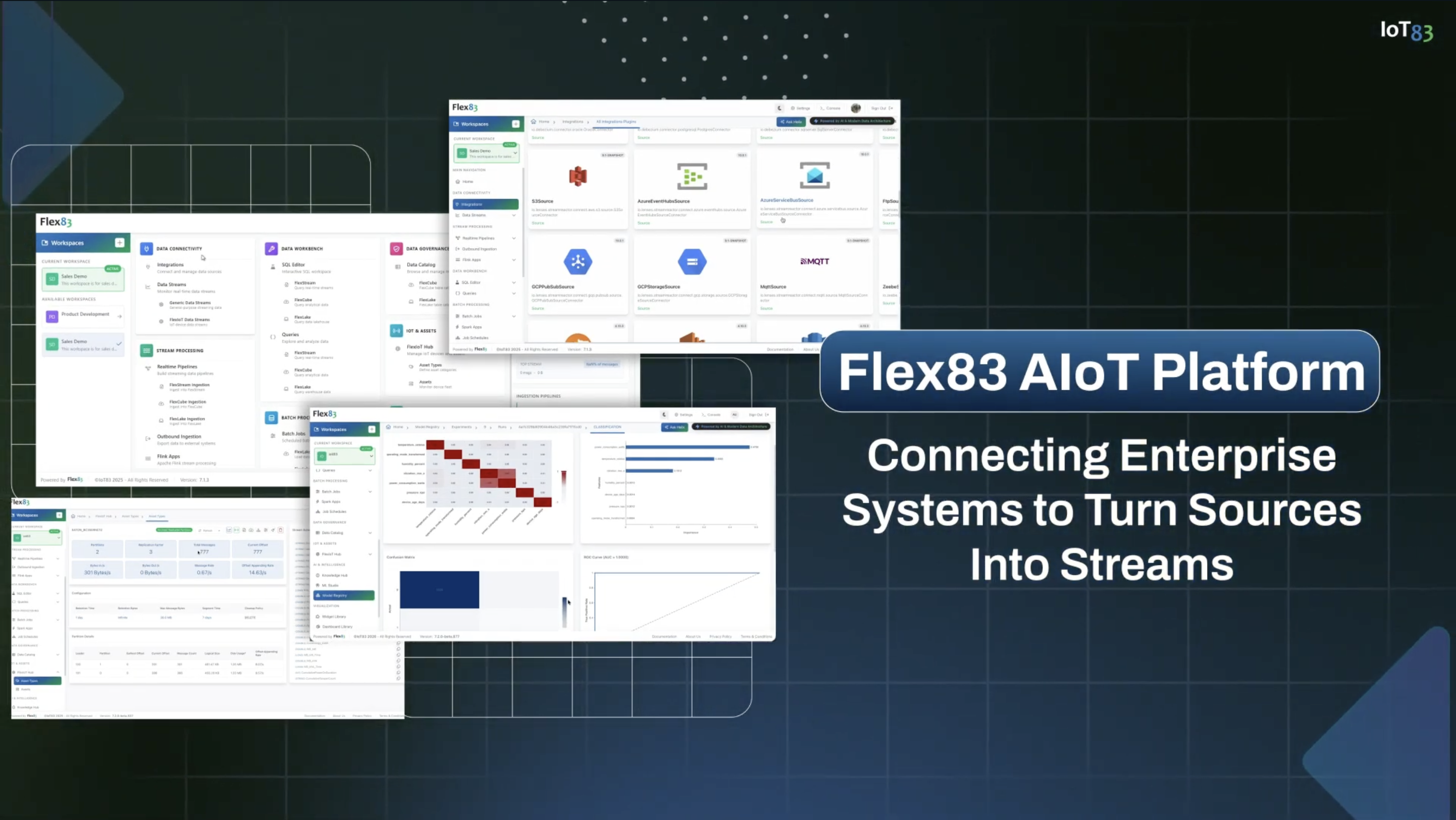
















Operational data is spread across systems that were never designed to work as one
Machines and control systems generate equipment data, IoT devices add telemetry, while ERP, MES, CRM, databases, and SaaS applications provide the business context around it.
Each source brings its own protocol, format, and integration requirements. As more systems are added, point-to-point connections multiply, making data harder to move, manage, and trust.
Different protocols
Plant-floor and enterprise systems expose data through different communication methods and interfaces.
Different source types
Operational, IoT, enterprise, and application data need to enter the same environment.
Growing integration footprint
As sources increase, so does the effort required to configure and manage their connections.
Data connectivity is the layer that brings the environment together
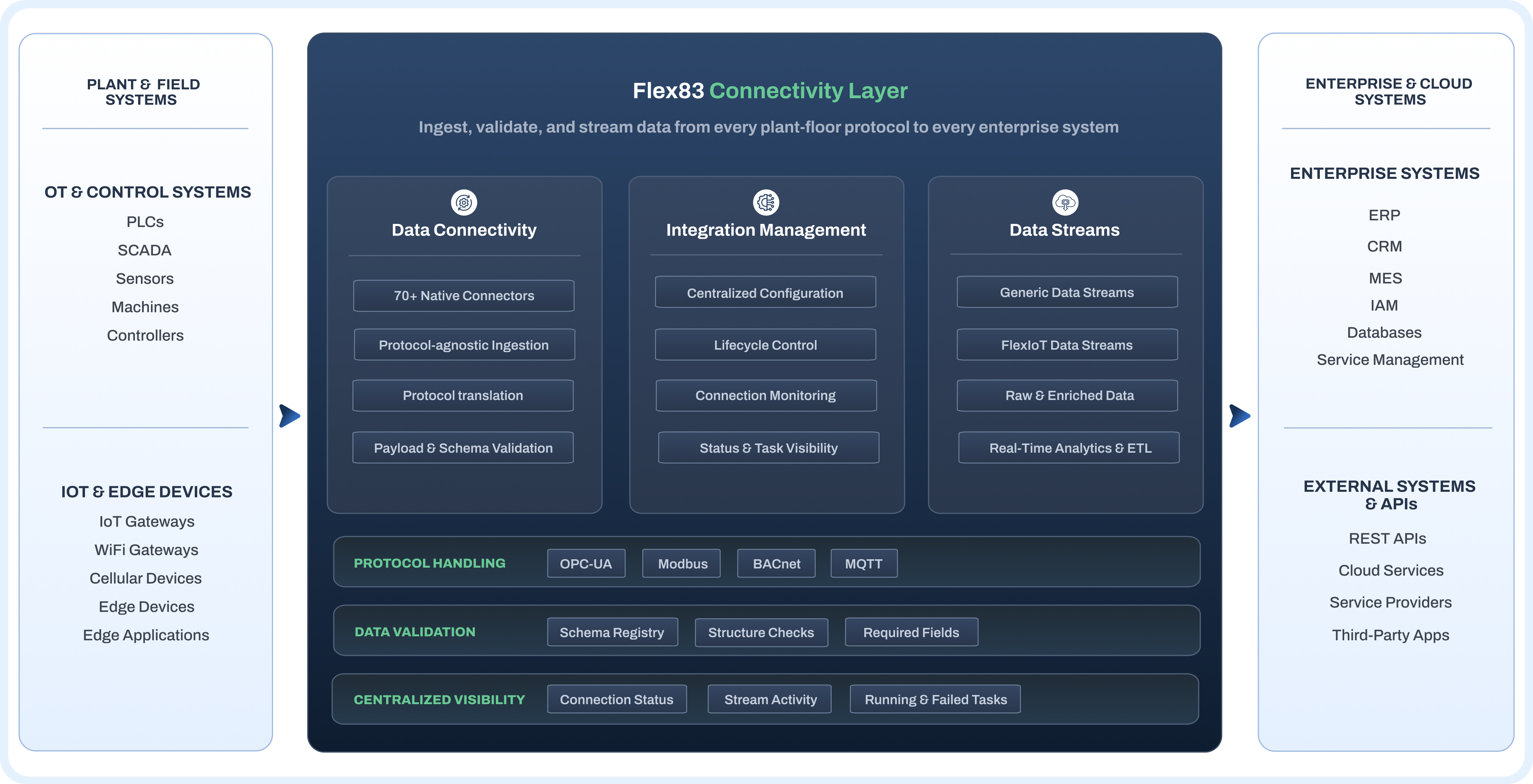
With 70+ built-in connectors, Flex83 sits between your plant-floor systems and your enterprise and cloud systems as one connectivity layer. Connect, translate, validate, and stream data without a separate integration approach for every source.
Available data source connectors
Connect the systems your data already lives in. Filter by type or search by name to check a specific source. 70+ connectors available in Flex83, including protocols and generic REST, file, and JDBC sources.





Cannot find your system?
Tell us what you need to connect. We will confirm whether it is covered by an existing connector, a supported protocol, or an API integration.
Add a connectivity layer, not a new stack
Flex83 sits alongside the plant-floor and enterprise tools already in place, so nothing needs to be replaced to get connected.
Please refer to the animation/infographic in HTML file.
Validate payloads before processing
Define expected data structures and check incoming payloads against them.
"asset_id": "SMC750ABX12",
"temperature": 21.4,
"timestamp": "2026-08-17T12:00:00Z"
}
Keep incoming data aligned to expected structures
Schema validation gives teams a defined contract for the payloads entering the data environment.
Turn connected sources into data you can trust and track
Validate payloads, control integrations, and follow every stream from one environment
Configure, manage, and inspect connections
Keep connection setup and lifecycle management in one place instead of managing each integration separately.
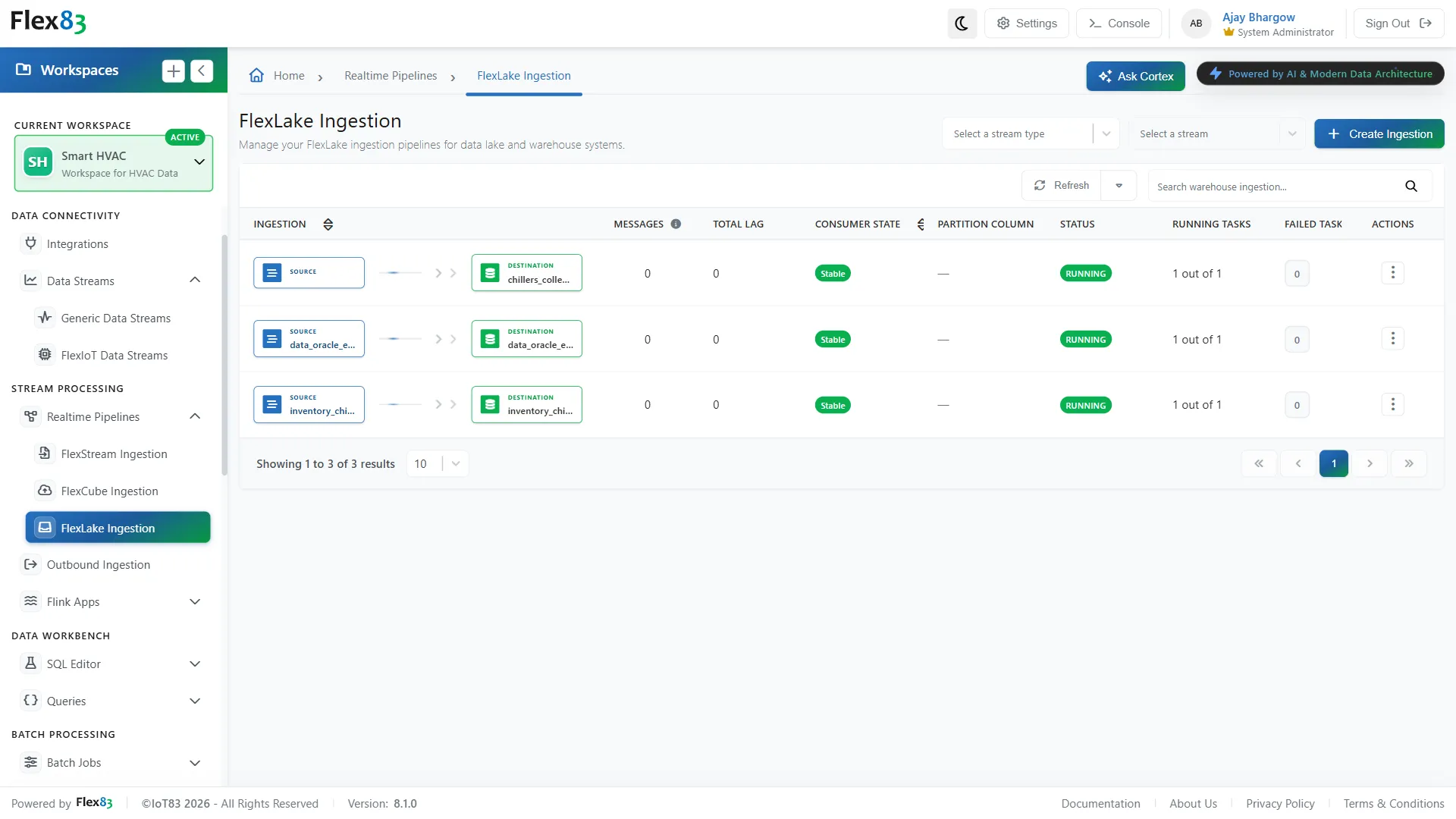

Once connected, data becomes a stream you can manage
Flex83 provides two stream views for real-time analytics and ETL: Generic Data Streams from integrations and FlexIoT Data Streams from FlexIoT devices.
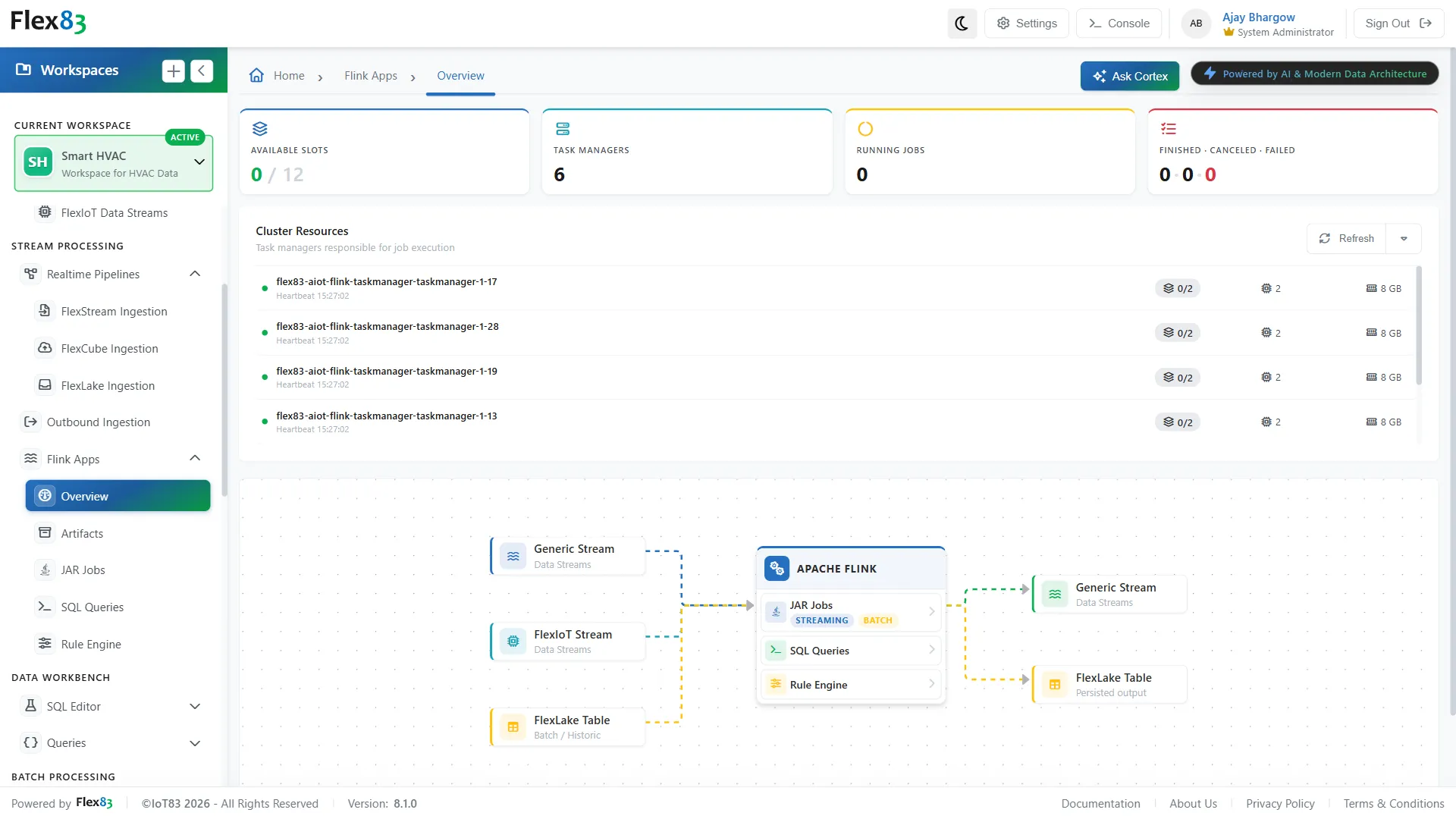
Follow device data from raw to enriched
Manage FlexIoT streams from raw data to enriched data and inspect real-time stream activity from connected FlexIoT devices.

Why Flex83 for data connectivity?
Four reasons teams run their connectivity through Flex83. Select one to see what it covers.
70+ connectors, one connectivity layer
Onboard supported data sources through protocol-agnostic ingestion, with protocol translation handled at the connectivity layer instead of per integration.
Every connection configured from one interface
The Integrations module is where connections are set up, controlled through their lifecycle, and monitored, so managing them does not move between tools.
Connected data becomes a stream you can watch
Generic Data Streams from integrations and FlexIoT Data Streams from connected devices both feed real-time analytics and ETL from the same environment.
The same layer holds as you scale
New sources connect through the connectivity layer already in place, so adding one does not mean adding a new integration approach beside it.
Proven at production scale
Flex83 is the connectivity layer behind production deployments running at carrier-grade scale.
65M+ connected devices
An OEM building AI-enabled products needed one platform to unify device connectivity, data management, and AI/ML, rather than stitching together disconnected tools for every stage from model development to edge deployment. Flex83 now supports its platform at a carrier-grade scale of 65M+ connected devices.
40,000+ files processed daily
A global telecom provider was capped at 5,000 to 7,000 geospatial network files a day, leaving hardware underused and costs climbing. Flex83 restructured the ingestion pipeline to process 40,000+ files daily, reaching the goal in a third of the expected project time.
5M+ connected endpoints
A power and utilities provider needed to scale assets, users, integrations, and analytics together without re-platforming every time it grew. Flex83's unified data foundation now supports 5M+ connected endpoints at a predictable cost of under $0.10 per asset, per month.
Frequently Asked Questions
What types of systems can Flex83 connect to?
Flex83 connects to OT and control systems (PLCs, SCADA, sensors, machines), IoT and edge devices, enterprise systems (ERP, CRM, MES, databases), and external systems and APIs, all through 70+ built-in connectors.
How does Flex83 handle different protocols?
Flex83 translates protocols like Modbus, BACnet, and OPC-UA at the connectivity layer, so teams don't need to build separate translation logic for every connected system.
Does Flex83 validate data before it's processed?
Yes. A schema registry defines the expected payload structure, and incoming data is checked against it before moving into processing.
What's the difference between Generic Data Streams and FlexIoT Data Streams?
Generic Data Streams cover data delivered through integrations. FlexIoT Data Streams provide raw and enriched stream views generated by connected FlexIoT devices, including partitions, pipelines, and message rate.
How do I manage all of my integrations?
The Flex83 Integrations module lets you configure connections, manage their lifecycle (start, pause, restart, or delete), and monitor status and activity from a single interface.
Can Flex83 scale as we add more data sources?
Yes. New sources connect through the same connectivity layer instead of requiring a new integration approach for every system. That's the same architecture behind Flex83 deployments scaled to 65M+ connected devices and 5M+ endpoints in production.
Let's bring your data together
Connect the systems you already have and create a stronger foundation.
.jpg)