Ship a predictive maintenance pipeline — end to end.
PdM needs ingest, contextualization, time-series storage, model training on failure data, real-time scoring, and operator workflows. Most teams ship the model but never the pipeline. Flex83 ships every layer — from sensor to work order — on one platform.
The PdM demo is one model. The PdM product is six systems.
A working anomaly model is the easy part. The product is the ingest pipeline, the asset model, the real-time scorer, the alarm router, the operator workflow, and the work-order integration — all wired together and operated 24/7.
$260K
Discrete manufacturers lose $260K an hour to unplanned downtime. PdM only pays back if the pipeline actually triggers work before the failure.
70%
McKinsey’s Industry 4.0 survey reports 70% of pilots fail to scale. Most stall at the integration layer between the model and the operator workflow.
6 systems
Ingest + asset model + storage + ML + alarms + operator workflow — each from a different vendor or repo. Operating six systems together is what kills the project.
The full PdM stack — from sensor to work order — on one platform.
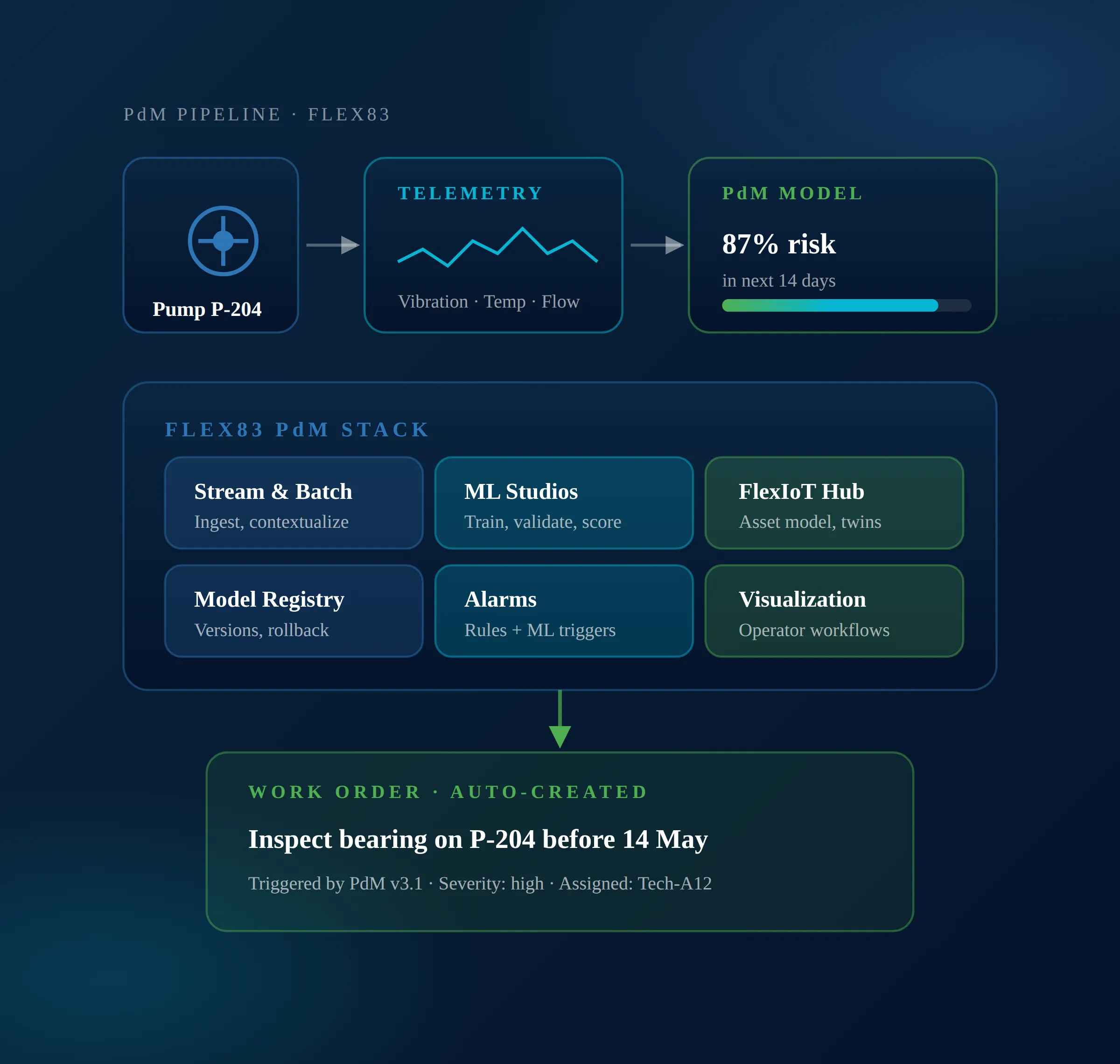
Flex83 ships every capability a production PdM pipeline needs. Stream and batch ingestion feed the asset model. ML Studios trains failure-prediction models on historical telemetry. Model Registry promotes them into production scoring. Alarms route triggers into your operator and CMMS workflows.
Your team owns the model and the workflow. Flex83 owns the pipeline that connects them.
Real-time scoring against the model on every sensor reading.
Train on years of historical telemetry and failure history.
Train, validate, and tune PdM models on Flex83-managed clusters.
Promote, A/B, and roll back PdM models in production safely.
Asset hierarchies, twins, and identity for every piece of equipment.
Trigger work orders, dispatch, and notifications into your CMMS.
From vibration spike to work order — in one pipeline.
A reference architecture for shipping production-grade predictive maintenance on Flex83.
Stream sensor telemetry from PLCs, gateways, and historians.
Map raw readings to assets, sites, and process hierarchies.
ML Studios trains failure-prediction models on labeled history.
Real-time scoring of every reading against the registered model.
Alarms create work orders and notify operators in their CMMS.
PdM stops being a pilot and becomes a product.
Three things that change when the full pipeline ships as one platform.
Catch failures days before they happen
Real-time scoring against years of failure history means PdM triggers work orders before vibration, temperature, or flow drift becomes a breakdown.
Close the loop with operators
Models that don’t trigger workflows are wallpaper. Flex83 sends triggers directly into your CMMS, your dispatch tool, or your operator dashboard.
One pipeline, every asset class
Pumps, compressors, motors, conveyors — same pipeline, different asset type. Define the asset once; the rest is configuration, not code.
Branded dashboards at telecom scale.
Devices on PdM pipelines in production today
Edge inference for assets requiring local scoring
Headline outcome powered end-to-end on Flex83
Ingest, contextualize, train, score, and trigger — no integrations
Stop demoing models. Start shipping PdM products.
Talk to a Flex83 platform expert about your PdM roadmap. We’ll map your asset hierarchy, walk you through the reference pipeline, and show what a production-ready PdM product looks like in 8–12 weeks.