From Edge to Cloud: How Flex83's Unified AIoT Platform Connects Industrial Operations


Industrial companies have invested years in connecting equipment and collecting operational data. Yet collecting data and using it to improve operations remain two different challenges.
Production equipment generates telemetry, sensors report operating conditions, and enterprise systems hold maintenance records and service histories. The challenge is connecting these sources so industrial teams can use their data across monitoring, analytics, and digital services.
Research found that manufacturers use only 43% of the data they collect effectively. This highlights the gap between data collection and operational value.
Closing that gap requires more than connecting equipment to the cloud. Data must move across different devices, networks, and systems while retaining the context applications need. The architecture must also accommodate new equipment and sites without requiring engineering teams to rebuild integrations for every deployment.
Industrial edge-to-cloud connectivity provides the foundation for this flow. Flex83 brings device management, data ingestion, processing, storage, and application connectivity together in one AIoT platform, helping industrial organizations establish a shared foundation for connected operations.
What Is Industrial Edge-to-Cloud Connectivity?
Industrial edge-to-cloud connectivity links equipment and operational systems to the platforms that process, store, and use their data.
The edge includes sensors, programmable logic controllers (PLCs), machines, and gateways. Cloud and platform services provide data processing, storage, governance, and application integration.
A complete architecture brings together four capabilities:
- Edge integration: Connects equipment and establishes device identity and communication.
- Data connectivity: Moves information between devices, operational systems, and cloud services.
- Data processing and governance: Structures information and makes it available to authorized applications.
- Application and AI integration: Supplies processed data for monitoring, analytics, and machine learning.
These capabilities must work together. A device can transmit telemetry successfully without making its data ready for analysis. A unified edge-to-cloud architecture connects the stages so applications can access information with the context and structure they require.
Why Industrial Operations Need a Unified Architecture
Addressing these challenges requires a unified architecture that connects industrial systems, data, and applications.
Connecting diverse industrial equipment
Manufacturing environments combine legacy PLCs, SCADA systems, modern sensors, and cloud-connected equipment. Each source may use different communication protocols and data structures.
An industrial IoT platform must accommodate this diversity and provide consistent ways to manage connected devices and their data. Otherwise, each additional equipment type introduces more integrations to develop and maintain.
Making industrial data reliable for AI
A study by KPMG found that 83% of surveyed technology leaders believed their organizations were building strong AI data foundations, while 76% still identified unreliable data as a top AI risk.
The findings highlight the importance of data quality alongside infrastructure investment. Industrial applications need reliable readings, asset context, and relevant operating history to support useful analysis.
Edge-to-cloud architecture connects the systems that collect, process, and govern this information before applications use it.
Reducing repeated integration work
Expanding an IoT pilot across sites or customer deployments introduces new device configurations, access requirements, processing workflows, and application integrations.
A shared architecture lets teams reuse established device-management policies, data pipelines, and integration patterns. This reduces duplicated engineering work while allowing deployment-specific requirements to remain distinct.
How Flex83 Connects Industrial Systems from Edge to Cloud
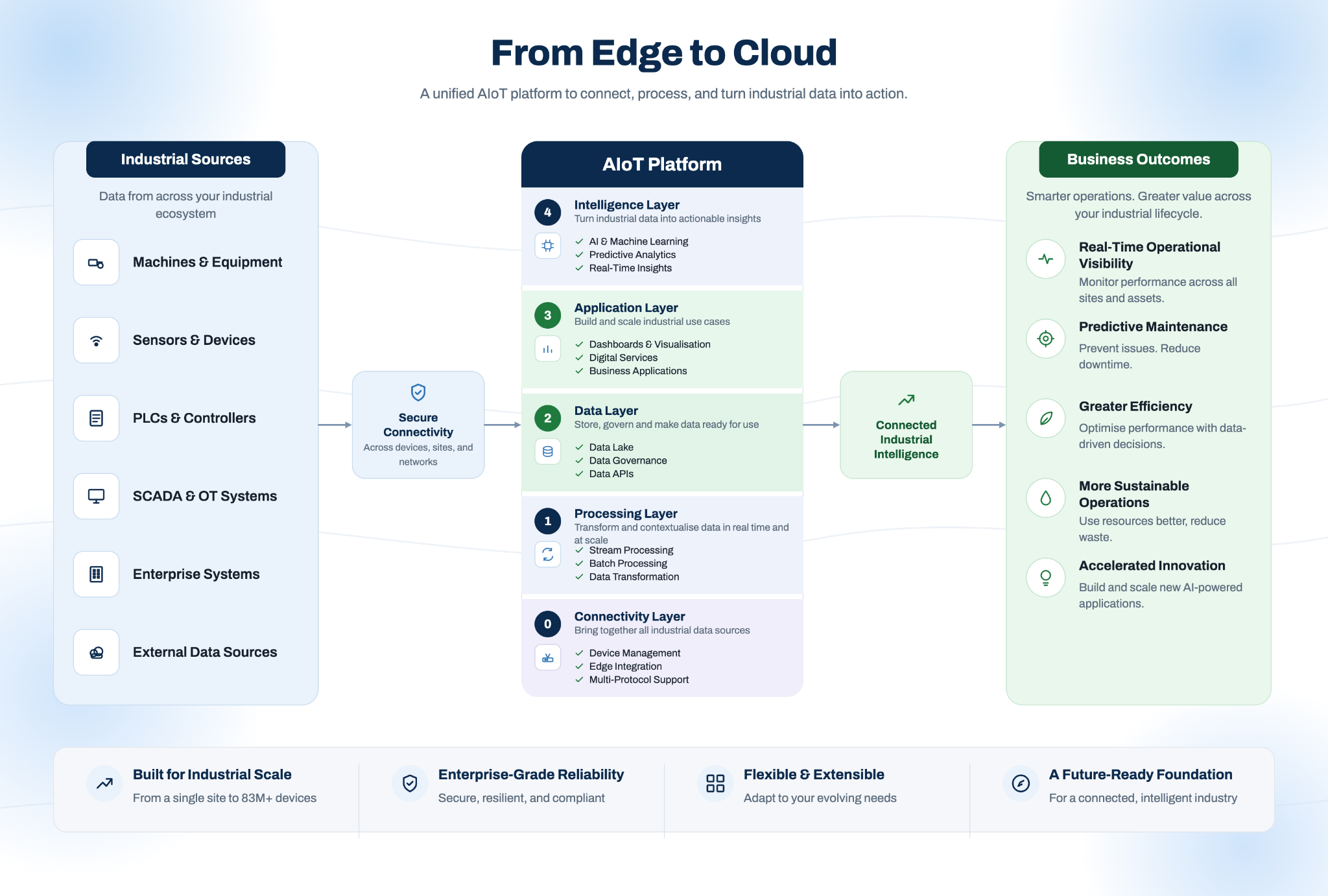
Flex83 connects industrial devices and existing data sources to shared processing, storage, and application services.
1. Connect and manage devices
Flex83's FlexIoT Hub provides device registration, MQTT credentials, communication authorization, and connectivity monitoring.
Devices can be grouped under asset types that define shared configuration, ingestion patterns, and credential policies. Asset Groups organize equipment by location, from sites and buildings to floors and rooms. Multi-tenant capabilities separate devices, credentials, and data streams across customers or business units.
These functions give teams a consistent way to onboard, organize, and monitor connected equipment.
2. Understand the role of an IoT agent
An IoT agent is software that manages communication between a device or gateway and an IoT platform. Depending on its implementation, it may collect telemetry, translate protocols, process data locally, or forward messages to cloud services.
Flex83 platform documents device registration, credential management, and connectivity monitoring through FlexIoT Hub. Local agent and gateway requirements depend on the equipment and communication architecture, so they should be evaluated separately.
3. Connect cloud and enterprise data
Industrial data also resides in databases, enterprise applications, and cloud services. Flex83's connectors support sources such as MQTT, MongoDB change data capture (CDC), Salesforce CDC, and Azure Event Hubs. Outbound connectors deliver processed data to supported destinations, including Amazon S3, MongoDB, and Elasticsearch.
Azure IoT Hub and Azure Event Hubs serve different purposes. Microsoft's Azure IoT Hub supports device management and bidirectional device communication. Azure Event Hubs provides event-streaming capabilities for high-volume data ingestion.
4. Process data through reusable pipelines
FlexStream Ingestion captures incoming messages, serializes them in AVRO format, and exposes pipeline metrics such as processing lag. Consumer statistics and data-lineage views help teams inspect message throughput and trace data from source streams to destination tables.
Realtime Pipelines support stream ingestion, Flink-based processing through custom applications or SQL, and rule evaluation.
For example, the Rule Engine can trigger an alarm when a temperature reading exceeds a configured threshold. Teams can combine conditions using AND and OR logic to support more complex rules.
These capabilities provide a consistent way to process incoming data and make it available to downstream applications.
5. Make data available to applications
Different industrial applications need different forms of data access. Flex83 supports these requirements through complementary services:
- FlexCube: Analytical storage for fast queries and dashboard workloads.
- FlexLake: Governed, long-term storage for historical analysis.
- Outbound Ingestion: Delivery of processed data to supported external systems.
- AI and machine learning capabilities: Access to data for supported analytics and model workflows.
A single data flow can support operational dashboards, historical analysis, external applications, and AI workflows. The applications and models built on top of this foundation determine the resulting operational outcomes.
Industrial Applications Supported by Edge-to-Cloud Connectivity
The effectiveness of each application depends on data quality, appropriate processing logic, and integration with operational workflows.
- Remote equipment monitoring: Device status and telemetry help teams monitor connected equipment across locations.
- Asset performance and condition monitoring: Telemetry, historical records, and configured rules provide a foundation for condition alerts and asset-performance applications.
- Connected products and digital services: Multi-tenant architecture helps OEMs manage connected products across customer environments while keeping device and data access separated.
- Industrial analytics and AI: Processed operational data supports analytics and machine learning workflows, including potential applications in anomaly detection, predictive maintenance, and process optimization.
What to Consider When Building an Industrial Edge-to-Cloud Architecture
Before selecting a platform, industrial teams should evaluate:
- Compatibility: Confirm support for required devices, protocols, and interfaces.
- Connectivity resilience: Understand buffering, retries, and behavior during network interruptions.
- Security: Evaluate device authentication, authorization, credential management, and tenant isolation.
- Data governance: Check schema management, source context, and access controls.
- Processing and storage: Match throughput, latency, retention, and query capabilities to application needs.
- Integration: Verify available connectors and identify where additional engineering is required.
Evaluating the complete data path helps teams understand how the architecture will operate across sites and applications.
Build Connected Industrial Applications with Flex83
Industrial edge-to-cloud connectivity creates the foundation for turning equipment data into information that applications can use. A unified AIoT architecture connects devices, data pipelines, storage, and applications while supporting the requirements of different industrial deployments.
Flex83’s combines device management through FlexIoT Hub, ingestion and processing through FlexStream Ingestion and Realtime Pipelines, and data services through FlexCube, FlexLake, and outbound connectors. These capabilities establish a foundation for connected products, equipment monitoring, and industrial analytics.
Our industrial deployments illustrate the value of reusable architecture. A global power management manufacturer established a shared digital foundation supporting more than four million records, with new applications shipping three times faster, while a utility provider expanded from 100,000 endpoints to more than five million while keeping total cost of ownership below $0.10 per asset per month.
Explore our unified AIoT platform and discuss your industrial connectivity requirements..
Frequently Asked Questions
1. What is edge-to-cloud connectivity in industrial IoT?
It’s the path data takes from a sensor, PLC, or controller at the edge to the platforms that process, govern, and serve it to applications in the cloud. On Flex83, that’s FlexIoT Hub, FlexStream Ingestion, and FlexCube and FlexLake, each carrying a piece of that flow.
2. How does an industrial IoT platform connect devices to the cloud?
Typically through device registration and credentialing paired with ingestion, processing, and storage. On Flex83, that’s FlexIoT Hub handling registration and MQTT credentials, FlexStream Ingestion and Realtime Pipelines carrying and processing the data, and FlexCube and FlexLake making it queryable once it lands.
3. Does Flex83 integrate with Azure IoT Hub?
Flex83’s Azure connector ingests from Azure Event Hubs, a different Microsoft service built for event streaming rather than device management. If a deployment specifically needs data that originates in Azure IoT Hub, that integration path needs separate validation.
4. How does a unified AIoT platform simplify integration?
A unified AIoT platform brings device management, processing, storage, and application connectivity into a shared architecture, allowing teams to reuse integration patterns and reduce duplicated engineering work.
5. What protocol and authentication model does FlexIoT Hub use for device connectivity?
MQTT. Registration issues a username, password, and client ID scoped to that device’s own topics, checked on every publish and subscribe rather than only at connection. Credentials can be revoked instantly, reissued, or a device can be forced to reconnect, no physical access needed, and the same model keeps devices, credentials, and data streams fully separated across tenants.
6. What’s architecturally different between FlexCube and FlexLake, and when does each apply?
Both receive the same processed stream in parallel, so it’s not about re-ingesting. FlexCube is fast storage built for dashboard-speed queries; FlexLake is governed, long-term storage built for historical analysis.
7. What source and destination connectors does Flex83 support for data that doesn’t come from a device?
Source connectors include Salesforce CDC, MongoDB CDC, MQTT, and Azure Event Hubs. Outbound sinks include MongoDB, Amazon S3, Elasticsearch, and Adobe Experience Platform, all running through the same pipeline as device telemetry.